
Scowcroft Strategy Scorecard:
Grading Trump’s second National Security Strategy
Last week, the White House released its new National Security Strategy (NSS), representing the Trump administration’s view of the world’s greatest challenges—and how the United States can protect its interests. The strategy marks a significant departure in framing from the first Trump administration and has caused a stir in Washington and around the world. Experts at the Atlantic Council’s Scowcroft Center for Strategy and Security dove into the document and graded it based on five criteria.
Matthew Kroenig
Vice president and senior director at the Scowcroft Center for Strategy and Security
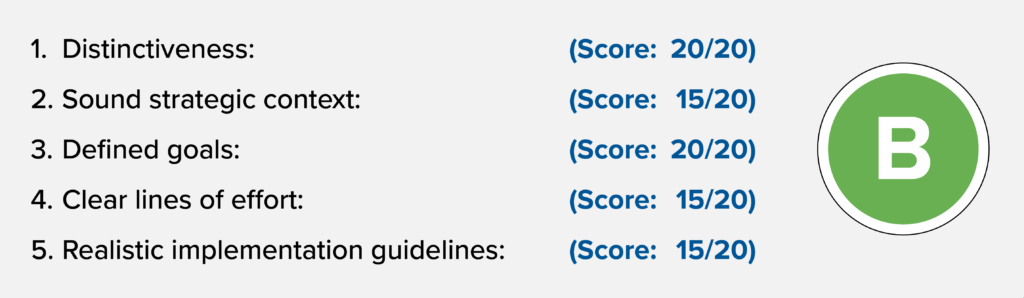
The strategy earns a “B” grade from me. It explains what is new and different, with a new focus on the Western Hemisphere. It reaffirms longstanding principles of US grand strategy, like nuclear deterrence and preventing hostile countries from dominating important regions. It announces new policies for new problems, like how to maintain US technological leadership. On the negative side of the ledger, it dismisses longstanding principles that continue to work, such as promoting democracy and human rights. It also fails to adequately identify the threat posed by revisionist autocracies and a strategy for countering it.
Distinctiveness
Is there a clear theme, concept, or label that distinguishes this strategy from previous strategies?
Yes. The strategy identifies the Western Hemisphere as a priority theater for US national security strategy through the “Trump Corollary” to the Monroe Doctrine. This is a change from past strategy, and the promise of new economic engagement will be welcomed by countries in the region.
Sound strategic context
Does the strategy accurately portray the current strategic context and security environment facing the United States? Is the strategy predicated on any specious assumptions?
The strategy would have benefited from a dedicated strategic context section. The discussion of the national security threats facing the nation—especially from the “Axis of Aggressors” —are only thinly sketched.
Defined goals
Does the strategy define clear goals?
Yes. The strategy is remarkably clear in its articulation of the goals on page five. This includes defined goals to achieve US dominance in emerging technologies, support allies in Europe and the Indo-Pacific, and counter adversaries in the Western Hemisphere.
Clear lines of effort
Does the strategy outline several major lines of effort for achieving its objectives? Will following those lines of effort attain the defined goals? Does the strategy establish a clear set of priorities, or does it present a laundry list of US foreign policy activities?
The strategy lists many principles and activities, but it does not aggregate these up into major lines of effort.
Realistic implementation guidelines
Is it feasible to implement this strategy? Are there resources available to sustain it?
More so than its predecessors, this strategy does specify clear priorities and rules out activities (like intervention and democracy promotion) that had been part of past strategies. One can debate the wisdom of the prioritization, but the hard-nosed prioritization does make the strategy inherently sustainable. As with all strategic documents, resourcing will be a major challenge to enacting the vision laid out within it.
Nate Freier
Nonresident senior fellow, GeoStrategy Initiative, Scowcroft Center for Strategy and Security
The 2025 National Security Strategy (NSS 25) appears to signal that the United States is no longer the broadly collaborative status quo power that the world has come to rely on since World War II. Instead, it suggests that the United States is now increasingly a more transactional revisionist power intent on altering its relationship with the rest of the world, often explicitly to its near-exclusive benefit. Since World War II, US strategy has generally exhibited an enlightened self-interest, recognizing the tangible and intangible benefits of its being a coalition-builder, a first-among-equals leader, and a reliable heavyweight international arbiter. The first has historically generated exploitable power via strength in numbers and the latter two have often preserved for the United States the right to set agendas and tilt outcomes in its favor. NSS 25 appears to mark a sharp departure from this traditional governing philosophy and, in doing so, engenders significant risk.
Distinctiveness
Is there a clear theme, concept, or label that distinguishes this strategy from previous strategies?
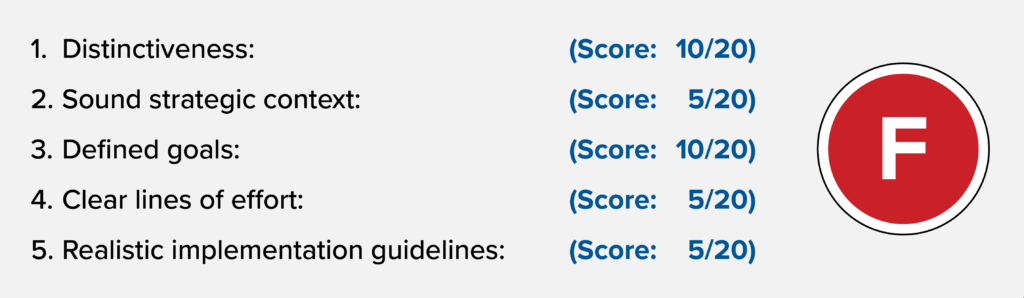
In practical terms, NSS 25 is distinct in that it does articulate a clear, unambiguous, and circumspect set of vital interests and priorities. And specifically, for example in the Indo-Pacific, it does at times deliver clear strategic logic as to why continued US commitment is essential. Further, NSS 25 exhibits a novel predisposition to lead with US economic, commercial, and technological advantage as principal competitive instruments. However, there is real risk in its under-defined approach to the often-malign behavior of “larger, richer, and stronger” rival states (e.g., Russia) and their illegitimate employment of the cover of “sovereignty” to prey on vulnerable neighbors and third parties. The strategy also exhibits an explicit abandonment of some timeless US commitments to political liberalization, human rights, and human security as if these are not—even in the context of “flexible realism”—often prerequisites for the long-term security of US interests.
Sound strategic context
Does the strategy accurately portray the current strategic context and security environment facing the United States? Is the strategy predicated on any specious assumptions?
Strategic context is the environment against which strategy is applied, within which it unfolds and adapts, and because of which it succeeds or fails. NSS 25 is excessively inward-looking and offers little substance on what is a highly contested competitive environment between rival states. The United States faces ongoing resistance from a combination of its purposeful rivals (e.g., the People’s Republic of China and Russia), as well as the environment within which it and they compete for advantage (e.g., physical proximity, structural vulnerability, prolific connectivity, fragile alliances and economies, and domestic and foreign disharmony). US rivals want to weaken the US position, replace the United States as the world’s indispensable great power, and force onerous constraints on US influence where it counts most. NSS 25 harbors real risk in that it focuses on what the United States wants but does not adequately portray the degree to which rivals will exploit strategic conditions, their inherent capabilities, and US action and/or inaction to advance their interests at US expense.
Defined goals
Does the strategy define clear goals?
In combination and from a practical standpoint, an interpretation of NSS 25’s description of what the United States should want for itself and what it also wants “in and from the world” provides an adequate picture of this administration’s direction. However, it is critical that goals match context. Context should, after all, flag the kinds of hazards and opportunities that help define and realistically shape goals. Thus, NSS 25’s limited articulation of context and the lack of substance attending this gap makes it difficult to adequately assign value to the strategy’s goals in isolation. Nonetheless, as a practical matter—save for what might be called the strategy’s rebalance to the Western Hemisphere—NSS 25’s goals at home and abroad are by themselves clear and, for the most part, consistent with traditional US security objectives. But there are risks embedded in the goals. For example, the strategy’s explicit rebalance to the Western Hemisphere and its softer, more conditional commitment to European defense and security have the potential to trigger horizontal rival escalation in perceived vacuums of US interest and commitment, as well as unfavorable ally and third-party bargaining with rivals as US activism is perceived in retreat.
Clear lines of effort
Does the strategy outline several major lines of effort for achieving its objectives? Will following those lines of effort attain the defined goals? Does the strategy establish a clear set of priorities, or does it present a laundry list of US foreign policy activities?
In some combination of NSS 25’s “Priorities,” as well as the “how” embedded in its description of regional approaches, one can discern actionable lines of effort. The “Enlist” and “Expand” elements of Western Hemisphere strategy and the three elements described under Asia (“Leading from a Position of Strength,” “Economics,” and “Deterring Military Threats”) have within them testable hypotheses for success and broad approaches to achieving it. However, NSS 25 would benefit from a more coherent design that is animated by a thorough description of the context within which it is to be implemented. Context, goals, and lines of effort, after all, provide a singular theory of the case. As described earlier, the degree to which economics dominate the amended US approach to Asia is notable and novel. But success here would seem to rely on a distinctively US commercial line of effort lying substantially outside the traditional control of US decisionmakers. Novel can be a strength and weakness. At minimum, novel here suggests an area of risk that merits significant alignment in a coherent strategic design with other complementary lines of effort where the risk associated with underperformance is mitigated by the potential for acceleration in adjacent efforts more under US policymaker control.
Realistic implementation guidelines
Is it feasible to implement this strategy? Are there resources available to sustain it?
Overall, this is a high-risk strategy. At times, it is stripped down and minimalist. And, therefore, the prospects of the United States achieving its limited objectives are better than are the chances for success in pursuit of more expansive and ambiguous strategic ends. However, the real risk here is in the strategy’s broad thrust. As US decision makers implement a strategy that so explicitly rethinks and rescopes the United States’ global role, they should expect that those who have either relied on or resisted US influence will themselves recalculate their strategic choices in ways that ignite a disruptive and unfavorable realignment of actors and forces within the international system. Further still, there are troubling elements of values erosion, ethno-centrism, and cultural shaming throughout the strategy that—when operationalized—have the potential to change how the world sees the United States, as well as the degree to which the actors upon whom the United States relies are willing to cooperate with it.
Alexander B. Gray
Nonresident senior fellow, GeoStrategy Initiative, Scowcroft Center for Strategy and Security
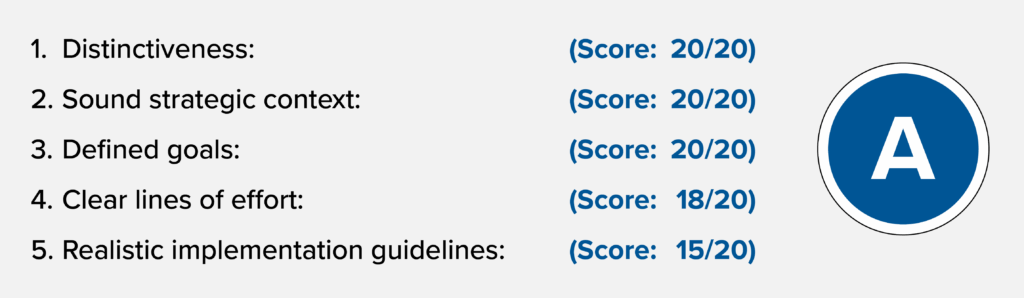
The Trump NSS is a powerful break from thirty-five years of US strategies that promise to prioritize everything and end up prioritizing nothing. With shrinking resources and public aversion to global entanglements, the NSS provides defined, manageable, and clear US national interests and places them in a strategic framework that can serve to advance US strategy.
Distinctiveness
Is there a clear theme, concept, or label that distinguishes this strategy from previous strategies?
The Trump administration’s NSS is a fundamental break with three decades of US strategy. The document is unlike anything put forward by a US administration since the end of the Cold War. Rather than assume that the United States has limitless global interests, the NSS seeks to undertake a difficult and needed referencing of “ways” and “means,” ultimately giving priority to those regions and tasks deemed most essential to core US interests. By seeking prioritization, and making the concomitant difficult choices, the NSS is truly unique and the most definitionally “strategic” document produced by the US government since 1991.
Sound strategic context
Does the strategy accurately portray the current strategic context and security environment facing the United States? Is the strategy predicated on any specious assumptions?
The NSS accurately reflects a more constrained strategic environment, with less material resources and public support for international engagement that is ancillary to core US interests. By focusing on the “basics,” and starting with defense of the homeland and working outward, the NSS refuses to accept that US strategy must ceaselessly expand to meet global challenges rather than picking and choosing which global challenges are most directly tied to US interests. The focus on the Western Hemisphere, and the unique threat posed by extra-hemispheric actors like China, is decades overdue; the NSS makes plain that protection of the homeland and the hemisphere and the pursuit of US interests in the Indo-Pacific are interwoven for the foreseeable future.
Defined goals
Does the strategy define clear goals?
The NSS’s goals are clear: defend the homeland; defend the Western Hemisphere, particularly from extra-hemispheric actors; prevent the rise of a dominant hegemon in Eurasia; and secure a free and open Indo-Pacific. This is a crisp, thoughtful, and calibrated elucidation of the central challenges facing US policymakers, and it forces Washington to ask difficult questions about commitments and obligations outside of these core tasks.
Clear lines of effort
Does the strategy outline several major lines of effort for achieving its objectives? Will following those lines of effort attain the defined goals? Does the strategy establish a clear set of priorities, or does it present a laundry list of US foreign policy activities?
The NSS is the most prioritization-focused strategy produced by the US government since 1991. The challenge facing implementers of the NSS will come down to interpreting and crafting policy responses for the main lines of effort mentioned. For instance, when extra-hemispheric powers meddle in the Western Hemisphere, what should be the US response? What level of Chinese influence is acceptable, and how should it be addressed? These are the types of questions, below the level of grand strategy, that force policymakers to make difficult decisions in real time.
Realistic implementation guidelines
Is it feasible to implement this strategy? Are there resources available to sustain it?
The most difficult part of any strategy, and particularly one as different from the recent past as this NSS, is implementation. Not only will there be extraordinary institutional resistance in Washington, and in allied and partner capitals, to this dramatic reorientation of US policy; there will also be the pressure of world events that frequently pull policymakers, even those dedicated to changing course, into unwanted entanglements. To execute this strategy, the Trump administration will require discipline to resist the “noise” of day-to-day news and focus with determination on prioritizing the core US interests named in the NSS.
Related content



Explore the program

The Scowcroft Center for Strategy and Security works to develop sustainable, nonpartisan strategies to address the most important security challenges facing the United States and the world.