

It’s May 2026 in the Kharkiv sector of Ukraine. A Ukrainian commander launches eight hundred autonomous drones—a coordinated swarm of air and ground systems programmed to suppress enemy air defenses, identify and strike artillery positions, and exploit gaps in Russian lines. The operation depends on real-time coordination: sensors feeding targeting data to strike platforms, movement algorithms synchronizing advance rates, and machine learning systems adapting to Russian countermeasures.
Eighteen minutes into the mission, Russian electronic warfare assets sever the swarm’s tactical ground uplinks to Western cloud infrastructure.1Jack Watling and Nick Reynolds, “Meatgrinder: Russian Tactics in the Second Year of Its Invasion of Ukraine,” Royal United Services Institute, May 2023. The swarm doesn’t abort—it continues operating on preprogrammed instructions. But it can’t adapt. Russian forces rapidly move their artillery and air defense systems. Ukrainian sensors detect the movement but can’t retask strike drones without cloud connectivity. The algorithms that would normally coordinate sensors with shooters can’t execute. What should have been a precisely synchronized operation devolves into hundreds of individual platforms executing obsolete instructions against targets that have already moved.
This scenario hasn’t transpired yet. But the conditions that could make it inevitable are already in place.
The war in Ukraine is often described in the language of weapons: air defense systems, artillery pieces, drones, and munitions. Yet a less visible element will shape the next phase of the conflict just as decisively as any piece of military hardware: the infrastructure to create and harness computational power, or compute.
From state preservation to warfighting speed
For four years, Ukraine has executed a strategically sophisticated digital strategy: protecting state continuity by migrating critical data and services from vulnerable domestic servers to Western cloud infrastructure.2Emma Schroeder and Sean Dack, “A Parallel Terrain: Public-Private Defense of the Ukrainian Information Environment,” Atlantic Council, February 2023. By mid-2022, just months into the invasion, more than ten petabytes of data—from ministries, universities, private firms, and individuals—had shifted to the cloud.3Amazon Web Services (AWS), “Safeguarding Ukraine’s Data,” AWS Public Sector Blog, June 2022. This ensured continuity of government operations, supported remote learning, and reduced the risk that a missile strike could erase essential records.
That migration was brilliant crisis management. It preserved the Ukrainian state under fire. But state continuity is not warfighting. As combat evolves toward mass deployment of unmanned systems, algorithmic control of targeting processes, and increasingly autonomous operations, Ukraine’s computational requirements are changing fundamentally. The challenge is shifting from keeping systems online to enabling decisions at machine speed—despite Russian efforts to sever access to the infrastructure that makes machine-speed decisions possible.
The question is no longer whether Western cloud providers have sufficient storage and compute capacity. They do. The question is whether Ukraine can reliably access that capacity fast enough to sustain operations when Russia is actively denying the connection.
What is emerging is a war over compute capability itself: a contest over which side can sustain the fastest operational cycles—sensing, deciding, striking, adapting—while spectrum and infrastructure come under both kinetic and electronic attack.
The bandwidth wall
In peacetime, cloud computing feels abstract, almost invisible. In war, it becomes concrete and existential. Remote data centers accessed via networks become critical infrastructure. Designating cloud systems as critical infrastructure in the Ukrainian context unlocks vital resources, ensuring these facilities receive prioritized air and cyber defenses, guaranteed energy provisioning, and international reconstruction funding.4Tianjiu Zuo et al., “Critical Infrastructure and the Cloud: Policy for Emerging Risk,” Atlantic Council, July 2023. When those links degrade, the cloud doesn’t just slow down—it vanishes.
Ukraine’s 2022 migration solved one vulnerability (domestic servers vulnerable to Russian missile attacks) while creating another: total dependence on contested network pathways now central to warfighting capability.
In peacetime, cloud computing feels abstract, almost invisible. In war, it becomes concrete and existential.
Drone swarms are often discussed as an artificial intelligence (AI) challenge—computer vision for target identification, autonomy for independent navigation, and coordination algorithms for multiplatform synchronization. In practice, the first constraint is bandwidth. A Carnegie Mellon University study found that a single high-definition (HD) drone video feed at twenty-five frames per second consumes approximately ten megabits per second (Mbps).5Carnegie Mellon University School of Computer Science, “Bandwidth-efficient Live Video Analytics for Drones via Edge Computing,” IEEE/ACM Symposium on Edge Computing, 2018. While a commander wouldn’t stream video from every platform in a massive swarm, even pulling just a handful of feeds for operator control and target designation—combined with the constant telemetry data, encryption overhead, and packet retransmission required to coordinate the remaining hundreds of drones—creates an operational bottleneck.6Carnegie Mellon, “Bandwidth-efficient Live Video Analytics.”
Because continuous human-in-the-loop control doesn’t scale gracefully in Ukraine’s contested electromagnetic environment, the operational logic is unforgiving: Forces must either process data locally at the edge—transmitting only highly compressed targeting summaries upstream—or accept that cloud-dependent systems will fail when links are degraded.
Satellite connectivity via Starlink has significantly strengthened Ukraine’s communications resilience. As a proliferated low earth orbit (pLEO) constellation, Starlink is inherently difficult to jam at the orbital level, making it an assured command and control (C2) backup to terrestrial fiber. However, even advanced pLEO architectures introduce constraints at the tactical edge. Uplink bandwidth (10 to 30 Mbps per terminal) and latency (25 to 60 milliseconds) create bottlenecks for high-volume operations. A single HD video feed can consume most of a terminal’s uplink budget, and the ground terminals themselves remain highly vulnerable to localized Russian electronic warfare.7Ookla Speedtest Intelligence, “Starlink Performance in Europe,” Q3 2024.
More dangerously, Starlink has become a single point of failure. If these tactical uplinks were effectively denied—whether by Russian terminal jamming, cyberattacks aimed at user networks, or corporate policy shifts—Ukraine would possess no terrestrial or satellite alternative capable of sustaining its current command tempo. If the link goes down, the current architecture of warfighting would collapse within days.8“Ukraine Says Starlink’s Global Outage Hit Its Military Communications,” Reuters, July 25, 2025; and “Starlink Crackdown Cripples Russians—but American Engineer Warns Ukraine Is Just as Vulnerable,” Euromaidan Press, February 6, 2026.
When Russia induces intermittent denial through jamming or cyberattack, cloud-centric architectures don’t just degrade—they fail.
The arithmetic is merciless. Ukraine is producing drones at industrial scale—well over three million annually across aerial, ground, and maritime categories toward a projected seven million in 2026.9“Ukraine on Track to Produce 3 Million Drones in 2025,” Kyiv Independent, December 2024. As autonomy spreads throughout this ecosystem, bandwidth requirements will outstrip available connectivity by orders of magnitude unless Ukraine fundamentally restructures how and where computation occurs.10See “Data Centers in Ukraine” and “Data Centers in Russia,” Cloudscene Market Directory, Cloudscene, 2024.
The infrastructure asymmetry
Ukraine operates approximately fifty-eight data centers compared with Russia’s 251.11International Energy Agency, “Ukraine’s Energy Security and the Coming Winter,” 2024; and Financial Times, “Russia Has Taken Out Half of Ukraine’s Power Generation,” June 2024. This disparity matters profoundly. More facilities mean greater resilience against kinetic strikes, sovereign control over critical workloads, and capacity to convert domestic energy into computational advantage. Ukraine has compensated through Western cloud access—a genuine strategic asset that Russia cannot easily match. But external dependence creates a ceiling that becomes visible as autonomy scales and adversaries systematically target the links.
The energy dimension compounds this vulnerability. Compute infrastructure requires massive electrical power. Data centers are power-conversion facilities as much as they are computing facilities. Ukraine’s electrical grid has been under sustained Russian attack since October 2022. Strikes have destroyed approximately nine gigawatts of generating capacity—roughly half of prewar levels.12Energoatom Official Statement; and Al Jazeera Staff, “Mapping Ukraine’s Zaporizhzhia Nuclear Power Plant,” Al Jazeera, September 2022. Millions of Ukrainians face rolling blackouts lasting up to four days.
This energy crisis has exposed critical fragility. Attacks have decimated thermal power plants, which provide critical load-balancing, while the largest nuclear facility, Zaporizhzhia, remains under occupation and offline. This places extreme strain on the remaining active plants, like the South Ukraine Nuclear Power Plant, to sustain baseload power.13“Ukraine’s DefTech at the End of 2025: From Drone Mass to Systems Warfare,” New Geopolitics Research Network, December 2025; and “Ukrainian Company Reveals Its New Drone Interception Control Technology,” Pravda, January 2026.
This strain creates a strategic trap: Russian attacks degrade Ukraine’s domestic power generation, which reduces capacity for domestic compute infrastructure, which in turn increases dependence on external cloud services accessed via networks that Russia can interdict. Ukraine needs compute infrastructure to fight effectively, but the same threats that create that need also are destroying the energy systems required to sustain domestic computing capability. This forces a difficult data localization trade-off: Keeping data within national borders ensures sovereign control and reduces latency, but relying on infrastructure outside of Ukraine’s borders trades that sovereignty for unparalleled physical security against kinetic attacks.
Russia, meanwhile, is pursuing computational sovereignty. Moscow is deepening AI cooperation with China, investing in domestic data-center capacity, and expanding energy infrastructure specifically to support compute-intensive operations. Russia announced a 200 percent increase in military spending for 2025-2026, with significant portions allocated to domestic technology development and infrastructure hardening.14Michael Newton, “How are Drones Changing War? The Future of the Battlefield,” Center for European Policy Analysis(CEPA), November 3, 2025.
This strategy doesn’t mean Russian capabilities are superior; to the contrary, Western cloud infrastructure remains far more advanced, boasting superior hyperscale efficiency, next-generation AI accelerators, and deeper integration of cutting-edge foundational models. But Russia is building resilience through sovereign control and redundancy, accepting lower performance in exchange for systems that can’t be easily severed by adversary action. Ukraine cannot fully mirror this approach given resource constraints and the ongoing attacks on its energy grid. But it must complement cloud reliance with domestic and forward-deployed compute nodes to sustain rapid decision cycles when connectivity degrades or fails.

The architecture of warfighting compute
What Ukraine needs—and what any military force will need for autonomous operations at scale in the future—is a layered computational architecture.
The first layer is cloud-scale compute for strategic functions, hosted primarily in allied nations outside of Ukraine. This handles large-scale data aggregation, AI model training, pattern analysis across theater-wide sensor networks, and long-term intelligence processing. This will remain vital and leverage Western technological advantages that Russia cannot match.
The second layer consists of domestic data centers for operational workloads that cannot tolerate cloud latency or link vulnerability. These support theater-level coordination, regional sensor fusion, command and control systems, and logistics planning. These facilities need hardening against kinetic strikes and cyberattacks—such as zero-day exploits or data-wiping malware designed to paralyze command and control. They also require redundant power supplies and geographic distribution to prevent single points of failure.
The third layer involves forward-deployed compute nodes at brigade and battalion levels. These are rugged servers in mobile containers or hardened facilities that can execute tactical coordination, sensor-to-shooter integration, and autonomous system management even when higher-echelon networks are degraded or severed. These nodes need enough processing power to manage hundreds of autonomous platforms simultaneously, updating targeting data, coordinating maneuver, and adapting to enemy actions—all without requiring constant capacity to access and employ cloud infrastructure.
Finally, edge compute on platforms themselves provides the last line of resilience. These are processing capabilities embedded in drones, ground vehicles, and sensor systems that enable basic autonomous functions—obstacle avoidance, target recognition, and formation keeping—without any external connectivity.
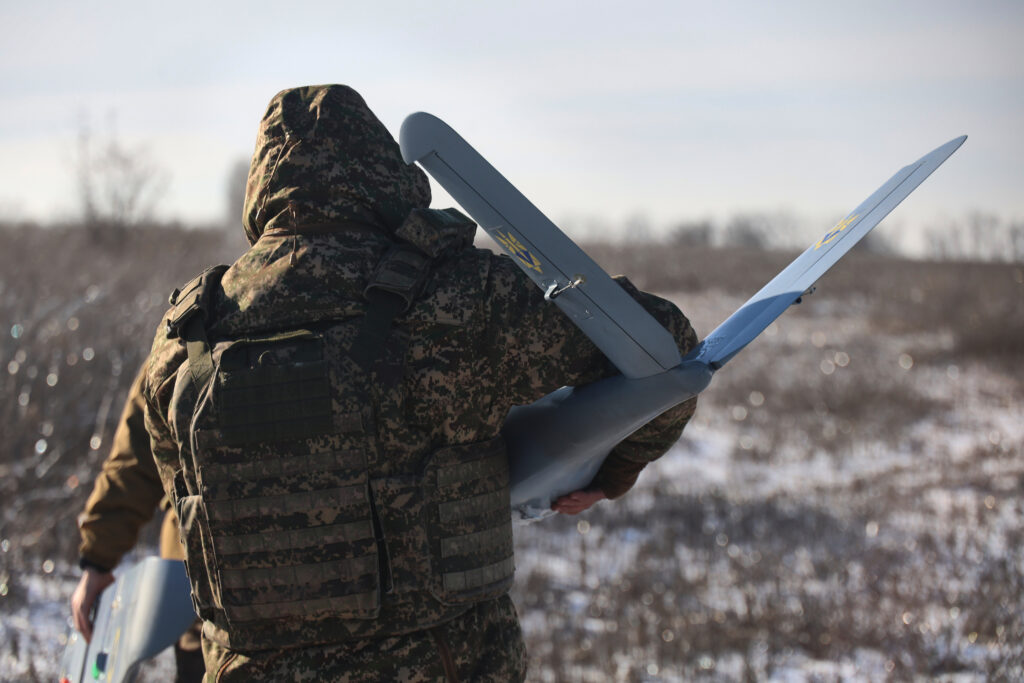
This is not hypothetical. New interceptor programs scaling in Ukraine in late 2025 operate on exactly this principle.15David Kirichenko, “Ukraine’s AI Drones Are Reshaping Modern Warfare as Precision Strikes Outpace Traditional Artillery,” Milwaukee Independent, October 24, 2025. These systems utilize optical navigation modules that cost less than a smartphone but possess sufficient edge processing to visually lock onto Russian drones. Once locked, they cut their radio link entirely, rendering Russian electronic warfare useless because there is no signal to jam. The drone effectively becomes a flying, disconnected server that solves a single terminal problem: collision.
Each layer serves a different function and operates under different connectivity assumptions. Cloud computing assumes reliable high-bandwidth links and optimizes for processing power and data scale. Edge computing assumes zero connectivity and optimizes for survival of individual platforms. The layers in between—domestic and forward-deployed nodes—are what enable operational effectiveness when conditions fall between those extremes, which in modern combat will be most of the time.
The cost implications are significant but manageable. A forward-deployed compute node with sufficient capacity to manage battalion-level autonomous operations might cost two million dollars, with a total cost of five million dollars when you include hardening, redundant power, and cooling systems. This is expensive relative to individual drones, but modest compared to traditional armored vehicles or artillery systems. More importantly, these nodes are force multipliers: A three-million-dollar compute node that enables effective coordination of five hundred autonomous platforms represents a far better return on investment than three million dollars spent on additional uncoordinated platforms.16General James E. Cartwright and Jags Kandasamy, “Operationalizing Artificial Intelligence and the Edge Continuum for Joint All-Domain Dominance,” Atlantic Council, August 2023.
Current Western aid to Ukraine has focused overwhelmingly on kinetic systems: artillery, air defense, and armored vehicles. Very little has gone toward computational infrastructure. This made sense when the primary challenge was state survival and maintaining basic military capability. As the war evolves toward autonomous operations, however, aid priorities need to evolve accordingly.
What Russia is learning
Russia’s approach to the compute challenge differs fundamentally from Ukraine’s. While Ukraine has leveraged Western cloud superiority, Russia has pursued what might be called “computational autarky”—accepting lower performance in exchange for independence and resilience.
Russian domestic data-center capacity, while less sophisticated than Western equivalents, provides sovereign control over critical military workloads. While Russian military planners face less risk from radio-frequency jamming of satellite uplinks due to their reliance on hardwired domestic fiber-optic lines, they trade one vulnerability for another. To sustain their operations, they must aggressively defend these physical nodes against kinetic strikes—as proven by air domain attacks like Operation Spiderweb—and targeted cyber operations aimed at paralyzing specific computing centers. While completely severing Russia from its compute power is exceedingly difficult, degrading its critical operational nodes is a highly viable threat.17“How Fiber Optic Networks Resist Signal Interference,” Fiber Optics Explained, May 2, 2025.
More concerning is Russia’s deepening cooperation with China on AI and computing. This isn’t just about purchasing Chinese technology—though that matters. It’s about access to Chinese expertise in autonomous systems, sensor processing, and algorithmic targeting. China already supplies roughly 80 percent of the critical technologies used in Russian drones, and engineers from both nations are collaborating closely on technology development and battlefield adaptation.18David Kirichenko, “The Booming China-Russia Drone Alliance,” CEPA, June 4, 2025. China leads the world in certain AI applications, particularly computer vision and pattern recognition. Russian access to Chinese AI capabilities could narrow the technological gap with Western systems faster than most Western analysts currently anticipate.
Russia is also learning operationally. Ukrainian drone strikes on targets inside Russia—reported almost daily throughout early 2026—force Russian air defenses to process massive volumes of sensor data, coordinate response across multiple systems, and adapt to Ukrainian tactics in near-real time. These aren’t just kinetic exchanges; they’re competitions in computational speed and algorithmic effectiveness. Russia is building institutional knowledge about autonomous operations under fire at operational tempo, not in peacetime exercises.
The Russian approach has significant weaknesses: lower-quality infrastructure, dependence on Chinese cooperation that may not survive geopolitical shifts, and vulnerability of domestic data centers to long-range Ukrainian strikes. But Russia has thought systematically about computational resilience in ways that Ukraine, focused on survival and leveraging Western support, has not yet fully addressed.
The compute war: Speed vs. resilience
The coming compute war will test whether Ukraine can preserve something that may be even more critical than state continuity: the speed of its learning and decision cycles.
Modern warfare increasingly resembles software development more than industrial production.
Modern warfare increasingly resembles software development more than industrial production. Ukrainian drone units update software and tactics continuously—a technique that works on Monday may be countered by Russian forces by Friday and adapted again by the following Monday. This operational tempo demands computational infrastructure that can support experimentation, rapid prototyping, large-scale testing, and instantaneous deployment across thousands of platforms simultaneously.
Victory will not hinge on who possesses the most servers in aggregate. It will hinge on who can keep computation, coordination, and adaptation functioning under active denial—when spectrum is contested, networks are degraded, and time itself becomes a weapon.
The paradox is that speed and resilience often conflict. Cloud computing optimizes for speed: massive processing power, global data access, and rapid scaling. But it assumes reliable connectivity. Autonomous edge computing optimizes for resilience: operation under denial, degraded communications, and individual platform survival. But it sacrifices coordination, learning, and adaptation that require centralized processing.
The side that solves this paradox—building systems that maintain speed while surviving denial—will have a decisive advantage. And all of this requires not just technology but operational art: understanding what computation must happen when and where, what can be prepositioned before links fail, what decisions can be delegated to autonomous systems, and what must remain under human control even when that means accepting slower execution.
The implications for the United States
There is a second lesson here that extends far beyond Ukraine. For the United States, this conflict is a preview of a fundamental shift in what constitutes strategic infrastructure.
Federal, state, and local governments in the United States still regard data centers primarily as commercial real estate—involving zoning questions, permitting challenges, and local economic development. The Ukraine war suggests a radically different framework: Sustaining compute under attack is a national security imperative, as critical as shipbuilding capacity or semiconductor production.
If the next phase of warfare is shaped by learning cycles and distributed autonomy, then the defense industrial base is no longer only steel and shells. It includes electrical grid capacity, cooling infrastructure, secure facilities, and resilient compute systems that can convert data into operational advantage faster than adversaries can disrupt the process.
Furthermore, because the United States projects power globally, it will face severe distance and latency challenges in any future conflict. A secure data center in Virginia cannot command a drone swarm in the Indo-Pacific at machine speed. This geographic reality dictates that the United States must possess forward-deployed, allied-hosted compute architectures to mitigate the immense latency constraints of expeditionary warfare.
This shift has immediate policy implications. First, grid resilience for computing infrastructure is paramount. Data centers require enormous electrical power: A large facility can consume as much electricity as a small city. In the continental United States, these facilities depend on a grid that was designed for efficiency, not resilience against military attack. Strategic data-center locations need hardened power supplies, backup generation capacity, and rapid restoration capabilities that current commercial facilities lack.
Second, the United States needs mandated geographic distribution of computing capacity. Commercial cloud providers optimize for efficiency, often concentrating computing capacity in specific regions with favorable power costs and network connectivity. From a national security perspective, this approach creates vulnerabilities. Geographic distribution ensures no single region or facility becomes a strategic single point of failure.
Third, the nation should consider a strategic compute reserve. The United States maintains strategic reserves of petroleum, grain, and medical supplies. A similar approach to dormant but maintained data-center capacity would allow activation during crisis, providing surge computing capability when commercial systems are disrupted or need to prioritize military workloads.
Fourth, technology export controls must expand. The United States restricts the export of advanced semiconductor manufacturing equipment to adversaries. It should consider similar controls on data-center technology, cooling systems, and high-performance computing architecture that could help adversaries build resilient computational infrastructure.
Finally, NATO computational resilience must be addressed. While NATO has already acknowledged that severe cyberattacks can trigger the Article 5 collective-defense pledge, the Alliance must go further to explicitly include computational infrastructure in its joint defense planning. Allied nations need assured access to computing capacity during crises even when their domestic infrastructure is under attack. This might require treaty-level agreements on computing resource sharing, protection of undersea cables connecting allied data centers, and prepositioned computational capability in forward-deployed locations.
These aren’t theoretical concerns. Ukraine is living this reality now. Ukrainian commanders are making life-and-death operational decisions based on whether they can access computational resources through contested networks. The United States and its allies would face these same challenges in any high-intensity conflict with a peer adversary capable of targeting networks and infrastructure.
The advantage the United States currently enjoys is time to prepare, though that may be running out. Ukraine is solving these problems under fire, improvising solutions while fighting for its very survival. The United States can—and must—solve them expeditiously, investing in resilience before conflict makes that investment impossible and focusing on enhanced deterrence to make such conflict unlikely.
What must happen now
For Ukraine, the immediate requirement is diversification of computational architecture. This doesn’t mean abandoning Western cloud access, which remains a critical advantage and asset. It means complementing that access with:
- Hardened, bunker-grade domestic data centers in western Ukraine, away from front lines but close enough to support operational tempo. These facilities need redundant power from multiple sources, physical hardening against missile strikes, and cyber defenses against Russian intrusion. International assistance should include funding for this infrastructure, which will likely need to be established through robust public-private partnerships.
- Forward-deployed compute nodes at the operational and tactical levels. These don’t need to match cloud-scale processing power, but they do need sufficient capacity to manage autonomous operations when higher-echelon networks degrade, with enough redundancy that destruction of individual nodes doesn’t collapse the entire system.
- Redundant nonradio communications to ensure reliable connectivity to drones, a core issue. Therefore, investment in redundant physical links is as vital as the computing layers. This capacity includes fiber-optic tethered drones that are physically immune to jamming and free-space optical (laser) links that can transmit high-bandwidth data between “mother” drones and forward nodes without creating a radio signature.
- Bandwidth prioritization and compression algorithms that reduce data transmission requirements. If raw video from one thousand drones requires ten Gbps but processed targeting data requires only one hundred Mbps, the system becomes sustainable on available networks.
- Energy infrastructure specifically designated for computing, including small modular reactors, solar arrays with battery storage, and protected generator facilities—power sources that can sustain computational infrastructure even when the broader grid is under attack.
For the United States, the requirement is recognition that this isn’t just a Ukrainian problem—it’s a preview of US challenges in future conflict. That recognition should drive Department of Defense investment in distributed computing architecture designed for operation under denial, not just peacetime efficiency.
It also should include mandating “endpoint autonomy” in acquisition. The Department of Defense must shift acquisition requirements to favor systems capable of fully disconnected execution. Rather than treating weapons solely as kinetic effectors dependent on off-board data, future programs must define them as self-contained edge compute nodes. Critical kill chain functions—target identification, discrimination, and terminal guidance—must reside on the platform’s own hardware. This ensures that a loss of a link during the terminal phase does not result in mission failure, treating connectivity as an enhancement for coordination rather than a prerequisite for operation.
A whole-of-government strategy for computational resilience is required, including the Department of Homeland Security for grid protection, the Department of Energy for energy infrastructure, the State Department for international agreements on undersea cables, and the Department of Commerce for export controls. Simultaneously, professional military education must treat computational infrastructure as seriously as logistics, fires, or maneuver. Commanders need to understand bandwidth constraints, latency implications, and trade-offs between centralized and distributed processing, just as they currently understand fuel consumption or ammunition expenditure rates.
Finally, experimentation and exercises must specifically test performance under degraded connectivity. While the US military has increasingly integrated assured C2 into its operational exercises, the depth and scale of these denied-environment simulations must rapidly expand. Exercises need to consistently simulate complete network denial, test autonomous operations under severe communications loss, and identify failure modes before those failures occur in combat.
For NATO and allied nations, the requirement is collective computational resilience as part of collective defense. This includes protected undersea cables connecting allied data centers with the same defensive priority currently given to sea lines of communication. It requires prepositioned computational infrastructure in forward locations, similar to prepositioned stocks of equipment but focused on enabling command, control, and autonomous operations. Information-sharing agreements must specifically address access to computational resources during crisis to ensure smaller allied nations aren’t disadvantaged by lack of domestic infrastructure. Joint investment in energy infrastructure is also critical to sustain allied computing requirements, recognizing that electrical power for computation is as strategically important as fuel for vehicles.
What’s at stake
The technology is already here. Ukraine is producing autonomous drones at industrial scale. Algorithmic targeting is becoming increasingly operational. Machine-learning systems are adapting to Russian countermeasures in real time. What’s missing isn’t technology—it’s the infrastructure to sustain use of that technology under deliberate adversary denial.
If this problem is solved correctly, autonomous tactical units will collapse the coordination overhead that currently limits military effectiveness. New algorithmically piloted systems will enable operational realities built on machine-tempo, combined-arms synchronization. Commanders will delegate bounded execution to formations that self-synchronize sensors, fires, and maneuver, exploiting fleeting windows faster than adversaries can respond, while retaining ultimate responsibility for intent, constraints, and actions taken.
If this problem is solved incorrectly—or not solved at all—autonomous systems will become liabilities rather than assets. Platforms that depend on cloud connectivity will fail when an adversary severs that connectivity. Operations that assume reliable networks will collapse when those networks degrade. The side that builds autonomous capability without building resilience will discover that sophisticated technology without infrastructure becomes inert hardware.
Ukraine’s cloud migration preserved the state under fire. The coming compute war will test whether Ukraine can preserve the speed of its decision cycles—and whether the West understands that speed without resilience is fragility waiting to be exploited.
The United States and its allies have been given an extraordinary gift: the opportunity to learn these lessons while someone else is paying the cost in blood and treasure. Ukraine is the laboratory. The experiments are ongoing. The data is available. The question is whether Western militaries and policymakers will learn quickly enough, and whether they will invest in computational resilience before the next conflict removes that option.
It is imperative to get this right—and get it right first. The autonomous transition will not wait. Neither will the United States’ adversaries.
about the author
Clara Kaluderovic is a nonresident fellow at the Atlantic Council’s Eurasia Center, a former Schmidt Fellow at the Special Competitive Studies Project, and a member of the Aspen Strategy Group’s Rising Leaders Class of 2026. Kaluderovic is co-founder and CEO of Mental Health Global, a nonprofit partnered with the Ukrainian Armed Forces to deliver AI-enabled mental health support in conflict zones, and co-founder of ex2, an AI nonprofit developing large language models for underrepresented languages including Kurdish.
Related reading


Explore the program

The Eurasia Center’s mission is to enhance transatlantic cooperation in promoting stability, democratic values, and prosperity in Eurasia, from Eastern Europe and Turkey in the West to the Caucasus, Russia, and Central Asia in the East.