By Mary Kate Aylward, Peter Engelke, Uri Friedman, and Paul Kielstra
China eclipses the United States economically. A diminished Russia’s war in Ukraine becomes a frozen one, while conflict over Taiwan turns hot and threatens world war. More countries acquire nuclear weapons. A democratic depression coincides with the decline of today’s multilateral system. Cryptocurrencies challenge the dollar. Artificial intelligence matches or even surpasses human capabilities. NATO endures, but fundamentally changes.
These are just some of the future scenarios that geostrategists and foresight practitioners pointed to when the Atlantic Council’s Scowcroft Center for Strategy and Security surveyed them in November and December 2025 on how they expect the world to change over the next ten years.
We found respondents generally in a dark mood, with 63 percent expecting the world in 2036 to be worse off than it is now. Just 37 percent think that it will be better off ten years hence—roughly on par with the results of this temperature-check question in the previous year’s survey.
The 447 survey respondents were citizens of 72 countries—the highest number of countries represented in the four years we’ve been conducting our annual Global Foresight survey. Roughly half were citizens of the United States, more than one-fifth were from Europe, and just under a fifth were from countries in the so-called Global South. Respondents skewed male and older (roughly three-quarters were male and a similar proportion were over 50 years of age) and were dispersed across the private sector, nonprofits (think tanks, advocacy groups, non-governmental organizations), government, academic or educational institutions, independent consultancies, and multilateral institutions.
So what kind of world do these forecasters envision in 2036? Below are the survey’s ten biggest findings.

1. Most respondents think China will surpass the US economically, as concern about a Taiwan conflict rises and 40 percent foresee another world war
Most survey respondents do not believe that the United States will be the world’s dominant power in 2036, with only seven percent saying that it will be. And while an even smaller percentage (four percent) believe that China will be the dominant global power, the great majority of polled experts (around nine in ten) believe that these powers will compete for supremacy either in a bipolar world largely divided into China-aligned and US-aligned blocs or in a multipolar one with multiple centers of power.
The survey results indicate widespread perceptions that China will wield considerable power over the coming decade. While nearly three-quarters of respondents predict that the United States will be the world’s leading military power in 2036, most respondents (58 percent) expect China to be the world’s top economic power within the next decade—with only 33 percent saying the same about the United States. Similarly sized minorities expect either China or the United States to be the leading power in technological innovation (47 percent for the United States, 44 percent for China) and diplomatic influence (38 percent for the United States, 33 percent for China), suggesting they could be peer competitors in these domains. The message respondents appear to be sending is that, by 2036, the “China rising” era will have given way to a “China risen” one, characterized by a significant erosion in relative US power in certain respects and an end to the US-dominated world order. (A deeper dive into the data reveals that Global South respondents rate China’s future power higher than respondents from other regions do; see finding 10 below.)
More than two-thirds of respondents (70 percent) believe that China will try to forcibly take Taiwan in the next decade—up from 65 percent in our previous year’s survey and 50 percent two years ago, signaling an increasing likelihood of this scenario materializing. The intensity of this concern seems to be growing as well: Twenty-one percent of respondents “strongly agree” that China will attempt to forcibly retake Taiwan over the next decade, up from 15 percent who felt this way in our previous two surveys.
And what starts in Taiwan wouldn’t necessarily end in Taiwan. In keeping with the top finding from our previous year’s survey, more than 40 percent of respondents envision another world war, involving a multifront conflict among great powers, erupting over the next decade. And within that group, 43 percent think the likely trigger will be in Taiwan or the East/South China Seas—the most-cited origin point for such a conflict, with Eastern Europe (25 percent) and the Middle East (13 percent) in second and third place. This result suggests that growing competition between China and the United States, if improperly managed, will become a global powder keg.

It’s clear that most respondents believe that China is poised to unseat the United States as the global economic superpower over the next ten years, challenging the United States on multiple fronts from currency to international institutions to political stability.
It’s also obvious that Beijing is feeling a newfound confidence as it leverages the international trade chaos wrought by President Donald Trump’s tariffs to position itself as a global leader advocating for a more open international trading system. Of course, Beijing continues to use a host of protectionist measures—from industrial subsidies to non-tariff barriers favoring domestic companies—to tilt the field in its favor.
But China’s ascent to economic supremacy could easily be derailed by its limited progress in shifting from export-driven growth to a more sustainable, consumption-driven economy. China’s present model is facing ever larger challenges as countries push back against a flood of Chinese electric vehicles, solar panels, and electronics.
— Dexter Tiff Roberts, founder and publisher of the newsletter Trade War on Chinese economics and politics, former China bureau chief and Asia News Editor at Bloomberg Businessweek, and nonresident senior fellow at the Atlantic Council’s Global China Hub

The clear majority of respondents who assessed that China will attempt to take Taiwan by force in the next decade included those respondents who also assessed that the United States would be the strongest military power at the time—suggesting many respondents believe overall military power alone is insufficient to deter Beijing.
Given that Beijing has ramped up its aggressive rhetoric and military exercises against Taiwan, which are starting to look like dress rehearsals for an attack, now is the time for action. To strengthen deterrence, the United States and its allies should improve intelligence to provide timely attack warning, posture forces to decisively win a first battle against China, and establish a victory plan to prepare for a long war. Meanwhile, the United States should encourage Taiwan to further strengthen its defenses and mobilize the whole of its society to deter China.
While Taiwan was most commonly cited as the flashpoint for a potential global multifront war in the coming decade, only one respondent cited the Korean peninsula, which suggests respondents are underestimating the potential for a larger war to start with North Korean aggression there. As we explored in a report based on a tabletop exercise, either a conflict in the Taiwan Strait or on the Korean Peninsula could escalate into a broader war, including nuclear escalation.
— Markus Garlauskas, former National Intelligence Officer for North Korea on the US National Intelligence Council and director of the Indo-Pacific Security Initiative of the Atlantic Council’s Scowcroft Center for Strategy and Security


The experts are very likely wrong on this one—or at least, they’re missing crucial context.
This idea that China was on track to take over the United States as the world’s largest economy was conventional wisdom in Washington (and New York) before the COVID-19 pandemic. Before 2020, Bloomberg Economics expected China to surpass US nominal GDP by the early 2030s. Even during the pandemic, many were impressed by the resilience of China’s economic growth when other major economies faltered. As late as 2022, Goldman Sachs predicted that China would overtake the US economy around 2035. But economists have been re-adjusting their predictions across the board. In 2023, Bloomberg Economics changed its forecast and projected that it would take until the mid-2040s for China’s economy to catch up to that of the United States. Simply put, Beijing’s economy in 2026 isn’t what it was in 2020.
While China’s growth has slowed down from pre-pandemic expectations, the United States has actually outperformed previous growth projections. In 2019, the International Monetary Fund projected that China’s GDP growth would hit 5.5 percent in 2024, while the United States would only grow by 1.6 percent. In 2024, however, the United States grew by 2.8 percent, while China grew by 5 percent. It’s definitely strong growth coming out of Beijing, but the United States’ nominal GDP was $10 trillion more than China’s in 2024. This makes it less likely, as China’s growth slows, that it will surpass the United States in 10 years. Assuming that 2025 growth rates continue, China would surpass the United States in nominal GDP in 2041. And some experts question the veracity of the growth numbers China releases, with some suggesting a 2025 growth rate as low as 2.5 percent.
Economic forecasting is not a precise science, but there are a few factors to look at when it comes to forecasting China’s economic growth vis-a-vis the United States. Let’s break down some of these factors behind China’s economic slowdown. Beijing is dealing with the sticky negative effects of its prolonged real estate slump—a sector which used to be a major driver of economic growth and investment. As the housing market struggles, consumer confidence remains low, and local governments are bogged down by debt. The country also has a population crisis on the horizon. By 2060, it’s projected that there will be around 70 elderly dependents for every 100 working-age people. China remains a strong export-driven economy with a high-tech sector that is continuing to innovate, but Chinese high-tech firms are only one sliver of its overall economy, and we’re still seeing the vast majority of AI investments worldwide being directed towards the United States. Indeed, it’s the United States that is leading the development of the most important technology of the twenty-first century.
None of this is to downplay the strengths of China’s economy or to neglect the headwinds that are facing the United States, but so far, the data doesn’t suggest that China will overtake the United States as the world’s largest economy by 2036.
— Josh Lipsky is chair, international economics at the Atlantic Council and the senior director of the Atlantic Council’s GeoEconomics Center.
— Jessie Yin is an assistant director with the Atlantic Council’s GeoEconomics Center.
2. Expect NATO to endure but undergo fundamental changes
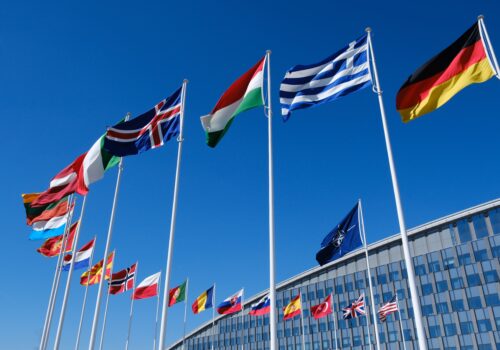
Amid major ups and downs for NATO in the first year of the second Trump administration—from commitments to ramp up defense spending at The Hague summit in 2025 to the standoff between Denmark and the United States over the status of Greenland—survey respondents are split evenly on whether the Alliance will grow more influential (35 percent) or less (35 percent) in ten years’ time. Behind these equivocal answers about NATO’s future power, however, is a clear and substantial measure of doubt regarding the future of the Alliance itself: Nearly half of respondents (44 percent) believe that NATO will no longer exist in its current form in 2036. Among this group expecting fundamental change, half (51 percent) anticipate that a reconfigured NATO will be less influential than the current alliance.
This finding likely relates to the part that the United States is expected to play in the Alliance going forward. A significant minority of respondents—39 percent—don’t envision the United States, by the year 2036, still having the central, commanding role in NATO that it has had since the Alliance’s founding, though the majority (61 percent) believe the United States will remain in this position. Among the group that envisions the United States no longer retaining its dominant role in the Alliance, 65 percent expect a coalition of states to take a leading role in NATO if Washington steps back, with smaller but still significant percentages citing Germany (33 percent), Poland (20 percent), France (19 percent), and the United Kingdom (18 percent) as potential Alliance leaders. (Respondents could choose more than one answer.)
Respondents also indicated that several NATO member states without nuclear weapons might acquire them by 2036. Among the 85 percent of survey respondents who think that at least one new country or territory will obtain nuclear weapons within the next decade, about 30 percent expect Turkey to acquire these weapons, 24 percent believe Germany will do so, and 15 percent anticipate Poland doing the same. This may reflect an assessment that a possible US withdrawal of its nuclear umbrella from Europe or from its leading role in the Alliance could prompt these NATO member states to go nuclear.
Notably, of the respondents who believe that the United States will be the world’s leading military power a decade from now, 70 percent think that the United States will retain its security alliances and partnerships in Europe, Asia, and the Middle East; among those who think another power will lead in the military field , that figure drops to 49 percent. Similarly, among those in the camp of the United States as the leading military power in 2036, 67 percent expect Washington to maintain a central role in NATO relative to just 39 percent who see another country or bloc leading militarily. These findings indicate a link between US military leadership and the maintenance of the country’s alliances and partnerships around the world.

The polling serves as a troubling warning sign. It reflects frustration with the long-term failure of European allies to fulfill their defense obligations and the Alliance’s failure to leverage its massive overmatch in power over Russia to end Vladimir Putin’s invasion of Ukraine on just and enduring terms. Another factor is surely the Trump administration’s determination to dilute US military commitment to and leadership in NATO. The Alliance simply will not function in the absence of robust leadership from Washington and a demonstrable commitment of force that inspires confidence in US allies and fear in US adversaries.
The good news for NATO is that the Europeans are now finally increasing their defense spending with haste, the United States continues to have vital interests in Europe that justify the aforementioned leadership and commitment, and the American public expect that of their government. Polls consistently show that some 65 to 75 percent of the American public believe that the United States should sustain or increase its commitment to NATO. That is what gives me an optimistic outlook about NATO’s future.
— Ian Brzezinski, former US deputy assistant secretary of defense for Europe and NATO policy and resident senior fellow with the Transatlantic Security Initiative in the Scowcroft Center for Strategy and Security
3. Many respondents envision a diminished Russia heading toward a frozen conflict in Ukraine
A high-profile, US-led push for a final negotiated settlement to the war in Ukraine dominated headlines while this year’s survey was in the field. Despite that, respondents shifted in the direction of anticipating a frozen conflict. Just 34 percent of respondents think that the war will end on terms largely favorable to Russia, down substantially from the nearly half of respondents (47 percent) who answered that way in our previous year’s survey. Conversely, slightly more than half of respondents (52 percent) now think the war ultimately will turn into a frozen conflict, up from 43 percent a year ago.
Meanwhile, respondents believe that Russia is destined to be a lesser power. By 2036, respondents expect minimal Russian clout across all five metrics of power tested in the survey. Just 2 percent of those surveyed believe that Russia will be the world’s leading country in cultural or soft power by 2036 and 1 percent say the same regarding military power. In all other areas, the figure rounds down to 0 percent. Respondents also cited Russia more than any other world power as a candidate to break up internally as a result of developments such as revolution, civil war, or political disintegration, with 36 percent expecting such an outcome relative to 30 percent in the previous year’s survey. (The latest figure is only slightly below this question’s high of 40 percent of respondents forecasting Russia’s breakup a few years ago, shortly before Yevgeny Prigozhin staged a rebellion against the Kremlin.)
Russian weakness, however, doesn’t necessarily reduce the danger it poses in Ukraine and beyond; in fact, it could increase the threat. Among the minority of respondents (22 percent) who expect a state or terrorist group to use nuclear weapons in the coming decade, 60 percent believe that Russia will do so, making it the most-cited actor.

Contrary to pundit chatter, in 2025 US policy largely did not veer in Putin’s direction. It has jumped back and forth between criticizing and placing pressure on Ukraine and Russia. It is fair to say that the US president seems reluctant to hammer Putin for his clear rejection of numerous American ceasefire and peace proposals, and rarely criticizes Putin without also hitting Ukrainian President Volodymyr Zelenskyy. Yet Trump still has sanctioned Rosneft and Lukoil, Russia’s two largest oil firms. And he continues to provide essential military intelligence to Ukraine that has enhanced the effectiveness of Ukraine’s very successful attacks on Russia’s hydrocarbon production, with serious impact on Russia’s revenue and its staggering economy.
If the White House policy continues, it is safe to expect another year like 2025—at most minor gains for Putin on the battlefield, at a terrible cost in casualties, and with no strategic success and more strain on the Russian economy. The Ukrainians will muddle through because Western support will be at least adequate, and because they have no other choice if they want to live freely as Ukrainians.
If Team Trump is able to digest the lessons of the past year, the United States will provide more support for Ukraine—with the sale of more advanced weapons, including Tomahawks—and put more pressure on the Kremlin in the form of sanctions. The administration would also embrace the position some of its members spoke about publicly a year ago and use its influence to persuade Belgium and other influential players to provide remaining frozen Russian state assets to Ukraine. This combination of measures, if pursued consistently for many months, would 1) weaken Moscow’s position on the battlefield and 2) increase the odds of Putin accepting terms to establish a durable peace, which is Trump’s stated aim and something Putin would only agree to under duress.
— John Herbst, former US ambassador to Ukraine and senior director of the Atlantic Council’s Eurasia Center
4. AI could match human capabilities within a decade, as concerns about the technology’s impact mount
Survey respondents expect artificial intelligence (AI) to progress rapidly over the coming decade. A clear majority (58 percent) believe that, by 2036, the world will have gone beyond today’s predictive and generative AI systems to achieve artificial general intelligence (AGI), which is defined in the survey as “an artificial intelligence system matching or exceeding the cognitive abilities of human beings across any task”—one of the most ambitious goals AI companies are currently pursuing.
More than half of respondents (56 percent) expect that, on balance, AI will have a positive effect on global affairs over the next decade, while less than a third (32 percent) believe it will have a negative effect. These results suggest that the polled experts generally are more optimistic about the technology’s future impact than, for example, the general public in the United States is. But notably, expectations of AI’s negative impact are increasing, rising three percentage points relative to the previous year’s results.
Similarly, while worries about AI’s economic impact remain low among respondents, they are growing. Fourteen percent of respondents now see job losses and economic disruption due to advancements in technology such as AI as the single biggest threat to global prosperity in the coming decade. That’s more than double the previous year’s figure of 6 percent.
When it comes to social media, our survey respondents have expressed consistently negative views about the technology’s impact on the world—perhaps because social media is now a mature technology with clear downsides, in contrast with the positive expectations people had for the technology fifteen or twenty years ago. Views about AI could follow a similar course if its downside impacts ultimately outweigh its positive ones.

It is not certain that we’re going to get to artificial general intelligence with current trajectories, and there’s also a tremendous amount of uncertainty about which approaches would get us to more generalizable and true reasoning capabilities—or whether those capabilities are even possible to achieve. What we’re seeing with each generation of the current models is higher performance, but it is not clear that training on larger and larger swaths of data, using more compute, is necessarily going to get us to that breakthrough capability of true artificial thinking.
— Tess deBlanc-Knowles, senior director of Atlantic Council Technology Programs
5. Brace for more countries with nuclear weapons—including Iran despite the Israel-Iran war—though not necessarily nuclear use
Our respondents overwhelmingly expect greater proliferation of nuclear weapons over the next decade, with 85 percent believing additional countries or territories will acquire these arms during that timeframe. The most-cited next entrant in the nuclear club is Iran, selected by 66 percent of those anticipating the spread of nuclear weapons—indicating a widespread assumption that the war waged this past summer by Israel and the United States to destroy Iran’s nuclear program did not definitively extinguish that program or Tehran’s nuclear ambitions. This finding may also explain why the second-most-cited actor to obtain nukes in the next ten years (chosen by 53 percent of those expected nuclear spread) is Iran’s rival and neighbor Saudi Arabia.
But many surveyed experts also foresee nuclear proliferation beyond the Middle East. Those who imagine additional nuclear powers emerging also point to East Asia (with 47 percent citing South Korea, 37 percent Japan, and 11 percent Taiwan) and to non-nuclear NATO members as mentioned in our second finding above.
Respondents appear to believe that this nuclear proliferation will occur in the absence of global governance to curb the spread of these weapons, with only 4 percent expecting the greatest expansion of global cooperation over the next decade to occur in the realm of nuclear nonproliferation.
Even with this likelihood of proliferation, however, respondents seem less concerned that nuclear weapons will actually be used over the next ten years, with 78 percent of respondents predicting no nuclear use relative to 52 percent who said the same in the previous year’s survey. Among the fifth of respondents who are forecasting nuclear use, 60 percent envision Russia employing such weapons, with 42 percent pointing to North Korea and, notably, 34 percent citing the United States.
The reduced expectation of nuclear use may stem from assessments that particular actors seem less likely to take such a drastic step relative to assessments a year earlier. For example, 15 percent of all respondents expect Russia to use nuclear weapons in the next ten years—down from 26 percent in the previous year’s survey. For North Korea those numbers dropped from 24 to 10 percent, for terrorist groups 19 to 8 percent, and for Israel 12 to 5 percent. The only actor registering a notable increase is the United States, with 8 percent of all respondents foreseeing US nuclear use. That’s up from 5 percent in the previous year’s survey.

The results present a somewhat contradictory picture. More than 80 percent of the participants expect more nations to acquire nuclear weapons in the coming decade, but nearly the same percentage (78 percent) expect that nuclear weapons will not be used in conflict. It’s possible these responses reflect reduced concern about Russia potentially using nuclear weapons in Ukraine. It does, however, raise questions about why respondents believe more nations would seek nuclear weapons in the absence of circumstances where they might need to employ them in a conflict.
The answer to this conundrum may be evident in respondents’ concerns about the potential for proliferation in Asia, where 47 percent of those anticipating nuclear proliferation expect South Korea to acquire nuclear weapons and 37 percent expect Japan to do so. These numbers likely reflect continuing concerns about a threat environment that includes China’s regional ambitions and the growing nuclear arsenals of both China and North Korea.
They may also reflect concerns about the reliability of US extended nuclear deterrence and credibility of the US commitment to come to the defense of allies. In Europe, this concern has led to occasional discussions among US allies about developing an independent nuclear deterrent. Respondents may have considered whether the nuclear threat environment and proliferation risks might evolve in response to ongoing changes in US national security goals and frequent threats of US military intervention. If the United States is seen as a threat to stability, it could become a source of nuclear risk rather than the foundation of a stable nuclear order.
— Amy F. Woolf, former specialist in nuclear weapons policy at the Congressional Research Service of the US Library of Congress and nonresident senior fellow with Forward Defense in the Scowcroft Center for Strategy and Security
6. Respondents are forecasting a more autonomous Europe, but one that still lags behind China and the US across most measures of power
Our latest survey offers mixed results for Europe and the European Union (EU). Respondents are bearish on the EU’s prospects for joining the top tier of global powers. No respondents forecast the EU becoming the world’s foremost military power in 2036, which isn’t surprising given its history as an economic union. Yet respondents are also pessimistic about the EU’s prospects for becoming the world’s foremost economic power (only 3 percent expected this) or tech power (5 percent) in ten years’ time. Just 8 percent of respondents predict that the euro will make the biggest inroads into the US dollar’s dominance over the next decade. Cryptocurrency, the renminbi, and gold all rated higher as challengers to the dollar. A significant minority of respondents (22 percent) foresee the EU breaking apart by 2036.
However, there is another more bullish side to the ledger. A substantial portion of respondents envision the EU as an important player in the diplomatic arena (17 percent say the EU will be the world’s foremost diplomatic actor in 2036). Thirty percent believe the EU will be the leading power in cultural or soft power, just below the percentage that say the same of the United States and nearly twice the percentage that foresee China occupying this position. For three years now, Global Foresight survey results have also shown steadily rising expectations that Europe—not necessarily defined in this instance as the EU—will have achieved “strategic autonomy” by 2036 through taking more responsibility for its own security, with 57 percent of respondents answering to that effect in our latest survey. That’s up from 48 percent in the previous year’s survey and just 31 percent the year before that.

The survey results about Europe’s quest for strategic autonomy seem to track the prevailing sentiment on the continent about its future in a brave new world of power politics.
A year into the Trump administration’s second term, the terms of Europe’s debate about greater sovereignty have changed under the impression of simultaneous abandonment and entrapment by the United States. Europeans still remember last year’s disconcerting Oval Office meeting with the Ukrainian president and the freeze of US military and intelligence support for Kyiv—even if it was ultimately temporary. That episode accelerated a fundamental shift for Europeans as they faced up to some deeply uncomfortable and costly realities about the continent’s posture in a new geopolitical era without predictable US support. French politicians and strategists could hardly hold back their collective “told you so.” But even among former skeptics of “strategic autonomy” in Central and Northern Europe, there has been a growing realization that Europe has to rapidly address capability gaps and grow its independent military, economic, and technological means to confront an aggressive Russia, an exploitative China, and a disruptive America.
In fact, we can see this already happening. In her September 2025 State of the European Union speech, European Commission President Ursula von der Leyen called for Europe’s “independence moment” after launching a slew of defense-related initiatives including the “Rearm Europe 2030” plan and “Security Action for Europe” to mobilize fresh cash for European defense spending.
The policy follow-up to this realization has been more mixed. Europe has stepped up financially and politically to keep Ukraine in the fight against Russia. It has proposed a package for €800 billion in new defense spending. European NATO countries have committed to new spending and capability targets. Some, like Poland, are already meeting them. Others are obliterating long-held orthodoxies—for example, Germany with its half-trillion-euro surge in defense investment. Beyond defense, the EU has sought to address its economic competitiveness, diversify its trade relations, counter China’s unfair economic practices, boost investment in technology and research and development through a restructured multi-annual budget, and more. But as so often happens in Europe, fragmentation, national interests, and pet projects, plus weak leadership from Brussels to Berlin to Paris, are holding back a more ambitious and concerted drive toward greater autonomy in any one area.
The survey responses share the contradictions and ambiguities of Europe’s political realities around strategic autonomy. Over a fifth of respondents believe the EU could break up over the next decade—not exactly a boost for building up European capacity. Even more strikingly, only miniscule minorities see the EU becoming the leading global power when it comes to diplomatic influence, the economy, or technology. Without Europe-wide coordination and leadership in at least some of these categories, European sovereignty will remain little more than an aspiration.
— Jörn Fleck, senior director of the Atlantic Council’s Europe Center
7. Respondents see water wars coming, as global warming surpasses key thresholds and climate cooperation cools
Our polling results surfaced some warning signs for climate change as a priority item on the global policy agenda. For the first time in three years of asking this question in Global Foresight surveys, climate change is not the leading perceived threat to global prosperity over the next decade. In our latest survey, just 17 percent of respondents cite climate change as the single biggest threat, relative to the 30 percent who mention war between major powers. That’s roughly half of the percentage of respondents who identified climate change as the biggest threat in our past two surveys. Moreover, only 19 percent of respondents now believe that climate change will generate the greatest increase in international cooperation over the coming decade, just behind technology governance (20 percent) and well down from the 49 percent of respondents who listed climate change just two years ago.
These findings on international climate action contrast with respondents’ forecasts about the changing climate itself. More than 80 percent of respondents expect the world to become hotter, including at least one year over the next decade where the global average temperature is 2 degrees Celsius (or more) warmer than preindustrial levels. The 2-degree increase is a threshold beyond which scientists believe the climate will become less stable; the central goal of the Paris climate accord, negotiated a decade ago, was to limit warming to 1.5 degrees Celsius—a temperature level that was passed in 2024.
This pessimism about limiting global warming may be connected to another finding: Only 40 percent of respondents think that global greenhouse-gas emissions will have peaked and begun to decline by 2036 (up only slightly from our prior year’s survey). Perhaps because of the expectation of rising temperatures, 57 percent of respondents think that public support for action to counter climate change will have increased by 2036. But as our findings indicate, that surge in public support may not correspond with more cooperation at the global level on these issues.
Likely anticipating this hotter, drier, and more unstable climate, two-thirds of respondents (64 percent) expect a war to be fought, at least in part, over access to fresh water in the next decade.

Climate change remains a threat—whether or not it is perceived as an urgent one. This is clear from the science and the 80 percent of respondents who anticipate a hotter world, which will mean more deaths, illnesses, and dramatic, untenable changes to our infrastructure, economies, and way of life.
Yet climate change is increasingly absent from the global news cycle. Headlines are crowded with concerns about AI, immigration debates, and extreme weather events that are ironically often climate-driven but rarely identified as such. Climate change, as a result, feels to some like an abstract, remote threat rather than an immediate one. We can only process so many crises each day, but climate change is a constant undercurrent. Unfortunately, deprioritizing climate change only intensifies its consequences, leading to more costly disasters and losses in the not-far-off future.
— Kathleen Euler, deputy director of the Atlantic Council’s Climate Resilience Center
8. Many experts anticipate international institutions decaying as democracy weakens
There’s been a lot of speculation recently about whether the decades-old rules-based international order is collapsing. Our survey respondents suggest we should prepare for such a reality. They express little confidence that today’s multilateral architecture will be influential a decade hence.
The international system put in place at the Congress of Vienna in 1815 endured, with modifications, for nearly a century. The international system associated with the Treaty of Versailles and related treaties ending World War I lasted a much shorter time. The international infrastructure that arose after World War II, including the United Nations (UN), regional security arrangements and alliances such as NATO, and the Bretton Woods economic institutions not only weathered the Cold War but came through it with enhanced authority.
Eighty years on, respondents seem to assess these bodies as increasingly creaky. An overwhelming majority of respondents (71 percent) believe that the UN will become less influential in the coming decade, compared with just 6 percent who say the opposite. For the Security Council, the UN’s most powerful body, 58 percent expect a decline in influence by 2036 and only 9 percent a rise.
On the economic front, survey participants also are much more likely to expect the post-World War II global financial institutions to grow less influential by 2036 than they are to anticipate them becoming more influential. A majority of respondents (65 percent) foresee the World Trade Organization losing influence relative to only 11 percent who imagine it gaining influence. For the World Bank, the equivalent figures are 50 percent and 14 percent; for the International Monetary Fund, 41 percent and 14 percent. Perhaps even more remarkable, only 5 percent of respondents cite declining trade as a result of protectionism as the biggest threat to global prosperity over the next ten years—a decline from the 14 percent who said the same in the previous year’s survey. The fact that this decline occurred after Trump dramatically increased tariffs on countries around the world indicates, apparently, minimal concern about the decline of free trade as a challenge to global prosperity.
This year’s survey also shows that nearly half of respondents (44 percent) believe that over the coming decade the current democratic recession will deepen into a democratic depression. In contrast, only 24 percent foresee a democratic renaissance during that timeframe.
Predictions about the decline of the international order intersect with those of global democratic decline. Respondents expecting a democratic depression are more likely to foresee core international bodies losing influence over the coming decade than those who forecast a democratic renaissance: from the UN (77 percent vs. 60 percent) and UN Security Council (64 percent vs. 53 percent) to the World Trade Organization (71 percent vs. 48 percent), International Monetary Fund (50 percent vs. 27 percent), and World Bank (53 percent vs. 44 percent).
Respondents who envision continued democratic decline have less faith that over the coming decade major-power war will be avoided, global cooperation will expand, and minority rights around the world will be protected. The vast majority of those anticipating a worsening democratic recession (83 percent) believe that the world overall will be worse off in ten years’ time, whereas 66 percent of those expecting a democratic renaissance think the world will be better off a decade from now.

Many respondents predict democratic decline, decaying international institutions, a risk of major-power war, and generally fear the world will be worse off in ten years’ time. These findings make sense given emerging challenges to US global leadership coming from both without and within.
The US-led, liberal international system has produced unprecedented levels of global peace, prosperity, and freedom over the past eighty years. In this timeframe, we have witnessed zero great power wars, a quintupling of per capita gross domestic product in the United States and dramatic growth in global GDP, and a tenfold increase in the number of people living in liberal democracies. Contrary to a common perception that US grand strategy went off the rails in the post-Cold War world, the data show that the world was safest, richest, and freest during America’s unipolar moment in the 1990s and 2000s.
Unfortunately, these indicators have leveled off and begun to decline in the 2010s and 2020s. Global democracy, for example, has declined in each of the past nineteen years. Our respondents project a continued diminution of US leadership and a corresponding acceleration of these negative trends in the decade to come.
— Matthew Kroenig, former US official in the Department of Defense and the intelligence community during the Bush, Obama, and Trump administrations, and vice president and senior director of the Atlantic Council’s Scowcroft Center for Strategy and Security
9. The dollar is likely to remain the world’s currency of choice, but keep an eye on crypto
Economists are engaged in an intense debate right now about whether the US dollar can hold on to its status as the world’s leading reserve currency—a position it’s held since World War II. (The Atlantic Council’s GeoEconomics Center tracks the dominance of the dollar on an ongoing basis.) Although the dollar is likely to remain the world’s currency of choice in 2036, our survey results indicate that it won’t go unchallenged. About 80 percent of respondents expect other currencies, commodities, or assets to make inroads into the dollar’s dominance over the next ten years.
The most-cited asset expected to make the biggest inroads into the dollar’s dominance is not a national currency but rather cryptocurrency (34 percent of respondents), with a further 11 percent saying that a commodity—gold—will pose the greatest challenge (we conducted the survey before Bitcoin suffered a precipitous decline in value, dimming optimism about crypto’s future prospects—for the time being at least). Contrast those findings with those for other national currencies besides the dollar: Twenty-one percent of respondents predict that China’s renminbi will make the biggest gains relative to the dollar, while just 8 percent say the same for the euro and 5 percent for the Japanese yen, with no votes for the British pound.
Respondents who foresee China as the world’s leading economic power a decade from now are more likely to imagine the dollar’s dominance eroding. But they are split on its most formidable challengers, with higher figures for China’s currency but also the Japanese yen and gold.

The dollar has had a turbulent year, down more than 9 percent against major currencies in 2025. Against that backdrop, it is interesting that survey respondents see cryptocurrency as the greatest threat to dollar dominance.
The concern is understandable. Crypto’s volatility and recurring crises have coincided with the growth of a “grey economy” where crypto-assets increasingly facilitate sanctions evasion, tax avoidance, and illicit trade beyond US oversight. This undermines the effectiveness of US financial sanctions, a cornerstone of dollar dominance. At the same time, the rise of dollar-backed stablecoins, alongside the United States’ first stablecoin regulation (the 2025 GENIUS Act), suggests Washington increasingly sees these crypto-assets as a way to preserve dollar dominance and bolster demand for dollar assets such as US Treasuries, even as the long-term risks and global spillovers are not yet fully understood.
When it comes to China, the survey results align with reality. While Beijing has been discreet about diversifying away from the dollar, it continues to do so methodically. Its wholesale central bank digital currency (CBDC) project has tested transactions in the digital renminbi, and China’s Cross-Border Interbank Payment System (CIPS) has expanded significantly over the past five years, reducing reliance on dollar-based payment infrastructure.
Still, the dollar’s status remains stable. Data from the Bank for International Settlements shows the dollar on one side of 89 percent of all foreign-exchange trades. Its liquidity keeps it embedded in the plumbing of global markets. Ultimately, the foundations of dollar dominance still lie in trust in US political and legal institutions, including the preservation of central bank independence, which has come under increasing threat.
— Alisha Chhangani, associate director at the Atlantic Council’s GeoEconomics Center
10. The Global South sees the future differently
Roughly one-fifth (18 percent) of this year’s survey responses came from citizens of countries located in what is often called the Global South. Although it’s an inexact and contested term, the Global South is a useful shorthand to describe countries that are outside the wealthiest group of industrialized nations. While respondents in this category are heavily weighted toward Latin America and the Caribbean (54 percent of the Global South group), forecasts from geostrategists and foresight practitioners across the Global South countries differ from those in the Global North in significant ways.
For example, respondents from Global South countries are much more likely to rate Russia’s chances in its war in Ukraine higher than other survey participants: Forty-six percent say that the outcome will be on terms favorable to Russia, versus 31 percent who say the same among the rest of the pool. Those from the Global South are also much more likely to see China as a leader in key fields, with 76 percent expecting it to be the top economic power by 2036 compared with 54 percent who feel that way among the rest of the respondents. Global South experts also are more skeptical about the longevity of US power, with only 60 percent of this group expecting the US to retain military dominance over the next ten years relative to 76 percent of other respondents. Remarkably, 22 percent of respondents in the Global South expect the United States to break up internally in the next ten years, compared with 10 percent of other respondents. Those from the Global South are more likely than respondents from elsewhere to expect a global multifront war in the coming decade (48 percent relative to 40 percent) as well, with a larger proportion expecting such a conflict to be sparked by events in the Middle East (35 percent compared with 8 percent).

The percentage of respondents from the Global South who expect the United States to break up internally in the next ten years is more than twice as high as that of respondents from outside the Global South. Similarly, 76 percent of Global South respondents expect China to overtake the United States as the world’s dominant economy, compared with 54 percent for the rest of the respondents.
These expectations may be due to a combination of factors. One is the US withdrawal to a position of greater economic isolation. Another is the perception that the United States is pulling back from humanitarian engagement in the Global South, and that it is undergoing a period of political discord—an assessment that may reflect the Global South’s own experiences with weak institutions.
Perceptions aside, political discord as a factor is measurable, especially when examined alongside data from the Freedom and Prosperity Indexes. Among “high freedom” countries since 1995, no country has experienced a greater decline in freedom than the United States. The decline is driven by institutional erosion and executive aggrandizement. Because some developing countries in the Global South have more recent history with political discord and breakdown than others, it is very possible that Global South respondents view political developments in the United States as existential threats to America’s unity, while others living in countries with stronger institutions have different understandings of and greater faith in the resilience of American democracy.
— James Mazzarella, former senior director for global economics and development at the National Security Council, now senior director of the Atlantic Council’s Freedom and Prosperity Center.
About the authors





Global Foresight 2036
In this year’s Global Foresight edition, our experts share findings from our survey of geostrategists on how human affairs could unfold over the next decade. Our scholars spot “snow leopards” that could have major unexpected impacts over the next decade. And our tech experts put AI’s forecasting ability to the test.