
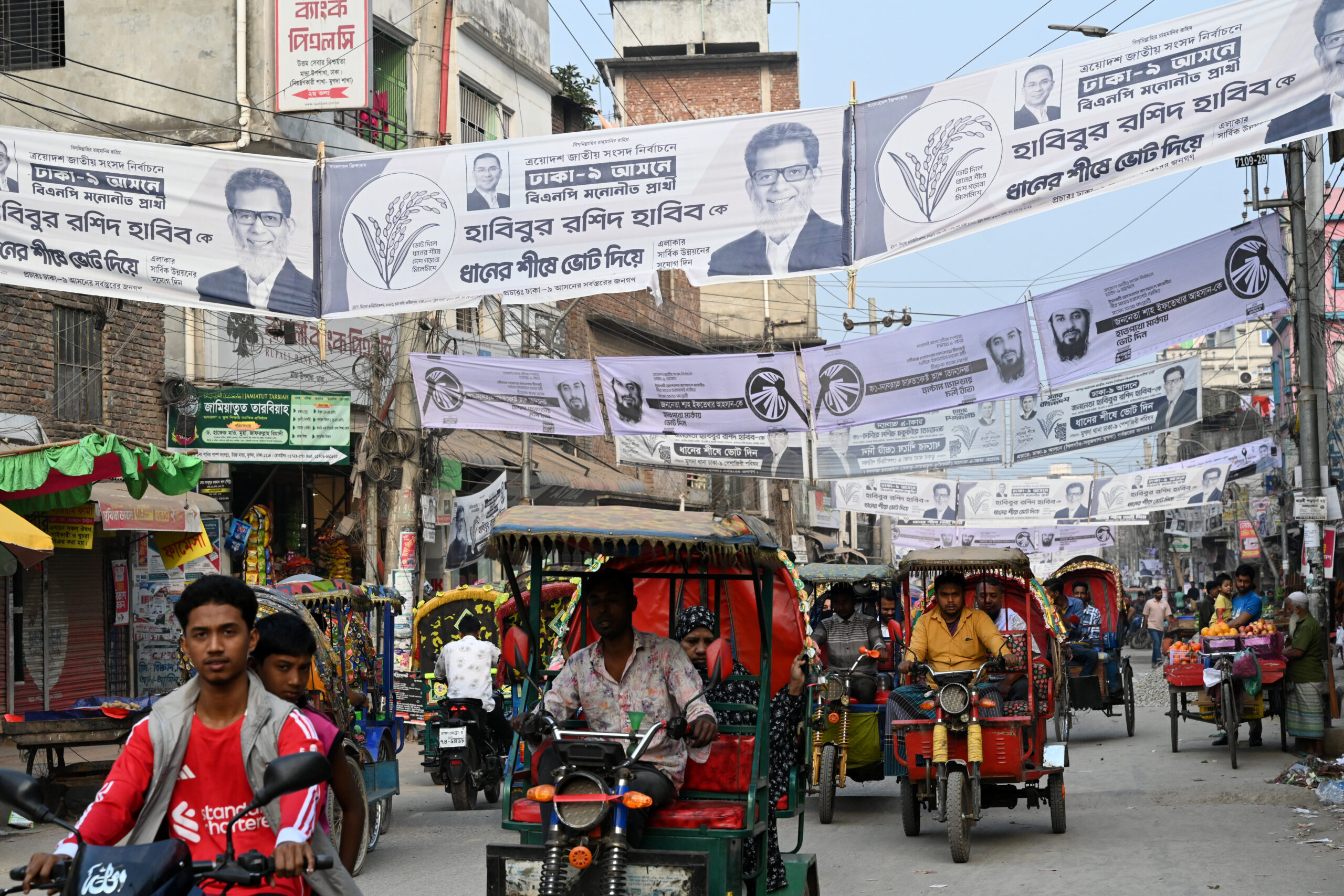
If South Asia’s 2026 election season has a linchpin, it is Bangladesh’s vote on February 12. As campaigning heats up in Dhaka, what happens at the polls will not mechanically determine results elsewhere—but it will shape the political climate for three elections that follow soon after: Nepal’s general election on March 5 and India’s state elections in West Bengal and Assam between March and May.
Bangladesh goes first—and in a region where narratives increasingly drive electoral outcomes, going first matters.
This is especially true because Bangladesh’s general election is saturated with stories that carry region-wide relevance. The nationwide vote is the first after former Prime Minister Sheikh Hasina was ousted by a student-led mass uprising in August 2024—one of several Gen Z-led protests that swept South and Southeast Asia at the time. It also unfolds amid deepening social polarization, rising religious extremism, and a faltering economy—all trends with implications well beyond Bangladesh itself.
Against this backdrop, the leading contenders each signal sharply different trajectories. A victory by the Bangladesh Nationalist Party (BNP) would point less to systemic political renewal than to the resilience of the long-standing duopoly of the Awami League and the BNP. Such a result would show that power in Bangladesh continues to circulate between entrenched elites despite the collapse of the ruling party. Gains by Jamaat-e-Islami would underscore the growing electoral salience of religious mobilization amid economic grievance. This would reinforce regional concerns about the normalization of Islamist actors through the ballot box. Meanwhile, a strong performance by the National Citizen Party (NCP) would echo the legacy of the 2024 student uprising—suggesting that antiestablishment, generational politics may be moving from street protests to an electoral force.
How the election plays out—and how power is eventually distributed in Bangladesh—will therefore significantly influence political debates, voter mobilization, and perceptions of electoral integrity across South Asia.
For Nepal, Bangladesh’s election could serve as a cautionary tale
Nepal heads into elections in early March after its own period of upheaval—marked by Gen Z–driven mobilization, civic frustration with corruption, and the resurgence of antiestablishment forces. In this sense, Nepali youth mirror their Bangladeshi counterparts in striking ways. This is no coincidence. Both countries have a median age of roughly twenty-eight, placing them squarely within the same demographic moment.
In both Nepal and Bangladesh, youth-led protest movements that contributed to the downfall of former regimes were fueled by the same combustible mix: persistent inflation eroding purchasing power; chronic youth unemployment and underemployment; a demographic surge unmatched by job opportunities; and deep resentment toward corruption, nepotism, and dynastic or patronage-based politics.
While both countries are experiencing powerful youth-led movements, the current situation is colliding with deeply entrenched political structures. The shadow of the old patronage machines remains long. In both nations, the combination of high “unofficial” campaign costs—where candidates in Nepal often spend upwards of twenty million Nepalese rupees ($150,000) despite lower official caps, and those in Bangladesh frequently exceed legal limits by up to twelve times to manage local muscle and mobilization—and the gatekeeping of established party elites continues to keep the playing field tilted in their favor. This remains true even though new student-led and reformist parties, such as the NCP in Bangladesh and the Ujyalo Nepal Party in Nepal, have emerged to challenge the status quo. Whether the upcoming 2026 elections will truly break these cycles of clientelism or simply replace one set of power brokers with another remains the defining question for the region’s democratic future.
Yet there is a key difference: Unlike in Bangladesh, Nepal’s elections remain broadly inclusive. No party has been formally excluded from the ballot, and no category of political actor has been declared illegitimate by administrative fiat. In Bangladesh, by contrast, the Awami League that ruled the country between 2009 and 2024 is effectively barred from contesting, rendering the February election fundamentally different in character. Many international observers have noted that Bangladesh’s polls are not fully inclusive as a result, particularly compared with Nepal’s open contestation across the political spectrum.
That distinction allows Nepal’s Gen Z movements to translate protest into participation rather than rupture. Bangladesh’s February election thus becomes a negative comparator in Nepali discourse: an example of how protest-driven transitions can harden into exclusion rather than renewal when a dominant party is sidelined instead of being defeated at the ballot box.
This contrast is unlikely to dominate Nepal’s campaign narrative. But if Bangladesh’s election is widely perceived as constrained or only selectively competitive, Nepali political elites can point to their country as offering, despite its instability, precisely what Bangladesh currently lacks: a pluralistic electoral arena where political grievances are mediated through institutions rather than mobilized against them.
That distinction will, in turn, shape how Nepalis debate legitimacy, restraint, and the stakes of institutional continuity—particularly as Bangladesh’s polls double as a referendum on interim government-backed constitutional overhauls.
Cross-border unrest would spell trouble for West Bengal
In India’s eastern state of West Bengal, Bangladesh is not merely a neighbor; it is a central reference point in the 2026 legislative assembly election.
The ruling Trinamool Congress (TMC) portrays itself as the last major eastern citadel resisting the expansion of India’s ruling Bharatiya Janata Party (BJP), a framing that has proven electorally effective before. Meanwhile, the BJP casts West Bengal as the next fortress to fall, using Bangladesh as the lever through which that siege is rhetorically conducted.
Bangladesh functions in West Bengal politics less as a foreign policy concern than as a domestic political proxy through which citizenship, demography, and belonging are contested. For the BJP, references to Bangladesh collapse cross-border history into a narrative of undocumented migration and demographic threat, allowing the party to frame West Bengal as the next frontier in a national project of border control and cultural consolidation without directly naming internal Muslim minorities. The TMC, by contrast, recasts the BJP’s rhetoric as an external imposition that misunderstands the region’s social fabric and weaponizes documentation against ordinary Bengali lives. In this way, Bangladesh becomes a rhetorical lever through which competing visions of Indian nationhood, federal authority, and citizenship are contested in eastern India.
Two recent developments sharpen this dynamic. The first is the Special Intensive Revision (SIR) of electoral rolls in West Bengal. Framed by India’s Election Commission as a simple administrative cleanup exercise, SIR has quickly become political dynamite. Opposition leaders argue it disproportionately targets Muslim and migrant-origin voters; supporters insist it is necessary to prevent illegal voting.
The second development is the intensification of anti-migration rhetoric. Senior BJP leaders, including Prime Minister Narendra Modi, have long accused the TMC of converting “infiltrators into voters.” That claim now operates in tandem with developments across the border. Any instability or violence politically associated with Bangladesh’s election will feed directly into Bengal’s campaign narrative, reinforcing the idea that border governance and electoral integrity are inseparable.
For the TMC, this is a defensive fight on two fronts: it must protect its image as Bengal’s pluralistic guardian while rebutting accusations that the state has become a demographic free-for-all. Bangladesh’s election will supply daily rhetorical ammunition to the debate.
Looking east, Assam charts its political and cultural future
If Bangladesh looms over West Bengal symbolically, it looms over India’s northeastern state of Assam historically and existentially.
For Assam, Bangladesh is a decades-old reference point in debates over ethnic identity, political belonging, and demographic survival. Long before the current election cycle, Assamese politics was shaped by fears of cultural dilution and political marginalization rooted in migration across a porous eastern border—anxieties that crystallized in movements such as the Assam Agitation, and which have never fully receded from the state’s political consciousness. Moreover, Assam is located in India’s historically disturbed northeast region, which borders China, Myanmar, Bhutan, Nepal, and Bangladesh, and where many ethnic groups have long had demands for autonomy or secession.
For decades, Assam’s electorate has been primed to view politics through the lens of demographic anxiety—concerns about who belongs, who counts, and whether Assamese cultural and political primacy can endure amid perceived population shifts. In that context, Bangladesh’s high-stakes election is not distant foreign news but a proximate signal feeding narratives about migration flows, population balance, and the durability of Assamese political authority. Electoral competition in Assam is deeply entangled with questions of ethnic identity and historical grievance, where each election is read as a judgment on whether demographic change is being actively managed—or quietly allowed to reshape the state.
Current Chief Minister Himanta Biswa Sarma has repeatedly invoked this historical memory, linking Bangladesh to Assam’s demographic future, border security, and the vulnerability of the Siliguri Corridor—the “chicken’s neck” connecting India’s mainland to its northeastern states.
In this election season, geography has become politics. The outcome of Bangladesh’s February elections will be interpreted as an answer to this question: will long-standing fears about migration, identity, and control be confirmed, or will they be contained? A BNP victory would signal a return to a familiar pattern, particularly regarding alleged tolerance of—or ambiguity toward—support networks linked to northeastern militant groups. By contrast, electoral gains by Jamaat-e-Islami would sharpen concerns about an emboldened Islamist agenda, intensifying debates over identity politics and social control.
The “Hasina factor” and India’s hegemonic influence
Hovering over all of this is the unresolved question of Hasina, who has been living in exile in India since August 2024, when weeks of violent unrest ended her fifteen-year rule. Her presence there remains politically catalytic. Dhaka has formally requested her extradition, a demand that took on new urgency after she was sentenced to death in absentia in November 2025. Yet New Delhi has so far refused to budge.
For the Bangladeshi youth activists who led the 2024 uprising, this reinforces claims that remnants of the former regime survive through external backing. At the same time, for the Indian political establishment, it complicates Delhi’s claim to neutrality.
In that sense, the “Hasina factor” also carries significant implications for the upcoming elections in West Bengal, Assam, and Nepal. In West Bengal, it fuels BJP claims that regional instability requires strong national oversight. In Assam, it reinforces the narrative that security threats must be managed centrally.
For Nepal, this is a cautionary tale about how a regional hegemon inevitably exerts influence over the domestic political trajectories of its neighbors, particularly during moments of political transition that disrupt established geopolitical balances.