DOHA—National security strategies, issued by US presidential administrations every four years or so, generally don’t get much news coverage. They are serious (and often ponderous) efforts to prioritize major US security concerns. At their best, they then describe a plan to deal with these concerns.
So, it’s worth noting that much of the sideline talk at the twenty-third edition of the Doha Forum this past weekend—including from a piquant combination of Donald J. Trump Jr. and former Secretary of State Hillary Clinton—focused on the so-called NSS and its intentionally unconventional and provocative nature.
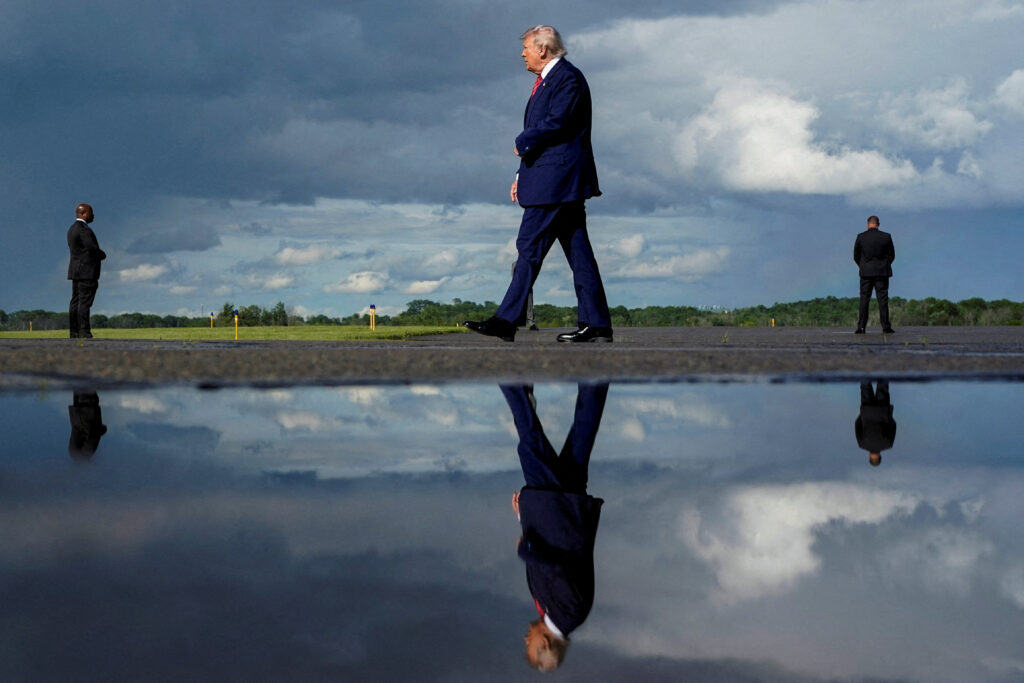
The new NSS, which dropped late last week, is significant not only for the spicy specifics of its worldview. It’s probably even more compelling for the insights it provides into US President Donald Trump’s second-term psychology, when compared to his first NSS, released in December 2017 at the end of the first year of his first term.
Put simply, the newest strategy represents Trump unleashed, while the first portrayed Trump constrained. It’s fair to regard Trump’s first NSS as an institutional effort by what Trump would call “the deep state” to translate his disruptive instincts into strategic orthodoxy. It was drafted under then National Security Advisor H.R. McMaster, when Trump hadn’t yet honed his own views. (The word “tariffs,” for example, doesn’t appear once.)
The 2017 document advanced the now-familiar concept of “great power competition” by elevating China as a strategic rival. It also reaffirmed NATO’s enduring value “as one of our great advantages over our competitors” by reasserting US commitment to Article 5 of the Washington Treaty, which commits the United States to common defense. At the time, foreign diplomats joked that the document articulated US interests better than Trump had.
What a contrast with Trump’s new NSS, which reads less like “the deep state” moderating the president and more like Trump bending the national security bureaucracy to his worldview. For the first time in an official US strategy document, Europe is described as facing the threat of “civilizational erasure.” The Western Hemisphere, often an afterthought in earlier NSS documents, is raised to an existential priority. The NSS also elevates American culture to a strategic concern, seeking the “restoration and reinvigoration of American spiritual and cultural health, without which long-term security is impossible.”
The comparison between the two documents captures a tale of two Trumps. First-term Trump chose national security leaders who saw their role as domesticating him and reining him in. The resulting strategy reflected institutionalists’ desire for stability. Throughout Trump’s first presidency, his cabinet often acted to constrain the impulses of the president and the convictions of his MAGA base.
Trump 2.0 governs alongside a far more loyal and closely aligned national security team, which sees its task as unleashing Trump and channeling his vision. Where the 2017 NSS imposed the language of the Washington establishment on the president, Trump has now ensured his administration speaks his vernacular.
Predictably unpredictable
Trump’s son Don Jr. had the assignment of disseminating the president’s message at the Doha Forum, a major annual gathering of international leaders and experts. Don Jr. celebrated his father’s genius. “What’s good about my father, and what’s unique about my father, is you don’t know what he’s going to do,” he said. “The fact that he’s not predictable . . . forces everyone to actually deal in an intellectually honest capacity.”
On the issue where the president has been particularly incalculable, regarding Russia’s illegal war on Ukraine, Don Jr. conceded that his father might well walk away from Kyiv—and it is that level of uncertainty on a matter of such central strategic concern that so deeply troubles many US allies.
Don Jr. took a swipe at Ukrainian President Volodymyr Zelenskyy and his country’s corruption, which he said was greater than that of Russia. “Because of the war,” he said, “and because he’s one of the great marketers of all times, Zelenskyy became a borderline deity, especially to the left, where he could do no wrong, he was beyond reproach.”
Also in Doha, Hillary Clinton, speaking with Foreign Policy’s Ravi Agrawal in the more moderated criticism US leaders traditionally use when speaking abroad, said the Trump NSS was “not to my liking.” She spoke with concern that the NSS signaled “a big turn away from the hallmark alliances of our foreign policy and our strength in influencing global events.” She called out the “very strong indictment of Europe—in particular, its openness and population composition. That is an unnecessary division between us and countries with whom we have a lot in common and are necessary to our security.”
She charged that Trump’s United States “has supported Russia’s invasion of Ukraine by rarely criticizing [Russian President Vladimir] Putin for the brutal war he has waged on the Ukrainian people and by attempting to coerce the Ukrainians into accepting a peace deal that would leave them vulnerable to further Russian activity.”
Strategic differences
The most striking contrast between the two Trump documents is the first paragraphs on Europe in both. In 2017 the NSS said: “A strong and free Europe is of vital importance to the United States. We are bound together by our shared commitment to the principles of democracy, individual liberty, and the rule of law. Together, we rebuilt Western Europe after World War II and created institutions that produced stability and wealth on both sides of the Atlantic. Today, Europe is one of the most prosperous regions in the world and our most significant trading partner.”
Fast forward to 2025: “American officials have become used to thinking about European problems in terms of insufficient military spending and economic stagnation,” the NSS said. “There is truth to this, but Europe’s problems are even deeper.” It noted that continental Europe’s share of global gross domestic product had fallen to 14 percent today from 25 percent in 1990, a result of “national and transnational regulations that undermine creativity and industriousness. But this economic decline is eclipsed by the real and more stark prospect of civilizational erasure.”
What also sets the new NSS apart is the now-familiar Trump hagiography and the explanation behind his current emphasis on peace-making, which began with his first-term Abraham Accords but has become a driving theme of Trump 2.0 and his open pursuit of a Nobel Peace Prize.
“President Trump has cemented his legacy as The President of Peace,” the NSS declares, by leveraging his “dealmaking ability to secure unprecedented peace in eight conflicts throughout the world over the course of just eight months of his second term.” It speaks of his peace efforts with Cambodia and Thailand, Kosovo and Serbia, the Democratic Republic of the Congo (DRC) and Rwanda, Pakistan and India, Israel and Iran, Egypt and Ethiopia, and Armenia and Azerbaijan, as well as his ending of the war in Gaza with all living hostages returned to their families. Trump has indeed made progress on many of the world’s conflicts, but they are far from resolved. Just this week, Thailand and Cambodia resumed fighting, and the president of the DRC accused Rwanda of violating their peace agreement.
While some in Trump’s electoral base say he is spending too much time on international affairs at the expense of voters’ domestic concerns, the NSS explains, “A world on fire, where wars come to our shores, is bad for American interests. President Trump uses unconventional diplomacy, America’s military might, and economic leverage to surgically extinguish embers of division between nuclear-capable nations and violent wars caused by centuries-long hatred.”
Take a breath
Matthew Turpin, who served as director for China in the first Trump administration, criticizes the media “hyperventilation” over the new NSS, and he has found plenty of evidence in the document that the administration still values Europe, isn’t abandoning Ukraine, and has every reason to prioritize the Western Hemisphere.
The NSS section on Europe is titled “Promoting European Greatness,” he points out, and it asserts that “Europe remains strategically and culturally vital to the United States.” The NSS states, “Our goal should be to help Europe correct its current trajectory. We will need a strong Europe to help us successfully compete, and to work in concert with us to prevent any adversary from dominating Europe.”
The NSS, writes Turpin, “is criticism of a passive-aggressive teammate who isn’t pulling their weight. It is an appeal to [an] ally to ‘be better.’”
The NSS says that Trump wants to end hostilities in Ukraine “in order to stabilize European economies, prevent unintended escalation or expansion of the war, and reestablish strategic stability with Russia, as well as to enable the post-hostilities reconstruction of Ukraine to enable its survival as a viable state.” It adds, “Not only can we not afford to write Europe off—doing so would be self-defeating for what this strategy aims to achieve.”
Quips Turpin: “How incredibly horrible that the United States should want Europe to live up to its potential and be a responsible ally . . . completely outrageous, huh?!?”
When it comes to the reason why the United States needs to concentrate on the Western Hemisphere, the strategy quite correctly points out competitors’ (presumably China’s and Russia’s) inroads there. “Allowing these incursions without serious pushback is another great American strategic mistake of recent decades,” the document explains.
A lesson in legacy building
The fact is that documents alone don’t make history. Leaders do—in how they produce them and act upon them.
That is even more true in the second Trump administration, where executive leadership has become so crucial to policy making, reducing the weight of the usual inter-agency process. I’ve heard one senior official refer to the space between the president’s ears as the world’s most important square foot of geopolitical territory.
So, does the 2025 NSS mark an inflection point in how the United States addresses global challenges? That depends on, as former British Prime Minister Harold Macmillan once put it in answer to a reporter, “Events, dear boy, events,” and how Trump drives them and responds to them.
In Doha, Don Jr. said people were telling him, “We have three years to act”—implicitly signaling that no future president would be quite like his father. And the window might be smaller still. Republicans in Congress tell me that the president’s focus on his legacy will run up against several matters in 2026 that could constrain him: Supreme Court decisions, threats to economic growth and the stock market, and midterm elections in November that could cost him the House of Representatives.
Many Republican constituents signal that they want Trump to focus more on the domestic issues he ran on, in particular the cost of living. But, they reckon, Trump has now acquired a deeper taste for foreign affairs that he’ll want to build upon, with a focus on his legacy.
One prominent recent visitor to the White House told me that Trump showed him portraits of the great US presidents and speculated on how he would be remembered. When he did this, he lingered on Ronald Reagan’s portrait, which hangs behind his workspace in the Oval Office, broadcasting a message of lineage.
The next such visitor might want to ask Trump how he intends to build upon Reagan’s global alliance-building and its legacy: a Cold War victory without a shot being fired that brought down the Berlin Wall, triggered the collapse of Soviet Communism, and expanded prosperity and democracy around the world. Focused on his legacy as well, Reagan built upon the US leaders who came before him through World War II and its aftermath.
“While other countries cling to the stale past,” Reagan said late in his second term, “here in America, we breathe life into dreams. We create the future, and the world follows us into tomorrow.” Reagan is also well known for versions of the saying, first attributed to President Harry Truman, “There is no limit to the amount of good you can do if you don’t care who gets the credit.”
Trump’s presidency is an American inflection point, and about that there is no doubt, but what’s unpredictable—the aspect about his father that Don Jr. so admires—is in which direction. The NSS has provided the mood music as the curtain rises on the final three years of the Trump presidency.
Frederick Kempe is president and chief executive officer of the Atlantic Council. You can follow him on X @FredKempe.
This edition is part of Frederick Kempe’s Inflection Points newsletter, a column of dispatches from a world in transition. To receive this newsletter throughout the week, sign up here.
Further reading
Mon, Dec 8, 2025
Scowcroft Strategy Scorecard: Grading Trump’s second National Security Strategy
Scorecard By
The Trump administration recently released its new National Security Strategy, a document that represents a major departure from past strategies. Experts from our Scowcroft Center for Strategy and Security hand out their grades.
Mon, Oct 27, 2025
Trump’s place in history depends on his approach to the CRINK
Inflection Points By Frederick Kempe
After a string of foreign policy wins, Trump's more significant challenge lies ahead: countering the bloc of China, Russia, Iran, and North Korea.
Fri, Dec 5, 2025
Experts react: What Trump’s National Security Strategy means for US foreign policy
New Atlanticist By
Atlantic Council experts delve into the newly released document outlining the Trump administration’s principles and priorities for US foreign policy.
Image: US President Donald Trump walks as he arrives at Morristown Municipal Airport in Morristown, New Jersey U.S., May 23, 2025. REUTERS/Nathan Howard