
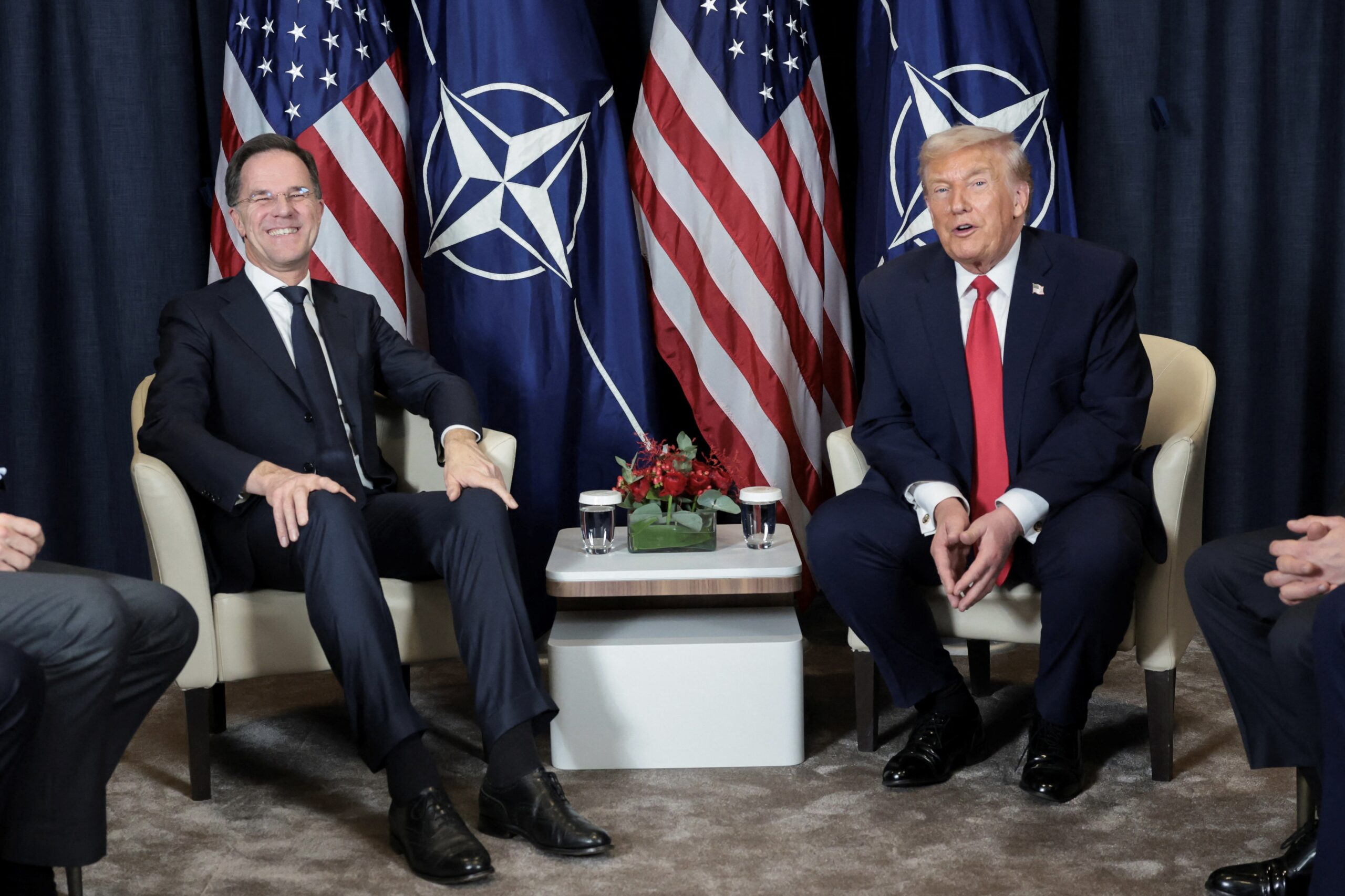
WASHINGTON—The best line of Donald Trump’s speech to the World Economic Forum in Davos was his pledge that the United States would not use force to seize Greenland. But the best news of the day was the announcement a short time later that the United States had reached a “framework” deal with NATO Secretary General Mark Rutte on Arctic security, and the US president was therefore rescinding the tariffs against Denmark and several other European countries that Trump had announced just days earlier.
While the details of the deal are still emerging, it may be that when faced with Denmark’s and Greenland’s resistance to US threats, European solidarity against those threats, unease in financial markets, and significant congressional unhappiness with the United States bullying a loyal ally, Trump decided to take a win on Arctic security and forgo a needless fight on Greenland’s sovereignty.
Taking force off the table
In the speech, Trump took the use of force to seize Greenland off the table. But he continued to demand US sovereignty over Greenland, rooting his argument in dubious history and poor logic. He claimed, for example, that countries that cannot defend their own territory cannot claim the right to possess it. That echoes a similar assertion by White House Deputy Chief of Staff Stephen Miller. But the whole purpose of alliances, including NATO, is that security is greater if responsibility for it is shared. A doctrine that the power to seize territory is its own justification—which is close to what Trump and Miller argue—would legitimize every aggressor.
Trump also claimed that to defend territory, the United States needs “title” to it. But the United States successfully defended Germany, South Korea, Japan, and hosts of other countries during and after the Cold War without seeking to annex them, and it did so from military bases that were “rented” and not part of the United States.
Trump argued that the United States was mistaken to “return” Greenland to Denmark after World War II. The United States did put military bases on Greenland during the war after Germany conquered Denmark in April 1940. But the United States never annexed Greenland during the war: it put military facilities on it pursuant to an agreement with the Danish government-in-exile, and that agreement recognized continued Danish sovereignty over Greenland. In 1951, the United States and Denmark concluded the Defense of Greenland Agreement, which enshrined extensive US basing rights.
While Trump ruled out war to conquer Greenland, he did suggest, albeit obliquely, that continued US support for Ukraine and for NATO depended on European acquiescence in his demands for Greenland. “Now what I’m asking for is a piece of ice,” Trump said of Greenland. “It’s a very small ask compared to what we have given them for many, many decades,” he added about NATO. To underscore the point, Trump said several times in the speech that allies had not been there for the United States.
In fact, NATO has invoked Article 5 of the North Atlantic Treaty once in its history: that was on September 12, 2001, the day after the attacks on the World Trade Center and the Pentagon. I was in the White House that day as part of my job on the National Security Council staff. “We need this,” is what then National Security Advisor Condoleezza Rice told the French government, referring to the decision to invoke Article 5. So the allies did—and it was not an empty gesture. NATO members, Denmark among them, later sent forces to fight alongside the United States in Afghanistan and Iraq. Some of those soldiers did not come home.
Trump rightly pointed out that NATO nations have not devoted enough to defense. He also took credit, also rightly, for helping fix that problem by pushing for NATO’s decision at its 2025 summit in The Hague to set new, high targets for members’ military spending. But Trump cannot take a win on NATO defense spending and then demand that NATO members acquiesce to US aggression against a fellow NATO member.
Trump seemed to be counting on threats of US economic pressure plus US reduction of support for NATO and Ukraine as sufficient leverage to force Denmark’s allies to abandon Greenland. That didn’t happen.
Getting to a deal in Davos
Europe does need US support against Russia’s aggression. But Denmark did not yield, and its fellow European countries largely held together. In the United States, many Americans seemed skeptical of the administration spending a great deal of time and money to acquire Greenland, especially as economic conditions at home remain uneven. More immediately, an adverse Supreme Court decision on the president’s use of the International Emergency Economic Powers Act statute for imposition of tariffs could attenuate Trump’s economic leverage. And Congress has already passed legislation (the 2025 National Defense Authorization Act) that complicates Trump’s ability to withdraw US forces from Europe.
The Europeans (and especially the Danes) knew all this, and it bolstered their willingness to resist. Their response from the start has been to offer Trump all the security cooperation he wants in the Arctic but stand firm against US demands for annexation, knowing that they can make the case to Congress and the US public. They were offering security but not surrendering on sovereignty.
Though details so far are thin, the meeting between Trump and Rutte seems to have settled on just that sort of deal: some arrangement to bolster security in the Arctic and, one hopes, the United States backing off on meritless claims to Greenland. Trump could justly claim such an arrangement as a win for both US and allied security in the Arctic.