
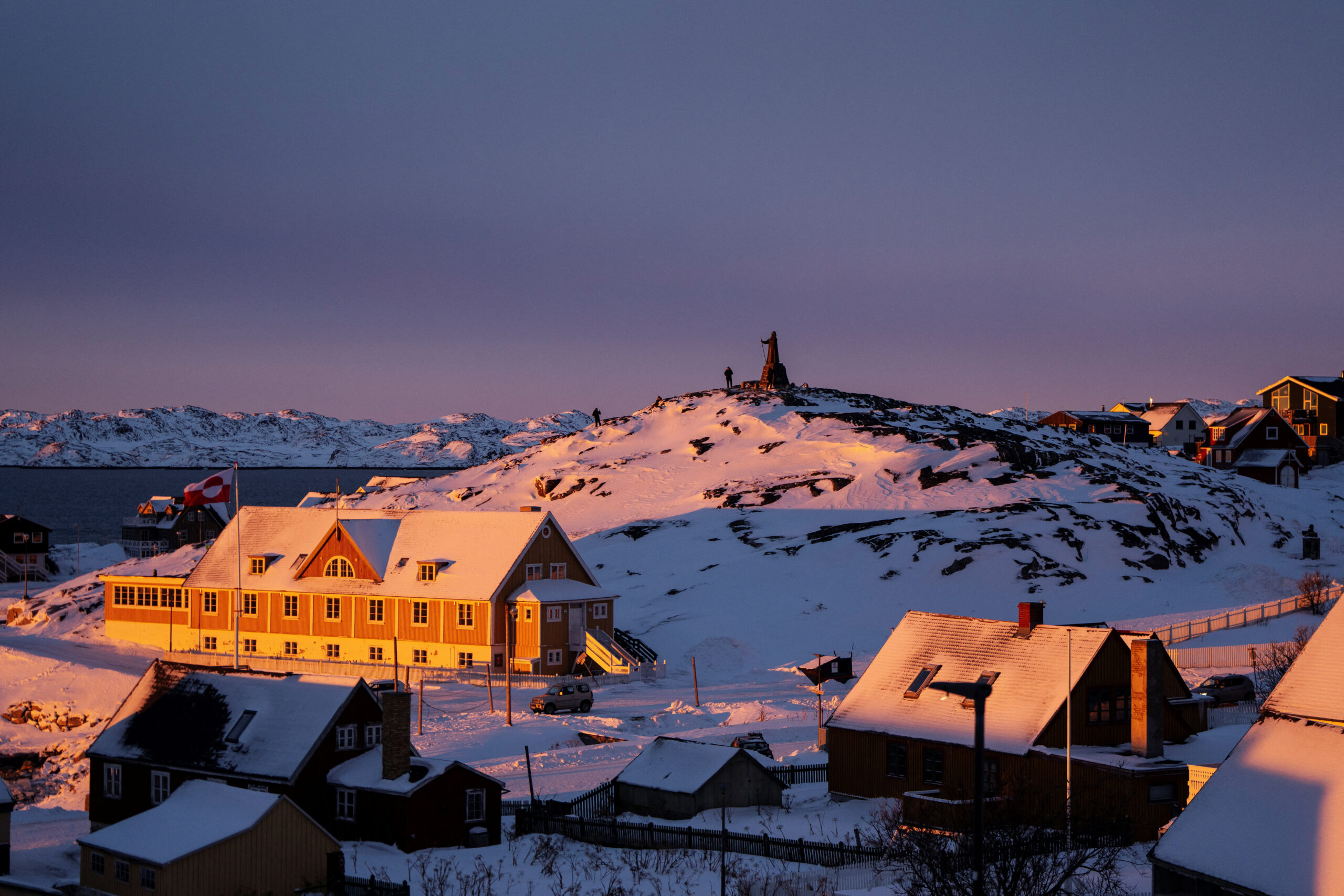
BRUSSELS—On Wednesday, US President Donald Trump announced that he would not implement planned tariffs on European allies after reaching a “framework of a future deal” with NATO Secretary General Mark Rutte on Greenland and the Arctic. Coming after weeks of sharp rhetoric and threats that often obscured the strategic issues at play, this development presents an opportunity for the United States and its allies to refocus on what is actually at stake.
Greenland is the world’s largest island, located in an increasingly contested Arctic region, making it a target for Russian pressure and Chinese influence. That reality deserves serious conversation among partners, not a public quarrel that weakens all sides.
Why Greenland matters
As Trump said earlier Wednesday during his address to the World Economic Forum in Davos, the United States has had a long history with Greenland. Washington first made an offer to acquire Greenland in 1867, and the idea has resurfaced repeatedly, including after World War II. Trump, too, has a history with the island. During his first term, Trump described his approach as essentially “a large real estate deal,” and he returned to that language in his speech in Davos.
It is unsurprising that Trump, who has had a long career in real estate, would approach this issue in this manner. But Greenland has never been a simple real-estate transaction. Its strategic location and mineral potential make it consequential to twenty-first-century security and economics. Its position in the Arctic among US allies and Russia introduces important geopolitical factors, as well. The problem is not the underlying interests; it is how they have been presented in recent weeks, through rhetoric and actions that have inflamed emotions and narrowed the path to a diplomatic solution that could strengthen US and allied security.
Not ownership, but alignment
Looking past the recent attention-grabbing rhetoric, there is an important issue here: Without a credible US security guarantee, the world’s largest island—sitting in a volatile and strategically critical Arctic region—is potentially vulnerable against future pressure from Russia and, more importantly, China.
That is why the central question is not ownership but alignment, especially as Greenland moves toward its expected independence from Denmark. In that event, will Greenland’s political and economic future remain anchored in the transatlantic community, where its natural resources can benefit Greenlanders and strengthen the free world? Or, will an independent Greenland drift into a gray zone of influence and insecurity that the adversaries of the United States and Europe could exploit?
Trump’s announcement that he would not levy additional tariffs on European allies could offer much-needed diplomatic space for a new approach that would address these questions. Driven by both national security and economic realities, the United States could use this moment to seek strategic certainty that Greenland will remain secure, stable, and anchored in the West.
For Danish Prime Minister Mette Frederiksen and other political leaders in Denmark in an election year, there is little room for nuance: Greenland is not for sale. Many Greenlanders feel insulted by the mere suggestion of being “bought,” and that reaction is understandable. But the recent outrage has also made it harder to have a rational conversation about the realities shaping Greenland’s future. Moreover, it distracts from the fact that Danish-Greenlandic relations remain complicated, shaped by history and unresolved questions about Greenland identity and autonomy as a nation.
As Anne-Sofie Allarp, a well-respected Danish journalist and author, wrote ahead of last week’s meeting in Washington between high-level US officials and their Danish and Greenlandic counterparts, “Danish and Greenlandic politicians of the past 30-40 years need a conversation with themselves about the real relationship between Greenland and Denmark.” She goes on to warn that Greenland’s independence could leave this “strategically important area close to the United States, on which the United States has important installations and which has important rare earths and metals, with an absolutely uncertain political future.”
The China factor
What has been underrepresented in the current debate, however, is that China has previously made overtures to Greenland—something that understandably raises concern in Washington. A 2022 study by the University of Copenhagen concluded that “Greenland views China as a deep-pocketed investor and a huge consumer market, especially in the mining, fishing, and tourism industries. Greenland therefore views China as an important partner in its economic development, which is important for its independence from Denmark.”
Chinese efforts to build infrastructure and gain economic leverage in Greenland have, so far, been held back by Danish and allied pressure. Without Danish insistence, Greenland might have allowed it to move forward. In 2018, for example, the Chinese state-owned company China Communications Construction Company was shortlisted to build three airports in Greenland, in Nuuk, Ilulissat, and Qaqortoq. This effort stalled only after Danish and US officials stepped in. China has also proposed to build “science stations” in the region with dual-use capabilities, consistent with Beijing’s broader ambition to expand its presence in the Arctic through the Polar Silk Road initiative. And the Chinese company Shenghe Resources has sought through other companies to exploit rare earth and uranium mining projects, including Kvanefjeld in Greenland, which was halted on environmental rather than geopolitical grounds.
For now, Chinese ambitions in Greenland have been constrained by Denmark. But the political trajectory inside Greenland is moving in the direction of independence. Nearly all the major political parties in Greenland support independence, only differing on the timing and the process. A referendum in Greenland to break with Denmark, while unlikely after the recent developments, cannot be excluded in the future. Even if a valid, pro-independence referendum required negotiations with Denmark to move forward, the long-term impact could be precarious. An independent Greenland would be free to pursue partnerships of its choosing, and it might choose to remain outside of the European Union and keep its distance from NATO. It might even attempt to balance between the United States and China, expecting investment and other benefits to be extracted from each. In short, preventing Beijing from gaining a lasting foothold in the Arctic could be far more difficult at that point than it is today.