
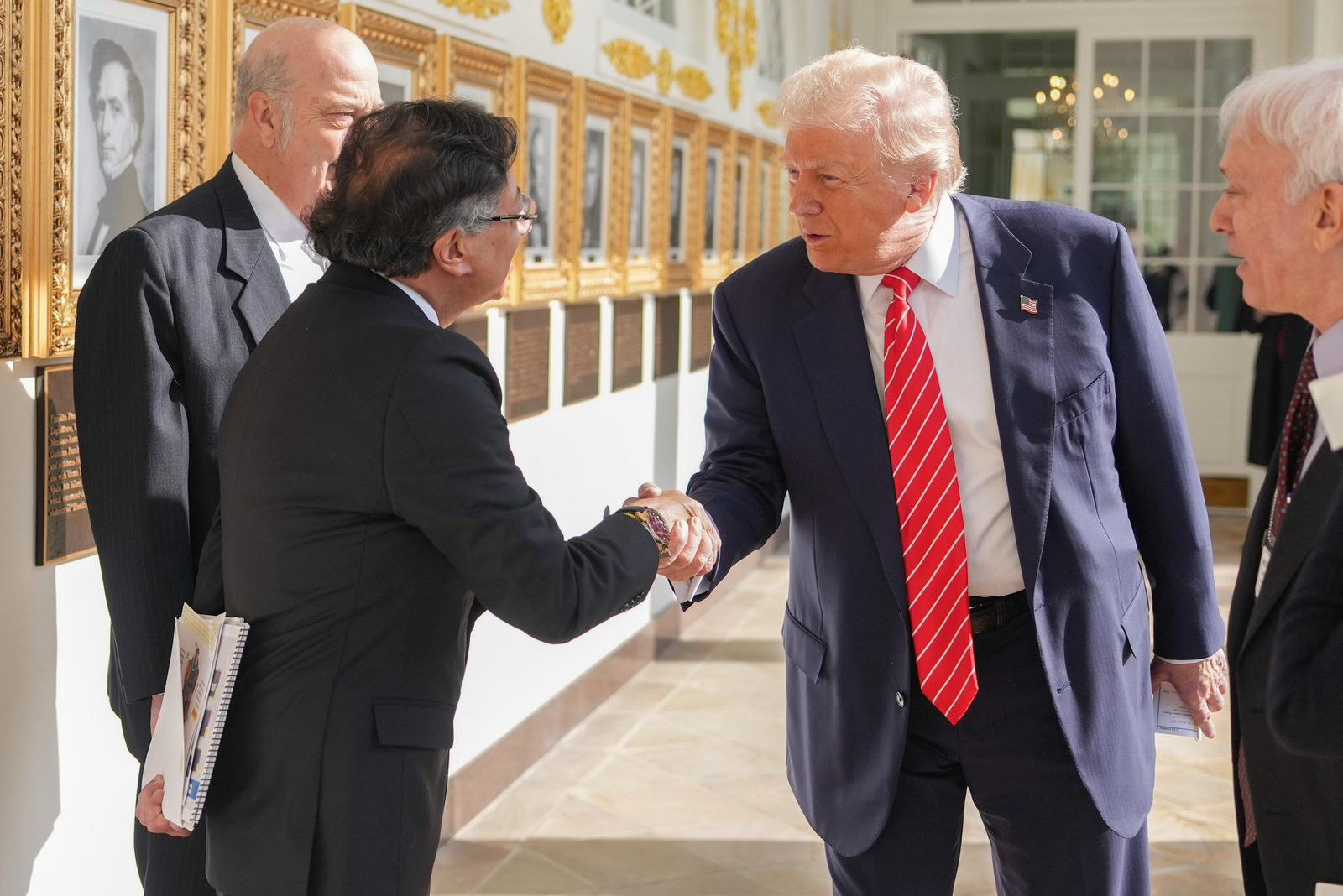
“I thought he was terrific.” This was US President Donald Trump’s take on Colombian President Gustavo Petro after a two-hour meeting at the Oval Office on Tuesday. Petro left the White House with an autographed MAGA hat and a copy of Trump: The Art of the Deal with a handwritten note reading “you are great.” The positive tone from both leaders coming out of the meeting, which seemed impossible just weeks ago, carries important implications for both a bilateral relationship that has gone through one of its lowest points in decades and for Colombia’s domestic political landscape ahead of the May 31 presidential election.
The meeting came after a year of public clashes between the two leaders, driven by diverging views on counternarcotics policy and broader geopolitical issues. It also took place only a month after the Trump administration removed former Venezuelan leader Nicolás Maduro from power—a move that came alongside Trump’s comments that Colombia, and Petro himself, could face similar consequences after Trump accused Petro of drug trafficking allegations.
The dramatic shift in the two presidents’ relations reflects Petro’s gradual adjustment from his confrontational posture with the United States that led to the Trump administration revoking his visa in September and leveling Office of Foreign Assets Control sanctions against him in October. In the days leading up to the meeting, Petro’s government resumed US deportation flights to Colombia, and just hours before the delegation arrived at the White House, Bogotá extradited the criminal leader known as “Pipe Tuluá,” who was indicted in Texas for moving narcotics into the United States in cooperation with Mexican cartels.
Through sustained backchannel diplomacy and these public actions, Petro signaled a clear willingness to cooperate and act pragmatically on issues Washington considers important, even as ideological differences between the two leaders remain.
Steps toward cooperation on security and regional challenges
While no formal agreements have yet been announced, both sides described the encounter as constructive. Petro told the press that the discussion covered Colombia’s potential role in supporting Venezuela’s economic recovery, including by providing infrastructure for crude oil refining and the transport of energy.
On the security front, they explored options for enhanced cooperation against transnational criminal organizations. Petro said he shared the names of high-value targets, whom he describes as “the main kingpins behind drug trade.” He also suggested the possibility of joint Colombia-Venezuela military actions against transnational criminal groups with US support.
Petro also raised his ongoing dispute with Ecuadorian President Daniel Noboa, who announced a plan last month to impose a 30 percent “security tariff” on Colombia over its failure to curb illegal mining and cocaine trafficking. Petro asked Trump to serve as a mediator and explore a trilateral counternarcotics effort. If it moves forward, it will mark the first instance of multilateral cooperation involving two regional governments and the Trump administration. Success here could provide a model for similar initiatives across the region.
Whether any of these initiatives will materialize remains uncertain, especially with Petro entering the last six months of his presidency. Still, reopening dialogue at the highest level of the bilateral relationship represents a critical step after months of antagonism. More importantly, it signals a shared willingness to prioritize progress on mutual priorities over ideological alignment.
Now, Washington is likely to expect tangible results, including the capture of high-value criminal targets discussed during the meeting. Acting on these expectations would undoubtedly complicate Petro’s broader peace agenda, forcing him to decide which priorities to pursue, especially after the Gulf Clan suspended peace talks on Wednesday in response to his engagement with Trump.
What the meeting means for the upcoming election
Beyond bilateral dynamics in the coming months, Petro’s shift toward engagement with Trump is likely to influence Colombia’s electoral landscape.
First, stabilizing tensions with Washington and demonstrating willingness to cooperate on security priorities could ease some of Petro’s unpopularity at home, which has been fueled by deteriorating security conditions. In theory, this could help him leave office with a stronger legacy and could also benefit the presidential candidacy of Senator Iván Cepeda, a member of Petro’s Pacto Histórico party. However, these effects are not guaranteed. Other factors, including the National Electoral Council’s decision to bar Cepeda from participating in a left-wing interparty coalition’s primary elections and exclude several Pacto Histórico lists from the legislative race could limit any gains for the party.
Second, the newly cordial tone between Petro and Trump limits the opposition’s ability to campaign on claims that Petro caused irreparable damage to the relationship with Colombia’s most important strategic partner. Going forward, candidates will need to move beyond criticism of Petro and build concrete agendas for strengthening the relationship with the United States.