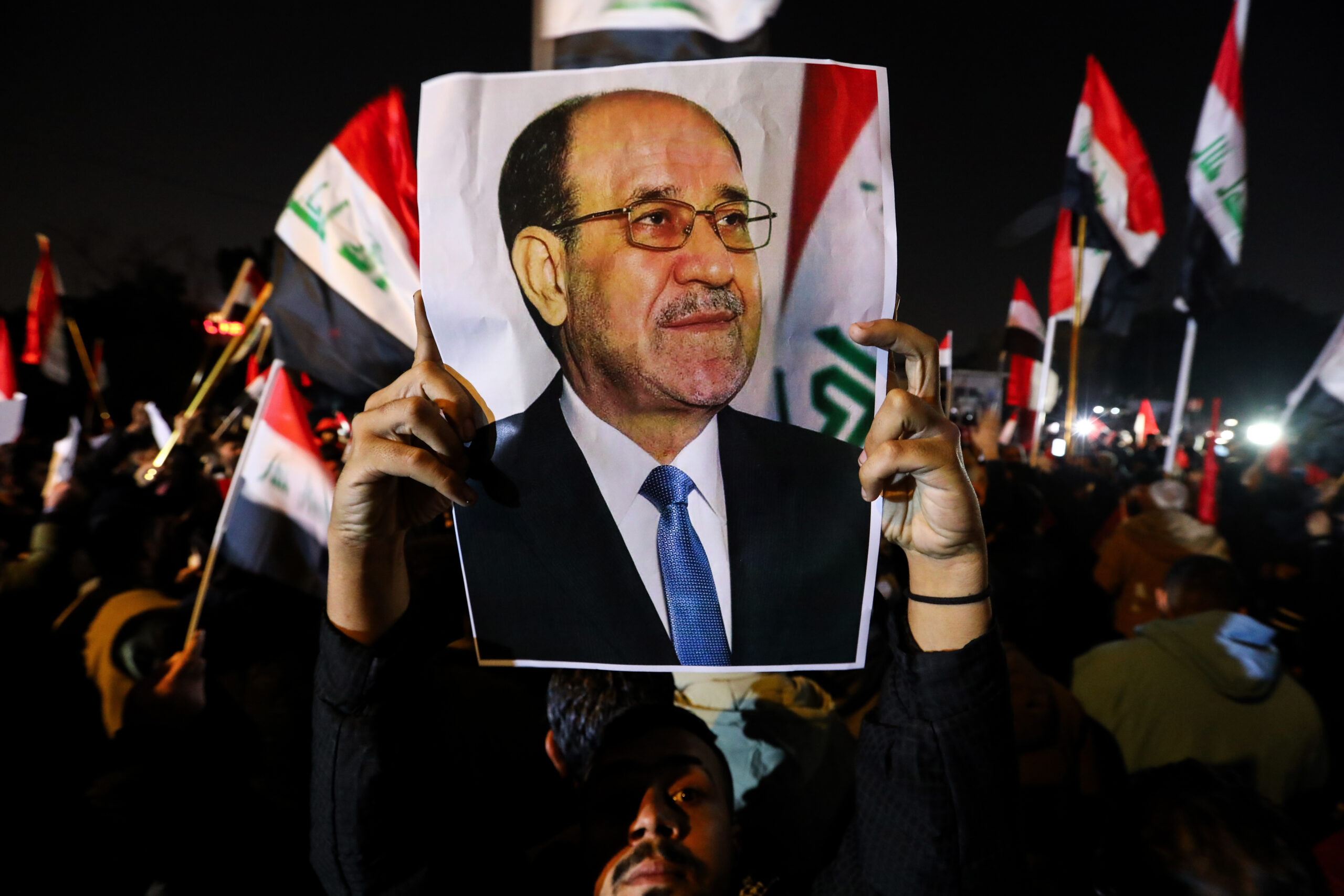
In a brief but unequivocal Truth Social post opposing Nouri al-Maliki’s bid to become Iraq’s next prime minister on January 27, US President Donald Trump sent shockwaves through the Iraqi political landscape. Prior to Trump’s message, Maliki’s improbable nomination for a third term as Iraqi prime minister appeared to be moving forward without significant opposition. A result of elite bargaining, a more hands-off approach from the United States, and eventual backing from Iran, Maliki’s nomination on January 24 was an alarming sign that Iraq might be heading backward rather than forward. In a few sentences, however, Trump effectively terminated Maliki’s candidacy and reasserted a US prerogative over Iraq’s premiership.
How did we get here?
When one of the authors—Victoria Taylor—visited Baghdad in November, leaders from the governing Shia coalition, the Coordination Framework, emphasized to her their firm consensus against a second-term prime minister and against any candidate who had his own political party. In fact, Maliki’s controversial second term as prime minister has often been cited as the very reason that no Iraqi prime minister should ever be granted a second term. Maliki’s name appeared at first to only emerge in discussions over the premiership as a tactical maneuver designed to force both Maliki and current Prime Minister Mohamed Shia’ al-Sudani to withdraw from consideration. Yet, Maliki’s bid for nomination gained steam after Sudani agreed to back him. There has been some speculation that Sudani made this move because he expected other actors to block Maliki’s nomination, which would allow him to emerge as the Framework candidate. On January 24, however, the Framework formally nominated Maliki—though notably, not by consensus.
A controversial history
That the United States would seek to block Maliki is unsurprising. During his two terms as prime minister from 2006 to 2014, Maliki laid the foundations of the current state in Iraq, making him largely responsible for many of its worst defects. During Maliki’s time in office, corruption and cronyism took root in government institutions. His record of entrenched sectarianism and paranoia, combined with his hostility toward Kurds and Sunnis during his eight-year premiership, led Iraq to the brink of civil war and culminated in the Islamic State of Iraq and al-Shams’s (ISIS’s) takeover of a third of Iraqi territory. While the US-led coalition reclaimed that ISIS-held territory, many of the ills that plagued Iraq under Maliki’s premiership continue to undermine the state. Former US officials who served in Iraq during Maliki’s time in power have since publicly described his disastrous run as prime minister in unsparing terms.
What’s more, Maliki has long-standing ties to Iran, going back to his years in exile prior to 2003, and his ideological commitment to Shiism has produced policies that supported Iranian interests at the expense of the United States. Maliki’s support for the total withdrawal of US forces in 2011 and subsequent support for Iran-backed militias entrenched Tehran’s influence over Iraq in lasting ways. US public statements on the most recent round of government formation rejected the idea of a “government installed by Iran,” suggesting that Trump’s opposition to Maliki is at least partially motivated by Iran’s support for his candidacy. However, to suggest that Maliki is beholden to Iran is to misunderstand Maliki’s motivations, which are often driven by his own personal political and economic interests. Given the political influence that Tehran and Iran-backed factions have over Iraqi politics, each one of Iraq’s prime ministers has received the nod from Iran, and the next prime minister will be no different.
A late US play
Although the United States had made clear to the Framework that it would not accept a government that included designated terrorist organizations, US messaging did not suggest firm opposition to any specific candidates. As Maliki’s nomination continued to speed ahead, the low-profile US engagement on government formation gave the appearance of tacit acceptance of his candidacy. This attitude changed just as Maliki’s nomination was on the cusp of approval, with a late US message to Framework leadership that the US experience during Maliki’s previous premiership was negative.
Whether the United States could have been clearer or simply engaged too late in the process, the Framework made a grave miscalculation about the depth of US opposition to Maliki, bringing what could have been a private dispute into the open. In successive social media posts and statements in the days following Maliki’s nomination, US engagement ratcheted up and the opposition to Maliki became increasingly direct, with calls to Iraqi leaders from US Secretary of State Marco Rubio on January 25, Special Envoy to Syria Ambassador Tom Barrack on January 26, and a sharp threat from Special Envoy to Iraq Mark Savaya (which was subsequently deleted when he closed his X account).
Trump’s message made US opposition crystal clear. Savaya’s alleged dismissal in the midst of the dispute over Maliki only heightened the drama and ramped up the conspiracy theories.
What happens next
Trump’s public opposition to Maliki has upended the government formation process, embarrassing Maliki and the Framework. The Framework now faces a stark choice: find a way to back down to preserve its relationship with the United States or risk political and economic consequences from the Trump administration. Maliki responded to Trump defiantly on X on January 28, rejecting US interference in Iraqi internal affairs and claiming the mantle of the defender of Iraq’s sovereignty. In public at least, Maliki’s denunciation of US interference was echoed by his colleagues in the Framework, which reaffirmed its support for Maliki’s nomination on January 30.
Yet there are indications that the behind-the-scenes negotiations continue. The Council of Representatives (COR) session set for February 1 was delayed, ostensibly due to the lack of agreement between the Kurdistan Democratic Party and the Patriotic Union of Kurdistan over the presidency. The delay also gives the Framework time to continue its internal negotiations, since under the Iraqi constitution, the president tasks the nominee for prime minister with forming the next government.
The easiest option for the Framework would be for Maliki to withdraw, giving Shia political leaders the option to select a new candidate. Although this could clear a path for Sudani, the price for Maliki’s withdrawal might require the Framework to support a candidate more closely aligned with him. Should Maliki refuse to withdraw, the Framework might seek face-saving alternates to block his path, requesting guidance from Grand Ayatollah al-Sistani, an influential Shia religious figure, or even advancing Maliki’s nomination to the COR with the expectation that the Sunnis and Kurds would not vote in his favor. However, relying on other leaders to obstruct Maliki’s premiership is a risky approach and, in some ways, how his nomination was approved in the first place.
A changed world
The stakes for Iraq’s next prime minister are high. The Framework, as well as Sunni and Kurdish leaders, must accept new realities in a changing world and their choice of prime minister must reflect this—not to appease external powers but to safeguard domestic security and prosperity. Internationally, the next Iraqi prime minister and government must deal with a White House that is assertive and unyielding. Elsewhere in the region, Iran faces the threat of additional strikes by the United States and Israel, with the ever-present possibility that an escalation spills over to Iraq.
Leaders in Baghdad must also contend with a new Syrian leadership whose Sunni extremist roots are viewed with suspicion by Iraq’s Shia leadership. The new government will have to make careful choices that allow it to navigate these shoals adroitly. On the domestic front, the next prime minister will face equally daunting problems: disarming militia groups that pose a threat to the country’s stability, addressing a looming financial crisis that threatens millions who depend on payments from the government, and reaching a sustainable agreement with the Kurdish Regional Government on oil revenues and financial remittances.