
The Gulf should not underestimate authentic intelligence
At the Milken Institute’s Middle East and Africa Summit 2025 in Abu Dhabi this week, Michael Milken observed that “the twenty-first century is being defined by a worldwide competition for human capital.”
He went on to note a striking shift: After a century of dominance, the United States is no longer the top destination for millionaires. That distinction now belongs to the United Arab Emirates (UAE). This change is more than a geopolitical curiosity; it signals deeper structural forces at work. Should these trend lines hold, Gulf states such as the UAE and the Kingdom of Saudi Arabia will evolve into global hubs—not only for energy and financial capital but for human invention.
Much of the global discussion about economic transformation centers on artificial intelligence (AI). Governments and firms focus on data centers, power grids, and the race to deploy AI-enabled systems at scale. Yet missing from this narrative is appreciation for a more enduring form of “AI”: authentic intelligence, or simply, human capital. The successful adoption, governance, and ethical deployment of AI technologies will depend not on machines alone, but on the people capable of interpreting, integrating, and improving them. In this respect, the most essential resource of the twenty-first century is unchanged from centuries past: talent. Across the Middle East and North Africa, today’s strategic bets reflect this insight.
While AI infrastructure is essential, the more important trendline, the one that will shape societies for decades, is the global movement of people. The capital that “walks on two feet” is increasingly flowing not to the United States or Europe, but to rising hubs such as the UAE and Saudi Arabia. As a matter of policy, these countries understand that long-term competitiveness depends on their ability to attract, cultivate, and retain human capital. This can be clearly seen in the number of expatriate workers in each country: in Saudi Arabia, for example, that represents 40 percent of the population, and in the UAE it is as high as 90 percent, according to the World Bank.
SIGN UP FOR THIS WEEK IN THE MIDEAST NEWSLETTER
The Gulf nations operate on a different paradigm. In cities like Dubai and Abu Dhabi, residents come not for citizenship but for opportunity. They live and work in environments defined by the rule of law, transparent commercial systems, accessible healthcare, and compelling professional prospects. What emerges is a new social equation: affiliation with a particular nationality becomes secondary to participation in a thriving, cosmopolitan system offering high-quality living, safety, career mobility, and tax advantages.
In this sense, the Gulf’s value proposition is less about assimilation and more about an alignment between ambition and opportunity—but there is a question over whether it can survive over generations. The unanswered question for the younger generation of expats in the Gulf is that of identity, purpose, and belonging. That said, this cohort increasingly finds the expression of oneself in the digital world, a world that does not require passports, a world where one often builds one’s own meaning and purpose both beyond and within national borders.
The role of education in the knowledge century
The broader challenge for sustained economic prosperity, however, lies not only in attracting talent but in developing it. In the knowledge century, upskilling increasingly occurs on the job, especially in fast-moving technology sectors where industry now outpaces academia in generating relevant, applied expertise. The gap between universities and employers is widening, raising the opportunity cost of traditional education, particularly graduate degrees whose value propositions are increasingly questioned.
Though it is true that a college degree still provides a healthy return on investment, between 12 and 13 percent for the past three decades, a recent report from the Federal Reserve Bank of New York also notes rising opportunity costs. Moreover, these returns vary significantly across majors. Technical training, such as quantitative and analytical skills, earns the highest return in subjects like engineering, math, computers, business, and economics. At the same time, the marketplace is scaling and adapting new technologies and products at a rapid pace. The challenge is that the skills needed to build and scale these applications, require skills and knowledge that are being created on the go. So, how does a university teach knowledge that can be applied to developing an idea that does not exist, with skills that will not be defined until they are needed?
Universities must examine the marginal value of an undergraduate or graduate degree versus the acquisition cost of a finite skill or experience. Or, if physical location is no longer a prerequisite for acquiring a degree, what is the relative value between a part-time program and a full-time program? Additionally, in terms of demand, much has been cited about millennials’ and more recent generations’ different set of life expectations. Changing preferences on experiences, consumption, causes, and personal branding, coupled with the user-driven nature of technology, requires a dynamic mindset for reinvention.
At the same time, universities must continue to serve as the hub for scholarship and ideas. Garud Iyengar, Avanessians director of the Data Science Institute at Columbia University, recently told me that “the defining value of a university is not just the transmission of today’s skills, but the cultivation of tomorrow’s ideas, whose relevance is often impossible to predict at the moment of discovery.”
Much of “the foundations of modern computing emerged not from efforts to meet an immediate industry need but from scholars pursuing fundamental questions,” he added.
“A system overly calibrated to short-term labor-market demand would never have produced those leaps. Rather than steering universities toward becoming predominantly skill factories, a healthier model is a differentiated ecosystem,” said Iyengar.
Today, as the global competition for human capital intensifies, the stakes for getting this right have never been higher. The Andalusian philosopher Ibn Rushd wrote that societies flourish when their people cultivate reason. Lifelong learning, therefore, is not merely a personal endeavor but a social imperative, a foundation for community well-being, economic vibrancy, and justice.
And while much of the world is fixated on artificial intelligence, the more consequential race may well be the one for authentic intelligence and the capacity to both attract and cultivate it. The nations that grasp this truth, those that invest not only in machines but in minds, will define the trajectory of the next century.
Khalid Azim is the director of the MENA Futures Lab at the Atlantic Council’s Rafik Hariri Center for the Middle East.
Related Reading

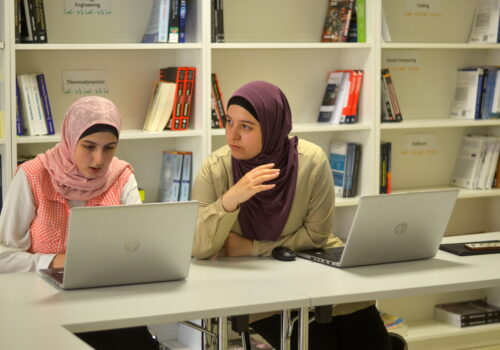
Image: Saudi students walk at the exhibition to guide job seekers at Glowork Women's Career Fair in Riyadh, Saudi Arabia October 2, 2018. REUTERS/Faisal Al Nasser