
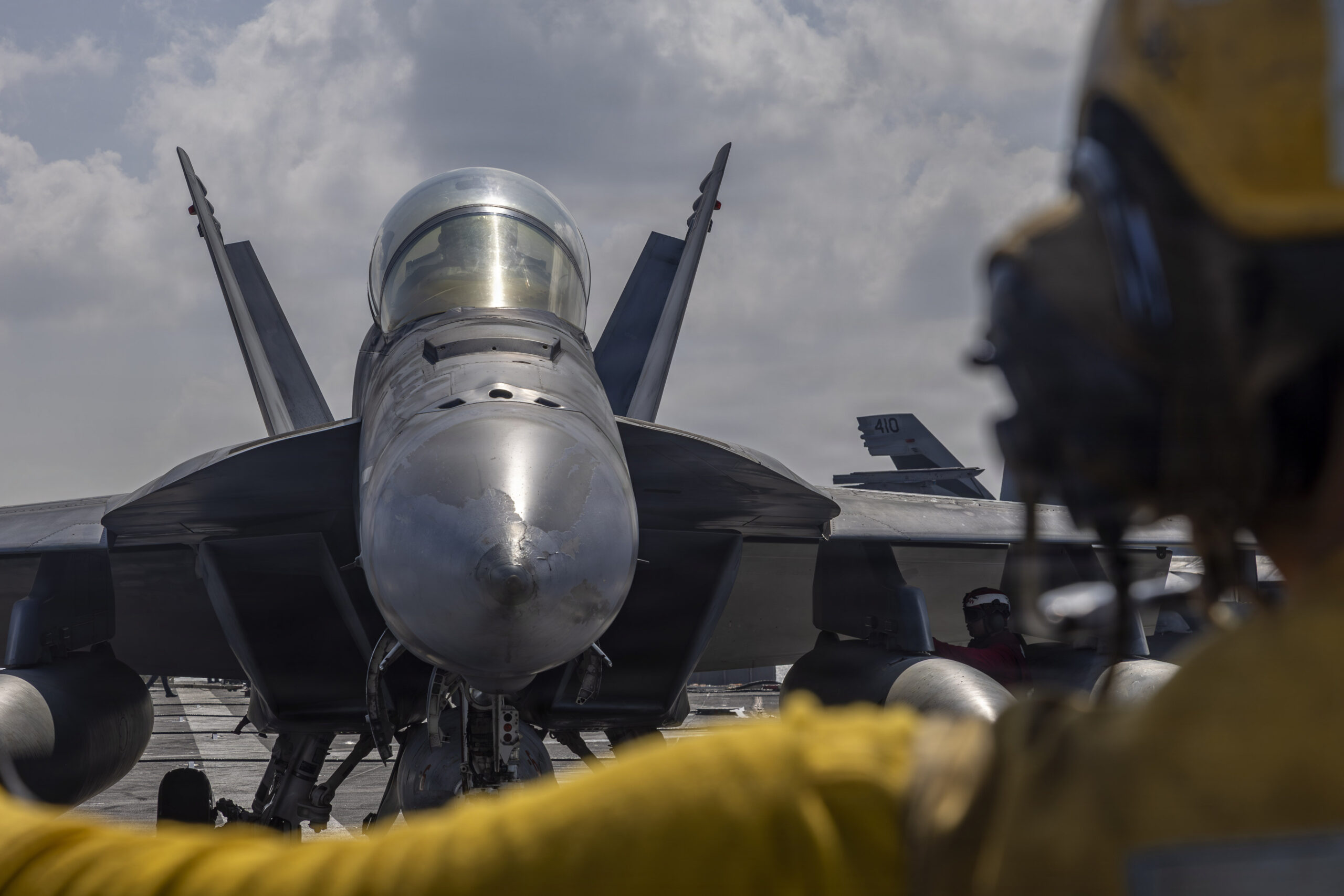
On Wednesday, US President Donald Trump posted on social media that a “massive” US armada led by the USS Abraham Lincoln was nearing Iran. “Like with Venezuela, it is, ready, willing, and able to rapidly fulfill its mission, with speed and violence, if necessary,” he wrote.
Jason Brodsky and Danny Citrinowicz have years of experience working on Iran and thoughtful but significantly different viewpoints. After they engaged in a fascinating back-and-forth on X, we asked if they would expand the conversation about the opportunities, uncertainties, and risks associated with a US military strike on Iran.
Click to jump to a question and answer:
1. What’s the most likely outcome if Trump acts on his pledge to protect the Iranian protesters?
2. How might regime change in Iran happen?
3. What happens if the Iranian regime hangs on?
4. What would you recommend to the US president?
1. What’s the most likely outcome if Trump acts on his pledge to protect the Iranian protesters?
Brodsky: I urge humility in predictions of what will ensue should Trump decide to militarily intervene in Iran following the protests. In the lead-up to the decision, I think the president is engaging in his usual approach of simultaneously issuing confrontational and conciliatory messages towards Tehran. This forms the basis of a psychological operation to confuse Iranian decision-making, and it feeds into the Islamic Republic’s impression of Trump as unpredictable. That has benefits, as it keeps US adversaries off base.
Nevertheless, the president has a documented record in his first term of such military interventions following human rights abuses among autocratic regimes in the Middle East. He authorized airstrikes against the Assad government in Syria after it used chemical weapons against its people in 2017 and 2018. Trump criticized his predecessor former President Barack Obama for setting a red line and then retreating from action in 2013. Therefore, I believe this, coupled with the Islamic Republic’s historic weakness and his very public messaging that help is on the way, will motivate the president to act. He favors quick, surgical, targeted, dramatic, and decisive military operations, and this will be his likely approach, potentially combining leadership decapitations with degradation of Iran’s military and security apparatuses.
Such a US military operation in Iran would be unprecedented. Thus, it is difficult to assess with great precision what might follow it in Iran. It depends on the extent of the US strikes. The Islamic Republic is bigger than Supreme Leader Ayatollah Ali Khamenei, and it has institutions, plans, and procedures to fill the void should he be eliminated. Nevertheless, Khamenei has personalized his power to a significant degree in Iran, and that, coupled with the longevity of his rule, could have short-term destabilizing impacts. It is true that observers also speculated whether the Islamic Republic would be able to survive following the death of Ruhollah Khomeini, Iran’s first supreme leader, in 1989, given the singularity of his leadership. Yet the system endured. But Khamenei’s leadership style is different from Khomeini’s era, especially in his centralization of power around him and his office.
Questions remain: If the US government decides to target Khamenei, does it also target his son Mojtaba Khamenei, who is a key lieutenant of his father and considered by some to be a potential successor? There are also clerics such as Alireza Arafi, Hashem Hosseini Bushehri, Mohsen Qomi, Mohsen Araki, Ahmad Khatami, Mohammad-Mehdi Mirbagheri, Mohammad-Reza Modarresi Yazdi, Hassan Rouhani, and Ali and Hassan Khomeini, who are potential contenders to replace Khamenei.
Does the Trump administration target other military and political personalities in Iran, such as members of the Supreme National Security Council (SNSC) and Defense Council? This would have the potential of being doubly destabilizing should Khamenei perish, as it is from this cohort that a constitutional interim leadership council is formed—the president, chief justice, and a member of the Guardian Council—if the Office of Supreme Leader is vacant. This could spark confusion and demoralization within the armed forces and security services as to the chain of command.
Citrinowicz: The latest wave of protests in Iran caught the United States by surprise, much as it did the rest of the world. Despite tough rhetoric from Washington, the reality is that the US government had no coherent plan for regime change in Tehran—and no meaningful operational capability to engineer political transformation inside a highly repressive, tightly controlled state.
Even now, it remains unclear how Trump intends to translate rhetorical support for Iranian protesters into effective policy. His statements and social media posts leave open two competing interpretations: that Washington seeks to leverage its substantial military presence in the Persian Gulf to pressure Iran on specific issues, such as its nuclear program and conventional military buildup, or that it harbors broader ambitions of undermining or even toppling the regime itself. The latter, however appealing rhetorically, is not grounded in strategic reality.
It is critical to recognize that US military action, limited or large-scale, is unlikely to catalyze mass political mobilization inside Iran. On the contrary, a strike would more likely consolidate elite cohesion around the regime, marginalize protesters, and reinforce Tehran’s long-standing narrative of external siege.
2. How might regime change in Iran happen?
Brodsky: Should there be a leadership void, there is the very distinct possibility of an Islamic Revolutionary Guard Corps (IRGC) takeover, anointing an IRGC commander such as the speaker of the parliament, Mohammad Bagher Ghalibaf, to assume power.
There are other potential scenarios, including a total collapse of the regime. Yet this would require mass defections within the armed forces and security services. Iran’s own history has a precedent, in February 1979, when Air Force commanders from the pre-revolutionary government pledged allegiance to Khomeini, in an episode called the Homafaran Allegiance.
Crown Prince Reza Pahlavi is relevant here. His name has been invoked during the protests—he is apparently the only specific opposition leader for whom Iranians have chanted. Iranians demonstrating view him as not only a symbol but also a potential transitional leader. This does not mean every Iranian protesting for the fall of the Islamic Republic wants a return to the monarchy per se. But it would be a mistake to dismiss him as he embodies an enduring nostalgia for the Pahlavi era among younger generations. These Iranians view the Islamic Republic as a historic mistake.
Citrinowicz: Iran lacks a credible, organized opposition capable of governing the country, even in the unlikely event of regime collapse. For Washington, regime failure without a viable successor would represent not a victory but a strategic liability.
At present, there is no credible alternative pathway to a stable and democratic Iran.
Any attempt by the United States to impose regime change by force, whether through the assassination of Khamenei or the dismantling of the regime would almost certainly produce catastrophic outcomes. The most likely scenarios would be a full takeover by the IRCG or a descent into civil war. Iran currently lacks a viable domestic opposition capable of governing the country. At the same time, the exiled opposition, including figures such as Pahlavi, remains fragmented, weak, and organizationally unprepared to assume power.
Consequently, externally imposed regime change would likely result in a more repressive and unstable Iran, not a democratic and prosperous one. A more realistic strategy is strategic patience: allowing internal dynamics to unfold in the post-Khamenei era while maintaining and improving the enforcement of crippling sanctions. Sanctions should not be lifted prematurely. They remain one of the few effective tools for pressuring the regime until it is either forced to reform or collapses under its own weight. At present, there is no credible alternative pathway to a stable and democratic Iran.
3. What happens if the Iranian regime hangs on?
Brodsky: The baseline for US policy moving forward should be that these protests have not stopped. They are merely paused because of severe repression. The drivers motivating Iranians seeking to oust the Islamic Republic have remained unchanged, and the grievances have only grown with time, with the system reaching a dead end and facing an economic crisis, a water crisis, an energy crisis, a deterrence crisis, and a crisis of confidence between state and society.
The Iranian system aspires for the United States and its allies to operate from the assumption that Tehran has the situation under control, there is nothing to see here, and the regime is going nowhere. But it would be misguided to center US policy on this regime-driven narrative.
Citrinowicz: Absent a fundamental change in Iranian regime policy, and despite its short-term success in suppressing recent protests, the Islamic Republic lacks the capacity to meet the basic economic and social needs of its population. As a result, regime change in Iran is highly likely in the long term, almost certainly following Khamenei’s death. The current system is not sustainable. This process may take months or even years, but as with the Soviet Union, continued stagnation without a dramatic ideological shift will eventually lead to collapse. Such a shift, however, is highly unlikely under Khamenei’s leadership.
This process may take weeks, months, or even years, but the outcome is inevitable. Iran is facing deep and persistent structural pressures: severe economic distress, deteriorating infrastructure, a collapsing energy sector, and recurring natural disasters. None of these challenges are temporary, and none are being meaningfully addressed.
While change is unlikely to be immediate, as long as the regime refuses to alter its policies and international economic and diplomatic pressure remains in place, its prospects will continue to deteriorate. Deeper ties with China, Russia, or the BRICS group cannot offset the impact of sanctions or structural mismanagement. Without sanctions relief, Iran’s economic situation will not improve, and renewed domestic unrest or internal change is only a matter of time.
4. What would you recommend to the US president?
Brodsky: The Trump administration should adopt a whole-of-government approach aimed at weakening the Iranian regime, using diplomatic, economic, military, kinetic, cyber, and covert tools.
First, the US government should freeze all diplomacy with the Islamic Republic. If the United States were to agree to a nuclear deal with Tehran now, the Iranians protesting would view it as an external US intervention to bolster the Islamic Republic when they want it gone. It would be seen as a betrayal. The Iranian protesters largely view the regime as irredeemable and incapable of reform.
Diplomacy between the United States and Iran since 1979 has repeatedly failed because of the ideological nature of the Islamic Republic, whose leadership has no interest in a rapprochement with the US government. It is also highly unlikely the current system of power in Iran will agree to the far-reaching concessions the Trump administration is demanding, as historically the existence of protests have not moderated Iranian negotiating positions.
The Iranian regime aspires to entrap the United States in a negotiating process because the process itself offers protection—in bolstering the currency and thwarting US military action—even without a deal. Iranian diplomats get something for just showing up. Whereas the US government would not.
Right now, unarmed Iranians are facing off against a highly armed state apparatus. That power differential should be reduced.
In addition to putting diplomacy on ice, the Trump administration should work with its allies and partners to more fully isolate the Islamic Republic diplomatically. They should seek to bar its representatives from leadership roles in international organizations, downgrade diplomatic ties with Tehran, especially in Europe, and work to deport regime-linked individuals residing in the West and freeze their assets to the extent permitted by law. In doing so, the US government can form an Iranian Elites, Oligarchs, and Proxies Task Force (IEPO), modeled after what it constructed with respect to Russia after it invaded Ukraine in 2022.
Second, the United States should continue levying economic sanctions against the Iranian regime—especially implementing the MAHSA Act to sanction the supreme leader personally for human rights abuses. Such designations deprive the Iranian regime of revenue, and the economic tailspin Tehran is facing is proof that US sanctions are eroding the power of the Islamic Republic. The Trump administration should proceed with this sanctions pressure for as long as this system endures. Designations of Iran’s supreme leader would also send an important symbolic signal to the Iranian people that the US government hears their calls and views Khamenei as an illegitimate leader.
Third, the US Justice Department and its partners around the world should seek to criminally indict Iran’s supreme leader and members of the Supreme National Security Council (SNSC). Khamenei reportedly issued an order to the SNSC to “crush the protests by any means necessary” and to show “no mercy,” according to The New York Times. Such steps implicate these officials in crimes against humanity. Khamenei and the SNSC members should also be made to face additional legal exposure for their roles in approving assassination and terrorism operations throughout the West spanning years.
Fourth, the Trump administration should pursue targeted military action against Iran’s regime. The goal here would be to hold it accountable for its abuses of the Iranian people, deter the regime from further aggression, erode its ability to retaliate and repress its people, and provide the time, space, and resources to even the playing field for the Iranian people to reclaim their country. Right now, unarmed Iranians are facing off against a highly armed state apparatus. That power differential should be reduced. Along with such operations, the Trump administration and its allies should deploy their formidable cyber and covert capabilities to assist in this effort.
If the regime limps along after such military operations, the US government should maintain pressure on the system—especially using economic pressure and diplomatic isolation—to ensure that Iranians are one day able to fulfill their national aspirations. The goal here is to give Iranians the time, space, and opportunity to take their country back from the Islamic Republic.
Citrinowicz: The dilemma facing US policymakers is stark. Military action carries a high risk of regional escalation, threatens US partners and assets in the Gulf, and could draw the United States into yet another prolonged Middle Eastern conflict. Such an outcome runs counter both to American public fatigue with endless wars and to Trump’s own preference for short, decisive engagements with clear endpoints.
As a result, the most effective tools available to Washington remain economic and diplomatic pressure. Sanctions, international isolation, and sustained constraints on Iran’s access to global markets do not guarantee political change, but they do force the regime toward a strategic crossroads: either moderate its behavior and make limited concessions to reduce pressure, or maintain ideological rigidity at the cost of a deepening economic crisis and the long-term erosion of domestic legitimacy.
From a US standpoint, encouraging political change from within the existing system is far preferable to attempting to impose regime change from without, the latter a goal that is costly, unpredictable, and historically fraught. Even if Trump ultimately opts for military action, US interests would be best served by a symbolic, tightly calibrated strike, one aimed at preserving deterrence while enabling a controlled de-escalation and maintaining broader pressure on Tehran.
Ultimately, the challenge for the United States is not to overthrow the Iranian regime, but to manage a long-term confrontation in a way that constrains Iran’s ambitions, protects US interests, and leaves the burden of internal political change where it belongs: with Iranian society and Iran’s own political system.
US demands should focus narrowly on constraining Iran’s military and nuclear capacity.
The US administration should leverage its significant military presence in the Gulf to strengthen the enforcement of sanctions on Tehran, with a particular focus on preventing Iranian oil exports to China. The sanctions regime should be preserved and tightened wherever possible, until the Iranian regime demonstrates a genuine willingness to make the necessary concessions.
In any renewed engagement with Iran, Washington should reassert clear and non-negotiable demands: a complete abandonment of Iran’s enrichment capabilities, including the removal of all enriched material, alongside meaningful restrictions on its missile program. At the same time, it would be counterproductive to condition diplomacy on Iran’s stance toward Israel or the Abraham Accords. Introducing such demands would likely foreclose the possibility of a diplomatic breakthrough that, under certain circumstances, could help prevent escalation.
