

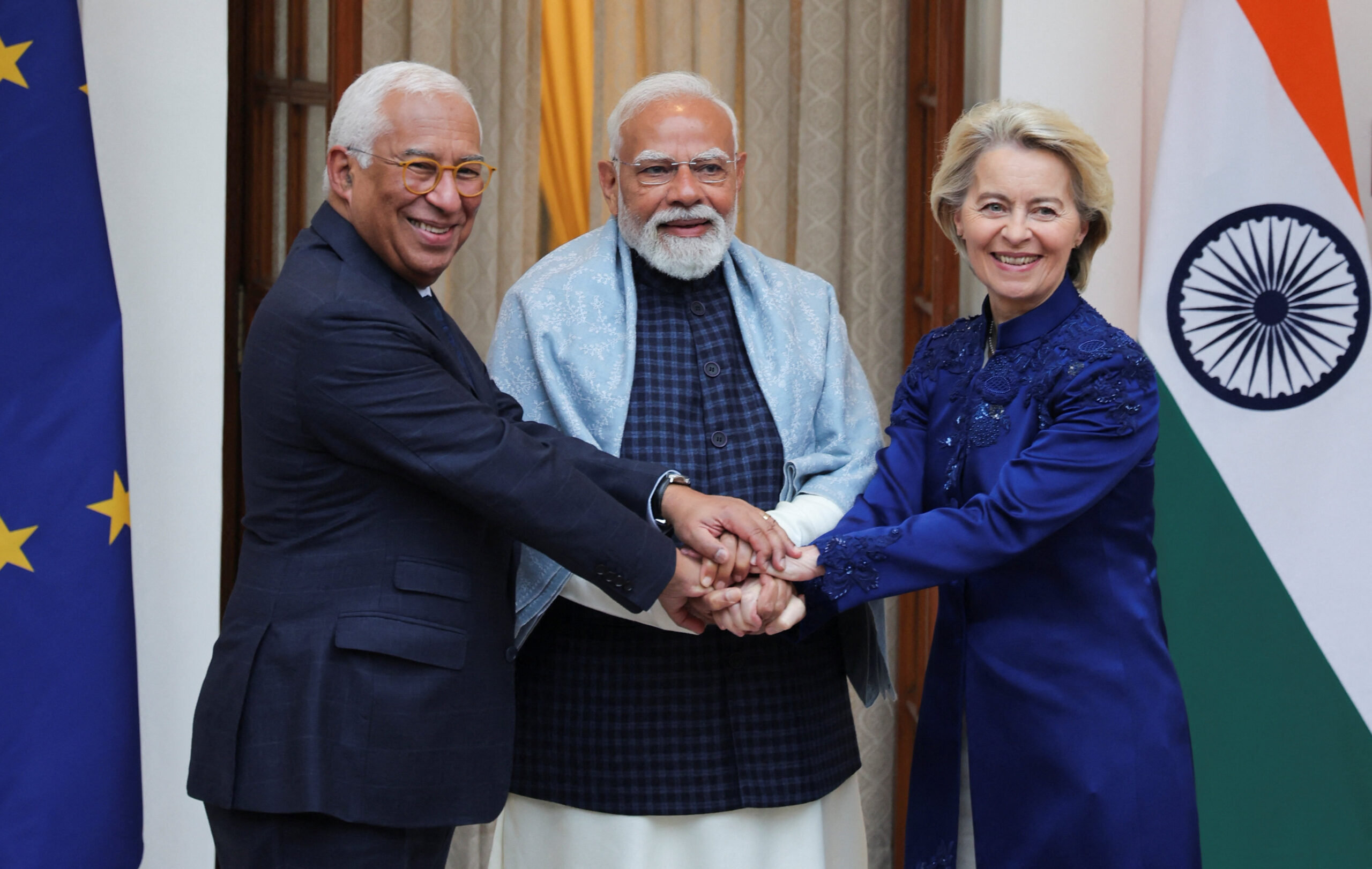
Indian Prime Minister Narendra Modi and European Commission President Ursula von der Leyen have both dubbed their new trade agreement as “the mother of all deals.” Whatever you want to call it, it is one of the most dramatic markers yet of how the global system is reorganizing itself in the time of Trump.
For decades, Brussels and New Delhi circled each other with caution—too many regulatory barriers, too much agricultural protection, and too little urgency held them apart. What brought down the obstacles, a senior Indian official told me as their negotiations advanced, was above all US President Donald Trump and the upset on both sides about his tariffs.
“The EU-India trade deal is part of the European Commission’s diversification strategy, which is a direct response to increasing pressures from the United States and China on the global trading system,” writes Jörn Fleck, senior director of the Atlantic Council’s Europe Center, in a smart roundup of expert reaction.
Michael Kugelman, senior fellow for South Asia at the Atlantic Council, adds, “With all the strain and uncertainty that characterize India’s ties with Washington, the EU is a logical space to embrace.” Kugelman points to shared EU-Indian interests, including the need to counterbalance China, and the fact that France and Germany are already among India’s leading trade partners.
The deal—covering trade, investment, digital rules, supply chains, climate standards, and technology—also reflects a shared EU-India conclusion: the United States may still be an indispensable economic and political partner for both of them, but it has at the same time become an increasingly unpredictable one. Both sides, for now, have given up on the notion that Washington can anchor the global trading system. It was time to look hard for alternatives.
Together, the EU and India are building something that looks less like old globalization and more like what comes next: large, values-adjacent economies knitting themselves together to hedge against volatility from all sides—China’s product-dumping scale, the United States’ tariff-tinged uncertainties, and, from Europe’s side, Russia’s geopolitical volatility.
What makes this moment an inflection point is that the gravitational center of global trade architecture, once greatly determined by the United States and its democratic allies, is shifting, but where it lands is uncertain. Today, the United States talks more about deal leverage than global leadership. Europe and India are adapting, having learned that excessive dependence invites risk and diversification breeds resilience.
The Atlantic Council’s Mark Linscott, who served as assistant US trade representative for South and Central Asian Affairs, scoffs at talk about the “mother of all trade deals” as hyperbolic. “The results are incomplete and will require follow-up action,” he writes, noting that both sides set aside the most complicated issues to close the deal in time for von der Leyen’s visit on India’s Republic Day this week. His analysis is worth reading.
Still, concludes Linscott, “When two of the biggest economies of the world agree to eliminate a significant proportion of their trade barriers . . . governments and stakeholders around the world should take notice.”
No one should take more notice than Trump, whose tariffs on Europe and India without any doubt have been the accelerator for this deal. It’s time to start tallying up the unintended consequences of Trump’s trade policies, and whether the result will be more or less American influence and revenues globally.
Frederick Kempe is president and chief executive officer of the Atlantic Council. You can follow him on X @FredKempe.
This edition is part of Frederick Kempe’s Inflection Points newsletter, a column of dispatches from a world in transition. To receive this newsletter throughout the week, sign up here.