WASHINGTON—Two deadlines in the first week of February—the end of US temporary protected status (TPS) for Haiti and the expiration of the mandate for Haiti’s Transitional Presidential Council (TPC)—threaten to intersect in ways that could further destabilize Haiti and the broader region.
Since the assassination of President Jovenel Moïse in July 2021, Haiti has found itself mired in turmoil. The government is largely nonfunctional, the economy is effectively paralyzed, basic services are collapsing, and gangs now control nearly 90 percent of the capital, Port-au-Prince. More than 1.4 million people are internally displaced, according to the United Nations International Organization for Migration, while close to two million are facing acute food insecurity. The result, United Nations (UN) Secretary-General António Guterres warned the Security Council this past August, is “a perfect storm of suffering.”
Haiti’s slow decline isn’t occurring in isolation. For the United States, a top destination for Haitians, the country’s continued deterioration is not a distant tragedy but a policy challenge with profound consequences. For the Trump administration, which has reasserted the importance of the Western Hemisphere in its strategy documents and actions, this is an opportunity to continue those efforts. To prevent Haiti’s further collapse, the Trump administration should focus on leveraging pre-existing, common-sense policies to stabilize the country in the short term and build state capacity to lay the groundwork for its longer-term recovery. The result would be a safer, more stable Haiti—and a safer, more secure Western Hemisphere.
TPS expires . . .
The primary US policy tool—and the more immediate deadline—is TPS, a bipartisan humanitarian protection program that allows migrants from countries deemed unsafe to live and work in the United States for a temporary but extendable period. Haiti was first designated for TPS just days after a catastrophic earthquake struck the country in January 2010, and it has since remained eligible amid worsening political and security crises. As of March 2025, 330,735 Haitian nationals living in the United States had TPS, according to US Citizenship and Immigration Services. The US-based diaspora sends billions of dollars home each year in remittances, an economic lifeline for Haitians facing economic deprivation.
Barring further extensions, which are not expected at this point, TPS for Haiti is set to expire on February 3. After that date, Haitians in the United States will need to have another lawful status to remain in the country or risk deportation, even though crisis conditions persist in Haiti.
. . . and so does the TPC’s mandate
Just days after TPS ends, Haiti faces an internal deadline that reveals another layer of dysfunction: governance.
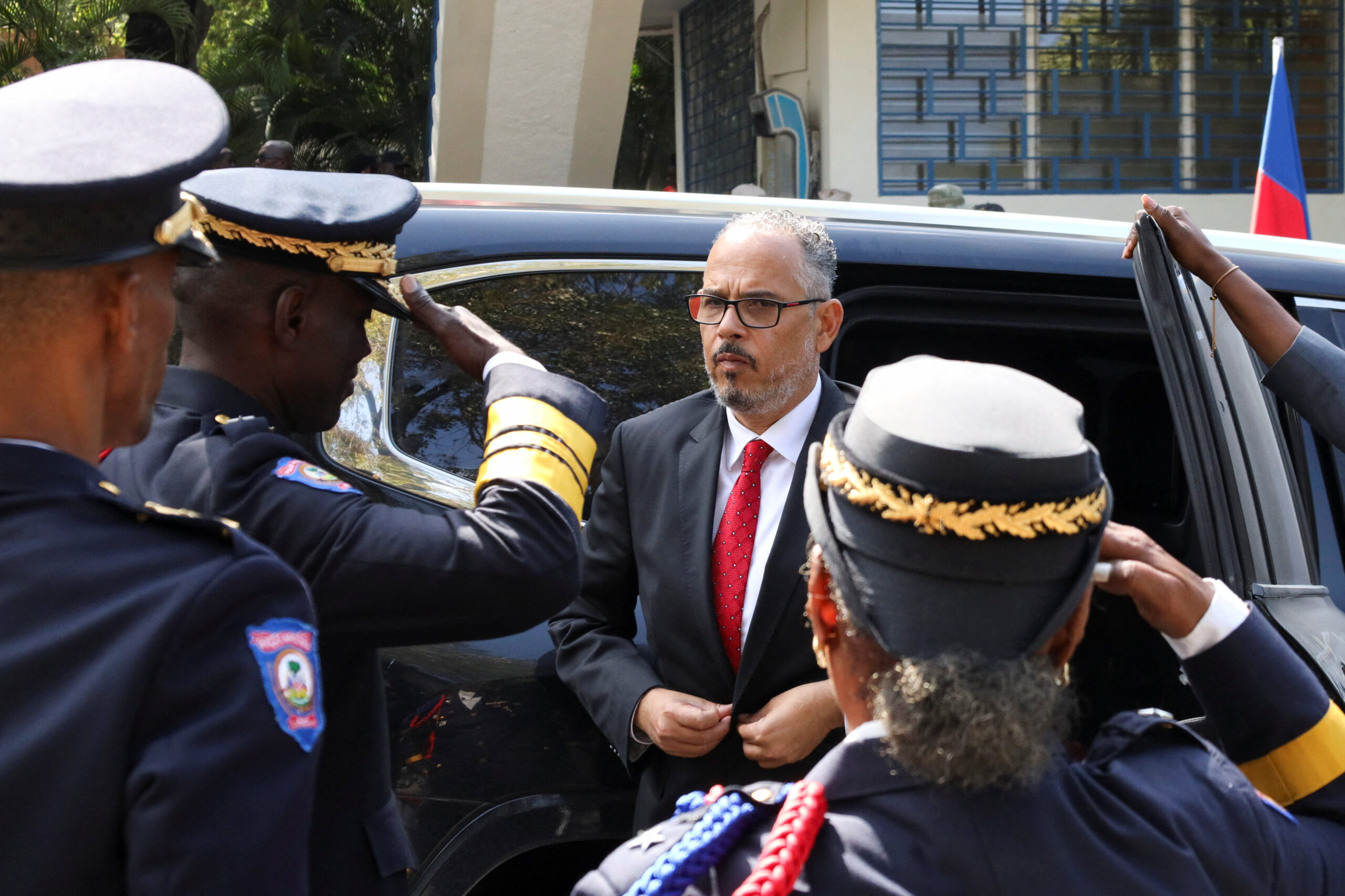
This year marks the country’s fifth without a president, its tenth without holding presidential elections, and its third without a single democratically elected official in power. On February 7, the TPC—the nine-member interim body currently running the Haitian government—will reach the end of its mandate.
Since 2024, the TPC’s principal duty has been to create the conditions needed to hold free and fair elections by the time their term expired. Despite undertaking several notable efforts, the TPC stated that the country’s unfettered security situation rendered elections “materially impossible” by the February deadline. The first round of elections is now set for August 2026, though experts warn the timeline will be difficult to meet absent meaningful security gains.
As the clock winds down on the TPC’s mandate, some members have launched a last-ditch effort to remove the sitting prime minister, Alix Didier Fils-Aimé. Appointed by the TPC and viewed as Washington’s preferred pick to run the government after February 7, Fils-Aimé has become the target of members’ efforts to maintain influence beyond the transition window. In response, US Secretary of State Marco Rubio called Fils-Aimé to offer support and restricted the visas of multiple members of the TPC.
There is little consensus on what will replace the TPC when its term inevitably ends. Will there be a power vacuum, and if so, will gangs fill it? Fils-Aimé has ruled out negotiations with powerful gangs regarding Haiti’s political future. This lack of clarity risks undermining legitimacy and further weakening the state’s capacity to combat the security crisis.
Consequences of these looming deadlines
While the expiration of both TPS and Haiti’s interim government in the same week is coincidental, the possible consequences of each could exacerbate Haiti’s internal crisis and expand the risks it poses to regional security.
In this context, the Trump administration’s decision not to renew TPS for Haiti risks accelerating the country’s decline and backfiring by fueling additional migration. In the absence of a stable government in place to manage returns, large-scale deportations to an already fragile country—even though the Department of Homeland Security (DHS) has deemed it “safe” enough for return—could deepen internal displacement and drive more irregular migration, including to the Dominican Republic and the United States.
Early signs of this strain are already visible on the ground. With Toussaint Louverture Airport in Port-au-Prince closed for more than a year due to gang violence, US deportation flights have arrived in Cap-Haitien, a comparatively stable northern city already strained by internal displacement and limited municipal services. Cap-Haitien is also home to Haiti’s vital textile sector, which the US Congress recently voted to continue supporting through reauthorization of the HOPE and HELP Acts. Any large-scale increase in deportations could further overwhelm local capacity, risking the destabilization of one of the country’s most stable regions.
And the repercussions of these deadlines would extend beyond increased migration. According to the Organized Crime Index, Haiti’s porous borders and weak enforcement mechanisms have enabled transnational criminal networks to thrive, engaging in drug and weapons smuggling that is likely to continue. As of May 2025, two Haitian gangs—the powerful Viv Ansanm coalition and the Gran Grif gang—have been designated as foreign terrorist organizations by the US government, underscoring the security threat that they pose.
What Washington can do
Haiti’s overlapping crises are multi-pronged and deeply rooted, and no single policy measure will remedy years of state collapse. Amid renewed discussions of the Monroe Doctrine, past US involvement in Haiti—from the 1915 occupation to later interventions in the 1990s and 2000s—can rightly be critiqued for contributing to the erosion of Haitian institutions. Despite these challenges, it remains in the United States’ best interest to help restore a measure of stability in Haiti.
Redesignating Haiti for TPS would help advance the administration’s broader goal of ensuring the Western Hemisphere “remains reasonably stable and well-governed enough” to prevent mass migration to US borders. Extending TPS would provide humanitarian protection and create economic opportunity for Haitians while also giving Haitian authorities time to rebuild governing capacity after the TPC’s mandate expires. However, the Trump administration is unlikely to pursue this option.
But the administration has options to improve state capacity beyond immigration policy.
One is the UN-authorized Gang Suppression Force (GSF), which has received US support in its aim to both suppress violence and pave the path for eventual elections. Although intended to improve previous models, critics warn that the GSF, which is expected to reach full strength by summer, is still unlikely to produce meaningful results.
The GSF illustrates a long-recurring pattern in Haiti policy, in which external actors construct parallel structures separate from Haitian institutions to address short-term challenges, only to leave little to no state capacity once funding or political support inevitably dissipates. Rather than repeating this pattern, a comprehensive vision for US-backed security policy should explicitly prioritize training and supporting Haitian forces—whether that be the Haitian National Police or a revitalized national military—so that security gains can endure long after international forces depart.
The same logic should guide US thinking on a democratic transition. While holding elections is politically necessary and could help re-establish the rule of law, conditions on the ground mean a vote is currently infeasible and could result in a worse outcome than the status quo.
To ensure elections are the result of stability rather than a substitute for it, the United States should prioritize institution-building approaches such as the Global Fragility Act (GFA), which was signed into law by US President Donald Trump in 2019 and implemented under the Biden administration. Although the GFA has since lapsed (and Haiti is no longer listed as a target country), a similar whole-of-government approach would align US diplomatic, security, and development tools around bolstering Haiti’s resilient civil society and the preliminary work done by the TPC. The framework for this involvement already provides a clear roadmap—now it is up to lawmakers and policymakers to follow it.
Critics of US involvement in Haiti often argue that the country is beyond repair. Yet, if the United States wants to send Haitian temporary residents home and build a more prosperous Western Hemisphere, it should support positive change rather than compound Haiti’s crises.