
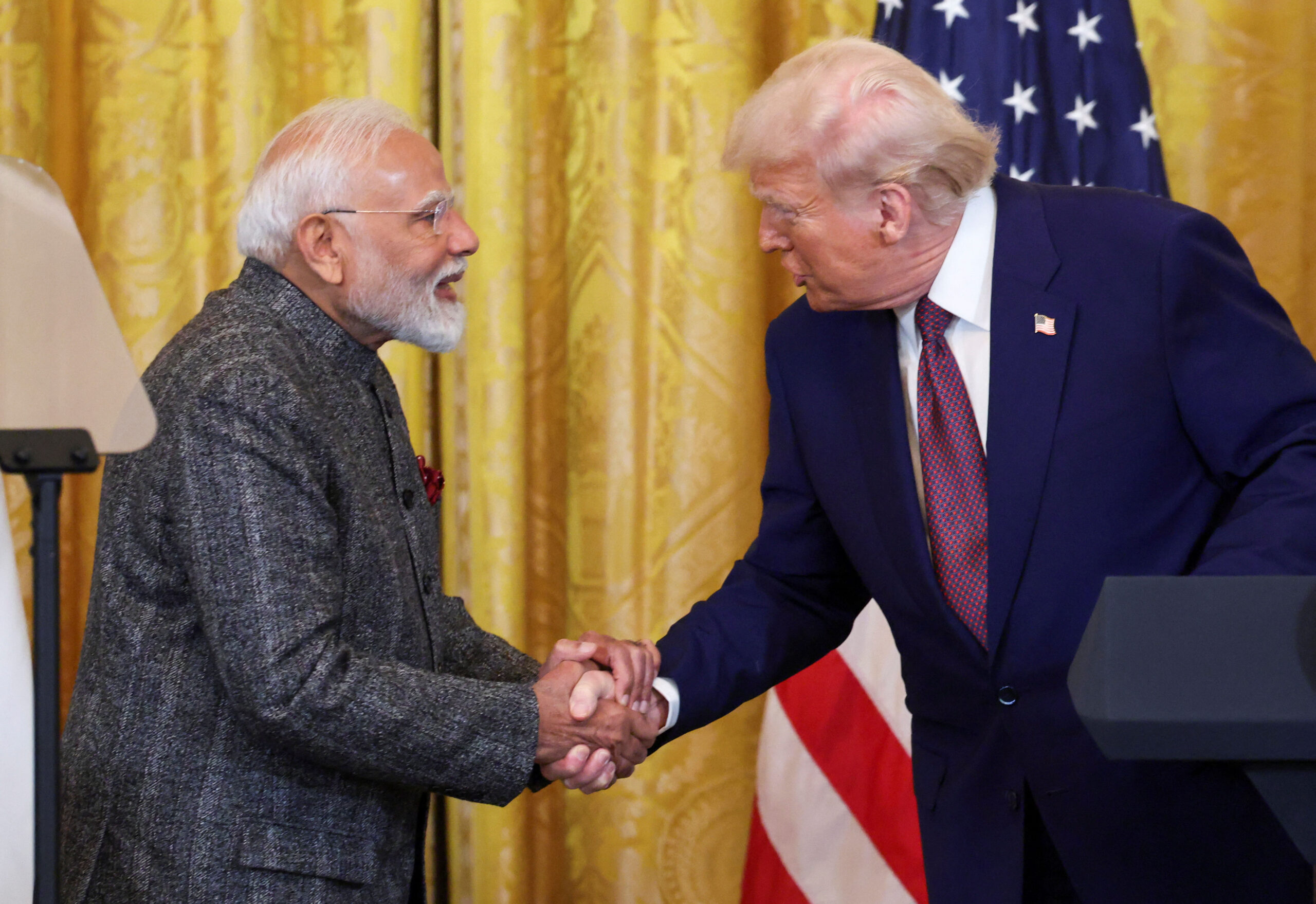
“Our amazing relationship with India will be even stronger going forward.” On Monday, US President Donald Trump announced that he and Indian Prime Minister Narendra Modi agreed to a trade deal that would significantly lower US tariffs on India. The agreement comes after several months of heavy US tariffs on India amid stalled trade negotiations that strained the two countries’ ties. The announcement raised several burning questions. Our experts provide their answers below.
1. What exactly did the two countries agree to?
Kugelman: In the absence of a formal statement, we don’t yet know exactly what they agreed to. Trump claimed that India has agreed to stop buying Russian oil and to purchase $500 billion worth of US goods—both of which seem hard to believe—while Modi has said only that tariffs will be coming down. What counts the most is that a 50 percent US tariff on India—one of the highest rates slapped on any country—will come down to 18 percent. That’s a major achievement.
Linscott: From the social media posts of both leaders, it appears they have reached agreement on the first phase of a more comprehensive bilateral trade agreement. That’s been expected and hoped for by many stakeholders since July or so, but the relationship took a very unfortunate negative turn over India’s Russian oil purchases.
2. What does this announcement signal about the US-India relationship?
Linscott: This announcement is quite important, as it can defuse the tension on the trade front that’s upended other parts of the relationship. Most immediately, it provides an opportunity for India to see the rate of US tariffs levied against it drop from 50 percent to 18 percent and for the United States to gain unprecedented market access in India. But the devil is in the details, and we have no text to review yet. My guess is that we’ll see a joint statement soon, followed by a legally binding agreement in the coming weeks. We may not see any fall in tariffs until then.
Kugelman: US-India ties have floundered for much of the past year. This trade deal is just what the doctor ordered: It’s a confidence-building measure that can help the two sides work through their various issues—including all the trust that the Trump administration has squandered in New Delhi in recent months.
3. What impact will this have on the countries’ economies?
Kugelman: The United States is one of India’s top export markets. India has come up with various workarounds to cushion the blow of 50 percent US tariffs, from allowing more commercial cooperation with China to concluding a massive new free trade agreement with the European Union, another top export market. But it’s hard to compensate for the loss of US markets. That’s another reason why this accord is so crucial.
Linscott: It likely will have no immediate impact until it is fully implemented, which could be some weeks off. When fully implemented, this deal can stabilize the trade relationship and then allow it to grow at an accelerated rate compared to the status quo ex ante.
4. Will India stop buying Russian oil?
Kugelman: For economic, diplomatic, and strategic reasons, India is highly unlikely to stop buying cheap oil from Russia, one of its closest partners. But it has reduced its imports of Russian oil since new US sanctions on Russia were implemented in November. That, coupled with a recent India-US natural gas deal and India’s increasing oil imports from the United States, likely addressed US concerns and helped the two sides get to the finish line.
Linscott: I think that if we see any backsliding in the downward trend in India’s Russian oil purchases, the 50 percent tariff will remain in place or will be reinstated. I doubt there will be any sudden shutting down of India’s purchases of Russian oil, but expectations are high that they will continue to fall, and even quickly so.
5. Where should we expect trade relations to go from here?
Linscott: This is the key question, and it’s hard to answer without the release of an agreed text. Most immediately, I hope to see implementation of this deal. But beyond that, the two sides should be entering into the next phase of negotiations and taking up a broader set of issues. We should see results on economic security, technical barriers to trade, sanitary and phytosanitary measures, digital trade, intellectual property rights, and a whole host of other issues down the road. In the next phase, the negotiations will cover areas that are typically included in a free trade agreement, such as the one concluded last week between India and the European Union.