
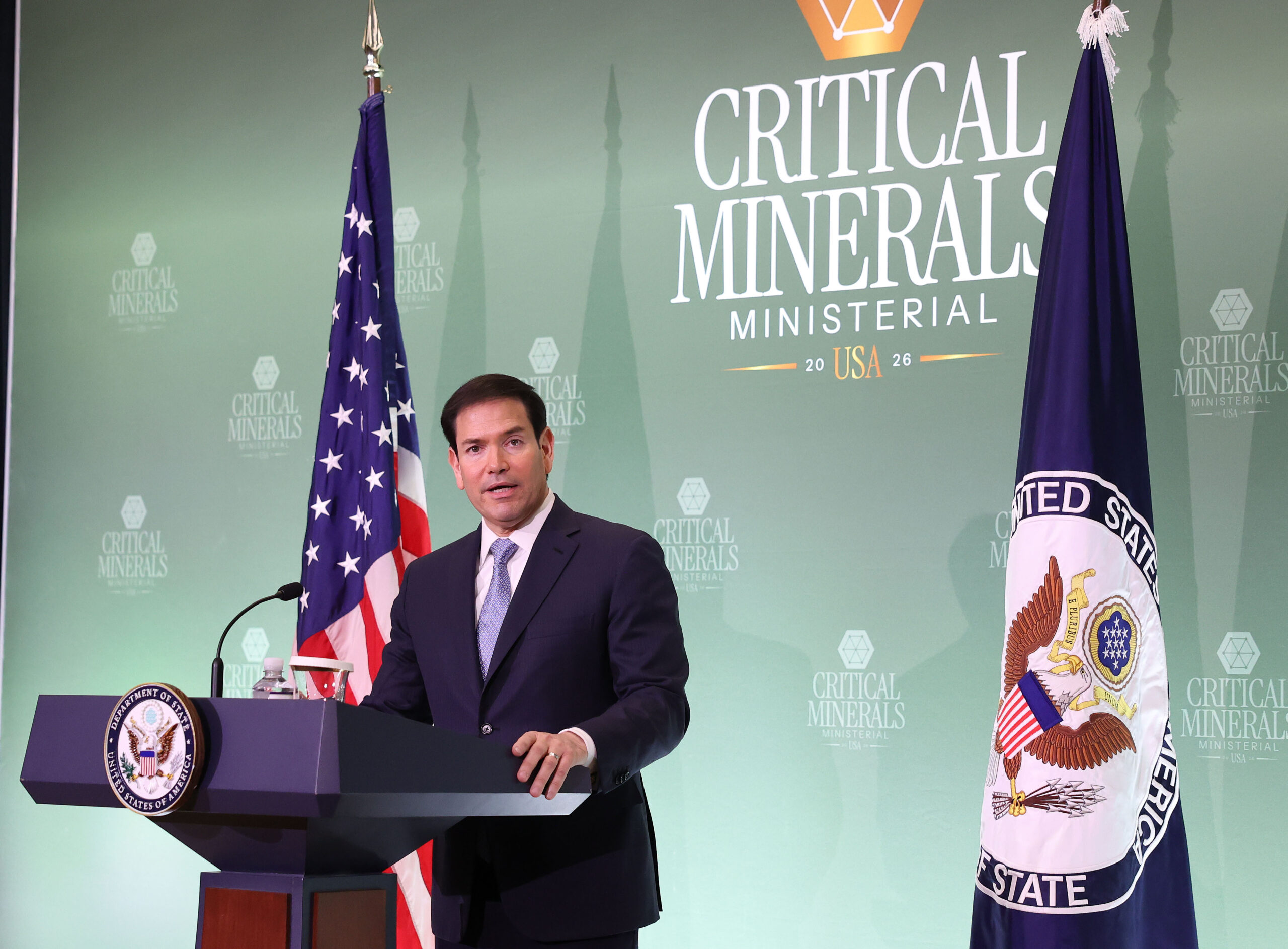
WASHINGTON—The Forum on Resource Geostrategic Engagement (FORGE), announced last week at the inaugural Critical Minerals Ministerial in Washington, DC, marked the opening salvo of the Trump administration’s 2026 critical minerals agenda. Coming on the heels of a frenetic year of executive actions, bilateral dealmaking, and the launch of the twelve-billion-dollar Project Vault stockpiling initiative, FORGE is the Trump administration’s clearest attempt yet to translate its sizeable ambitions around critical minerals into a functional architecture.
At its core, FORGE reflects a belief that the hardest challenges in the minerals markets are better addressed with partners. Collaboration is slower and harder but ultimately more durable and impactful. By attempting to align trade policy, price signals, and market access across partner economies, FORGE aims to elevate cooperation itself as a strategic asset that could reshape minerals markets in a way no country—not even the United States—could achieve on its own. Though operational details and membership are still being clarified, the opening of a plurilateral pathway represents a marked shift for 2026.
Bilateralism meets plurilateralism
The Trump administration has positioned FORGE as a successor to the Minerals Security Partnership, launched in 2022, but with sharper teeth and a commitment to speed. FORGE is not envisioned as a traditional multilateral coordination forum. Instead, it’s designed as a plurilateral coalition, creating a preferential trade-and-investment zone for critical minerals with coordinated price floors to counter adversarial market manipulation.
At the ministerial, US Vice President JD Vance described “reference prices for critical minerals at each stage of production,” maintained through “adjustable tariffs to uphold pricing integrity.” The objective of this approach is to create stable investment conditions for mining and processing projects that often require decades to deliver returns. If successful, it will help protect projects from the predatory pricing that hollowed out Western critical minerals production in previous decades.
Exactly which countries will ultimately participate in FORGE remains unclear. Still, the ministerial produced eleven new bilateral framework agreements—with Argentina, Morocco, Peru, the Philippines, the United Arab Emirates, and the United Kingdom, among others—bringing the total to twenty-one deals in five months. US officials claim seventeen more countries have completed negotiations. Beyond several memoranda of understanding (MOUs), the Trump administration unveiled more operational commitments, including a sixty-day action plan with Mexico and a joint commitment with the European Union and Japan to develop coordinated trade policies (such as border-adjusted price floors) and identify priority investment opportunities.
That’s impressive dealmaking velocity, but framework agreements are not operational mines. Each bilateral deal requires different concessions, obligations, and political risks. The administration hopes FORGE, chaired by South Korea through June, will link these disparate agreements into a functioning plurilateral system covering two-thirds of the global economy. That’s a much harder proposition than signing MOUs—but it also could permanently transform the critical minerals landscape.
The overarching question is whether a network built on bilateral leverage can be transformed into genuine plurilateral coordination. There are reasons for optimism. The Minerals Security Partnership’s struggles with similar challenges counsel caution, but the administration’s willingness to back frameworks with capital and concrete mechanisms may give FORGE more bite than its predecessor.
The power of price coordination
In January, Reuters reported that the United States is “moving away” from price floors on critical minerals, leading to panicked discourse among industry stakeholders and volatility in the market. The ministerial clarified the administration’s actual position: Coordinating price supports with partners through both bilateral deals and the FORGE network remains a top priority. The shift is not away from private interventions but toward internationalizing them, moving the burden away from solely resting on US taxpayers and restructuring price supports as a coordinated action among like-minded countries. This approach is arguably more effective given the scale of the challenge: A distributed burden is more sustainable, and coordinated intervention could be effective enough to deter Chinese market manipulation.
FORGE appears to be the forum through which the administration intends to pursue this coordination. Following last year’s Commerce Department 232 investigation into the national security implications of critical mineral imports, the White House concluded that supply chain vulnerabilities pose national security threats but that bilateral dealmaking and possible price interventions remain more effective than tariffs for addressing them—at least for now. The ministerial operationalized that conclusion and revealed an administration attempting something ambitious: practicing statecraft through markets rather than around them.
The challenges lie in the details. Prices vary by mineral, production stage, jurisdiction, and market conditions. Coordinating reference prices that function as effective floors without creating perverse incentives requires sophisticated policy design and sustained diplomatic consensus. The United States and its allies have spent months negotiating on this front, and operational details remain sparse.
Deploying capital and making deals
The meeting last week also highlighted just how much capital the administration is prepared to mobilize in service of supply-chain security. In its post-ministerial fact sheet, the State Department cited more than thirty billion dollars in letters of interest, investments, loans, and support mobilized by the US government over six months. Just days before the ministerial, Project Vault secured ten billion dollars from the Export-Import Bank (more than double the bank’s largest previous financing) plus two billion dollars in private capital.
Beyond government-to-government frameworks, the administration continues to facilitate business-to-business deals. This reflects a broader pattern: the administration positioning itself as dealmaker and convener, connecting companies with partners, projects with financing, and supply with demand across its bilateral network.
This approach raises an unresolved question for FORGE. While explicitly positioned as a successor to the Minerals Security Partnership, it remains unclear whether FORGE will take on a comparable role in catalyzing pooled investment or dealmaking, which was the primary focus of the Minerals Security Partnership and its associated public-private network, MINVEST. Instead, FORGE appears more likely to operate on a “membership by trade” model, in which participation is conditioned on adherence to shared trade rules rather than joint capital deployment. Under this approach, investment would remain largely bilateral, but within a plurilateral market framework designed to reinforce and de-risk those investments. This could allow the administration to shape outcomes across multiple supply chains without the institutional complexity of pooled financing. Whether that trade-led model proves sufficient or whether pooled investment coordination becomes a necessary next step remains an open question.
Digging deeper
The gathering in Washington last week succeeded in establishing an institutional architecture through FORGE, rapidly expanding the network of bilateral deals, and demonstrating a willingness to deploy capital through tools such as Project Vault. It also revealed a fundamental tension: the administration is moving fast, but minerals projects move slowly.
