

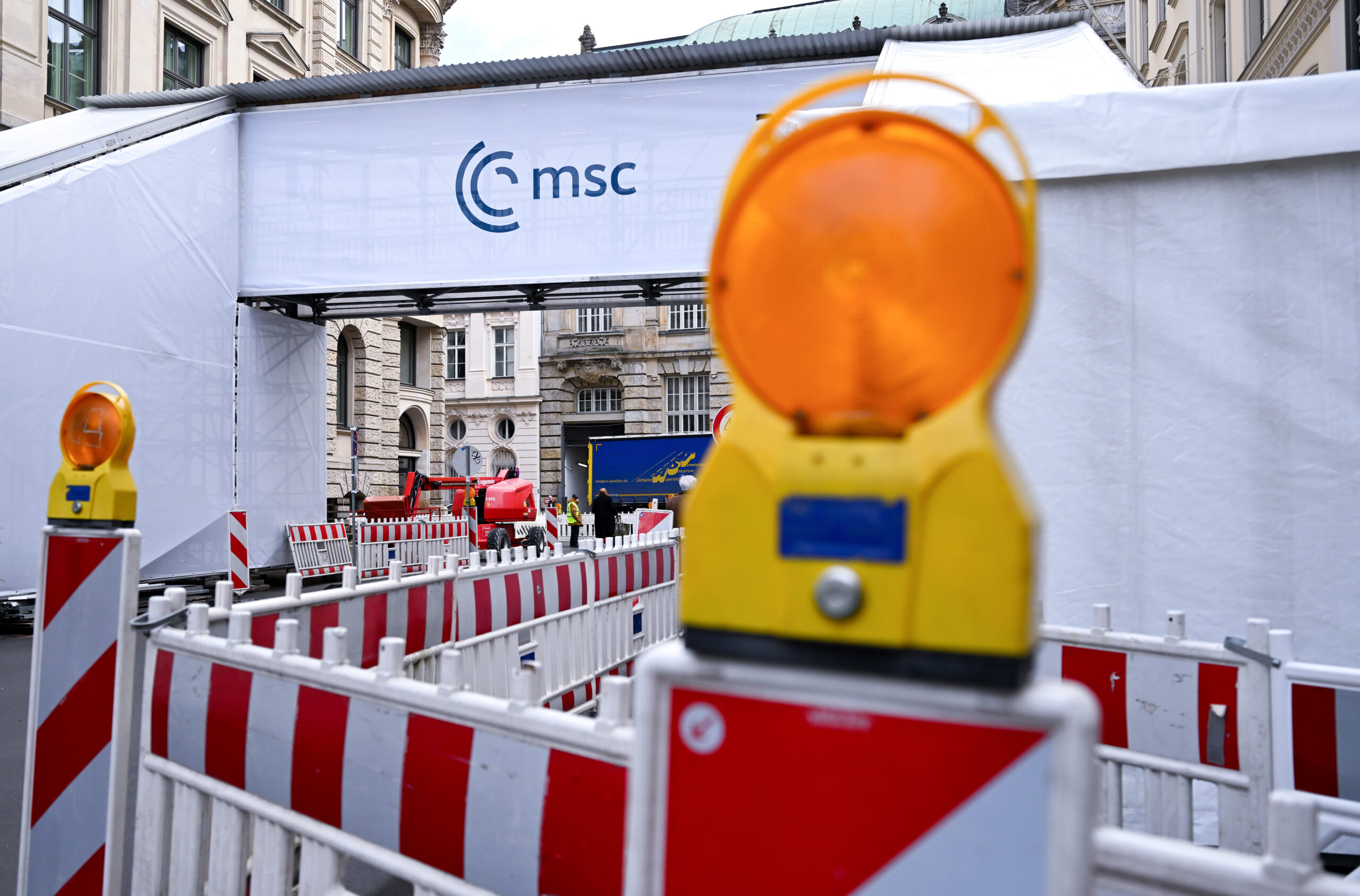
MUNICH—Close your eyes and shut out the cacophony—from Trumpian rostrums against Europe to agitated social media clamor opposing the US president—and there’s much more to like about the current world than conventional wisdom would suggest as leaders arrive here for the Munich Security Conference (MSC).
The MSC, arguably the most significant annual transatlantic security gathering, itself contributed to the unsettling noise in its conference-opening report, titled “Under Destruction,” setting the stage for one of the most crucial convenings in its sixty-three-year history.
“The world has entered a period of wrecking-ball politics,” the report explains. “Sweeping destruction—rather than careful reforms and policy corrections—is the order of the day. The most prominent of those who promise to free their country from the existing order’s constraints and rebuild a stronger, more prosperous nation is the current US administration. As a result, more than 80 years after construction began, the US-led post-1945 international order is now under destruction.”
Benedikt Franke, the MSC CEO, tells me, “The transatlantic relationship is in serious trouble. It seems there is insufficient awareness in certain political circles in the US of just how much trust was destroyed and how deep the rift runs.”
“Yes,” Franke continues, “Europeans can distinguish between the Trump administration and the rest of the US. But they are increasingly disappointed by the lack of pushback in the US. We watch with morbid fascination how the land of the free is deconstructing itself and what it has represented for 250 years.”
Getting oriented ahead of Munich
With all that as context, it’s worth taking a deep breath to separate hyperbole from reality. To do so, I recommend reflecting on the good, the bad, and the dangerous as transatlantic and global leaders converge on Munich—with some thoughts on how everyone could come out stronger. First, it’s useful to start with what good the Trumpian disruptive pressures and actions have produced.
After years of underinvestment and political neglect, US allies in Europe are finally spending more on defense capabilities and readiness, training together more frequently, and stepping up more seriously to their security responsibilities in the fourth year of a murderous Russian war on Ukraine—amid growing hybrid threats to Europe. NATO Secretary General Mark Rutte has generated controversy by telling his fellow Europeans that without Trump none of that would have happened—but he’s dead right.
Second, economic challenges from both China and the United States have shaken Europe into a greater recognition of—if not yet adequate action to resolve—their insufficient technological innovation and business entrepreneurship, their counterproductive overregulation, and their inadequate steps toward creating a true union for capital markets, defense, and foreign policy.
Third, look to the Middle East, where the chances have rarely been better for lasting regional peace and prosperity, and for greater economic and security integration. The region’s spoiler, Iran, has seldom been weaker. Its defensive and offensive capabilities are down, its nuclear capabilities are seriously damaged, its proxies are decapitated, its economy is battered, and its internal opposition is boiling. Those are all good things.
And despite all the talk of geopolitical risk, global equity benchmarks ended 2025 near their strongest annual performance in years, with European shares and the Dow Jones Industrial Average hitting new records this year.
That’s the good side. Now the bad.
What has eroded is confidence in the United States. Confidence in US intentions, reliability, and predictability hit new lows recently when President Donald Trump threatened to take Greenland by whatever means necessary, holding out the possibility of new tariffs on any European country that stood in his way. Allies don’t question US power and influence, but they increasingly ask whether Washington is on their side or whether it is more likely to weaponize its economic might against them when it is seen to serve US interests.
From the standpoint of Europeans, Trump’s second term has transformed transatlantic politics from a shared enterprise into a rolling negotiation, where commitments feel provisional, support for Ukraine comes with growing price tags, and transactions have replaced assurances. When French President Emmanuel Macron, European Commission President Ursula von der Leyen, and former Italian Prime Minister Mario Draghi all speak in one way or another about a ruptured relationship, they are coming to terms with a fundamentally changed world where an overregulated, disunified Europe with insufficient defense capabilities is in immediate peril of falling prey to the more avaricious Americans and Chinese. As Macron put it this week, “We have the Chinese tsunami on the trade front, and we have minute-by-minute instability on the American side. These two crises amount to a profound shock, a rupture for Europeans.”
That is the bad. There’s also the dangerous, not just for Europeans, but for Americans and freedom-loving peoples everywhere.
The greatest risk in Munich is not that the United States will formally abandon its European or Asian allies, which remains unlikely. The danger is that persistent ambiguity and eroding confidence becomes the norm, a situation adversaries are already exploiting. Russia continues to hammer away at Ukraine with impunity. Russian President Vladimir Putin sees that the Trump administration hesitates to condemn and punish Russian aggression. Observing that, Chinese President Xi Jinping may well decide that his country’s best chance to make a move on Taiwan is with Trump in office.
The larger question at the conference
Franke tells me that organizing this year’s Munich conference has been an exercise in maximum uncertainty and constant change. “We are used to moving targets and the occasional drama,” he said, “but this was the norm this time, rather than the exception. This seems to fit with our report [‘Under Destruction’], which laments the return of wrecking-ball politics.”
Wolfgang Ischinger, long-time chair of the MSC and a lifetime Atlantic Council board member, diagnosed the situation bluntly ahead of this year’s gathering: “transatlantic relations are, in my view, in a considerable crisis of trust and credibility.”
When allies cannot depend on one another’s intentions or actions, some dangerous dynamics emerge. Some European countries are already beginning to hedge against contingencies that assume US support in the event of an attack might arrive late, conditionally, diluted, or not at all. Such hedging weakens deterrence.
At the same time, Russia and China are incentivized to probe cracks and seams in Alliance solidarity, testing how far they can push before a unified response materializes. Russia is doing this every day in Ukraine, and every day it learns more about how far it can go before the United States responds alongside its allies to fully back Ukraine.
In Munich this week, the uncomfortable question is not whether NATO can still deter Russian aggression or whether Europe will really lift its defense spending to its new targets. These are crucial issues, but they are tactical. The larger question is strategic: Can the Alliance, nearing its eightieth anniversary, maintain the predictability that deterrence requires in an age of volatility and transactional politics? If the answer is no, then the Alliance could still appear to hold together—with all its exercises, committees, and flags—but it will steadily hollow out.
Two post-Munich possibilities
I come to Munich worried. Europe’s hyperbolic response to Trump could miss a golden opportunity—the possibility of a fortified and fundamentally improved Europe shaping the next iteration of the international order alongside its ally of the past eighty years, the United States, which doesn’t want to destroy the order that it created so much as remake it at less cost to itself and with more responsibilities laid upon its allies. To its credit, the MSC report also points to that possibility, invoking comparisons to the post–World War II age that Dean Acheson, former US secretary of state and one of the Atlantic Council’s founders, captured in his memoir Present at the Creation.
The MSC report notes, “A lifetime later, Acheson’s contemporary successor, Marco Rubio, invoked this language during his confirmation hearings, arguing the United States was ‘once again called to create a free world out of the chaos,’ because the existing order had ceased to serve US interests and was being exploited by others.”
With all this as context, Franke sums up the challenge: “The key questions we seek to answer this weekend are: Is the global order we have grown used to beyond repair? Are we seeing the end of progress or what [Joseph] Schumpeter has called ‘creative destruction,’ a painful process leading to something better in the end? Or are we seeing destructive creation, where something is built up which leads to the end of everything else?”
It’s hard to imagine a more significant inflection point than one that decides between those two very real possibilities. The stakes have seldom, if ever, been so large as the curtain rises on this year’s MSC.
Frederick Kempe is president and chief executive officer of the Atlantic Council. You can follow him on X @FredKempe.
This edition is part of Frederick Kempe’s Inflection Points newsletter, a column of dispatches from a world in transition. To receive this newsletter throughout the week, sign up here.