The possibility of a military confrontation between Washington and Tehran is on hold, at least for now, as the two countries have begun talks mediated by Oman. However, a strategic breakthrough from these talks—which according to US President Donald Trump should be resolved in the coming month—remains unlikely without substantial concessions by at least one party on topics previously considered out of the scope of negotiations. Iran maintains that its ballistic missile program and the support it provides its regional proxy network are non-negotiable—precisely the areas where the Trump administration demands drastic concessions.
That means diplomacy could stall or break down completely. So what will Trump, who has been steadily building up military forces in the region, do then?
There are two primary pathways he could take for a military strike. The first is a limited coercive strike—i.e. against Islamic Revolutionary Guard Corps and Basij militia compounds—aimed at fulfilling Trump’s red line about killing protesters and forcing Iran back to negotiations from a weaker position. However, such a strike would probably have a limited effect on the regime’s calculus and would not guarantee a manageable military confrontation, as Iran has stated that it is preparing to carry out retaliatory measures following any strike.
The second option would be a larger campaign aimed at achieving fundamental changes in the current regime’s calculus—such as accepting strict limitations on its ballistic missiles and proxies’ activity—or even bringing about regime change. For this scenario to be successful, the United States will need to present a credible threat to the current regime’s survival. This requires a sustained, well-coordinated military campaign supported by regional allies, forcing the regime to choose between “drinking the chalice of poison” for survival or facing a conflict that threatens its very existence.
The pursuit of regime change carries significant risks, including the potential for internal fragmentation into armed factions or even full-scale civil war. Nevertheless, the benefits of fundamentally changing—or even eliminating—the Islamic Republic could outweigh the risks if the alternative is an emboldened, undeterred Iran.
Here are six strategic reasons why a decisive military campaign is the right move:
- A unique moment to reshape the Middle East: Iran is at its weakest point since the 1979 revolution after recent protests, June’s twelve-day war with Israel, and the drastic degradation of its terror network. The Iranian defense doctrine—comprised of a nuclear program, conventional power, and regional proxy network—failed to deter Israel and the United States from striking it, effectively exposing the regime as a paper tiger. A decisive campaign against the regime could be the key to advancing US regional efforts that seem stuck at the moment, from regional integration through the Abraham Accords, to bringing Iranian-backed countries like Lebanon and Iraq closer to Western influence.
- The moral imperative: Current diplomatic efforts prioritize the nuclear issue while overlooking the regime’s brutal crackdown on protesters, which brought the current tensions to a boiling point in the first place. Reports coming out of Iran are heartbreaking. While official figures claim “only” 3,117 people killed, some estimates are far higher, ranging from over 6,000 to over 30,000 people killed in two days. Trump’s promise to “come to [the] rescue” of the Iranian people shouldn’t be a lip service, but rather a testament to the United States’ moral leadership. Negotiating is a prize to this regime, as talks could provide it with a much-needed lifeline in sanctions easing and improving its domestic and international legitimacy.
- The credibility dilemma: Opting against military force may avoid immediate conflict but risks comparisons to then US President Barack Obama’s “red line” in Syria. In 2013, Obama failed to respond militarily after the Assad regime used chemical weapons on its people, which the president had described as a “red line.” If Trump does not respond in this case, it could signal to Tehran that the Washington will blink under pressure as long as Iran remains resolved in its resistance.
- The economic stakes for the United States—and China: A different Iranian regime could reintegrate its massive energy reserves—the world’s second-largest gas and third-largest oil deposits—into Western markets. This aligns with the administration’s view of expending US access to energy resources as a key component in its foreign policy. The combination of ousting Nicolás Maduro in Venezuela and a regime change in Iran could severely disrupt China’s energy security, as Beijing relied on both countries for as much as 30 percent of its oil imports due to their discounted prices. Complicating China’s economic calculus and shifting its focus could promote other US efforts vis-à-vis China, such as preventing full-scale conflict in the Taiwan Strait.
- Skin in the game for the United States in Iran’s future: Internal systemic failures brought about by the regime—namely hyperinflation, water scarcity, and widespread corruption—along with recent demonstrations suggest the regime is in a state of terminal decline. However, waiting patiently for the regime to collapse while watching from the sidelines isn’t a sustainable strategy to promote US regional interests. Instead, a hands-on approach utilizing military force could allow the United States to actively navigate the situation, ensuring a favorable post-regime landscape while denying Russia and China the opportunity to exploit a power vacuum in Iran. This is not to say that the United States will necessarily need an ongoing presence with boots on the ground like in Iraq, but rather it should economically and diplomatically support opposition groups that could post an alternative to the current regime, backing them in their efforts to bring about positive change to the country.
- The ongoing threat of Iran’s nuclear program: While June’s US strikes on Iranian nuclear facilities were essential to stall an immediate Iranian breakthrough toward obtaining a nuclear weapon, they likely only rolled Iran’s efforts back by a few months. Iran has already stated it will continue its nuclear program, and its recent work to fortify underground facilities signals its refusal to abandon its nuclear ambitions. The current lack of monitoring by the International Atomic Energy Agency could allow the regime to utilize enrichment as a dual-purpose tool: either overtly, to secure diplomatic leverage and deter US military action, or covertly, as an “insurance policy” for regime survival. Trump has consistently affirmed that he will not allow Iran to obtain nuclear weapons, and he should act on those words.
Pursuing negotiations at this juncture risks providing the regime with a vital political and economic lifeline at the very moment it is at its most vulnerable. The gap between Washington’s and Tehran’s core positions necessitates the use of force to restore US deterrent credibility and force Iran to make drastic changes or risk the regime’s survival. In the current landscape, a decisive US-led coalition effort aimed at regime change may offer a more sustainable strategic outcome than a protracted diplomatic process that could end with a bad agreement and an emboldened Iran.
Michael Rozenblat is a visiting research fellow at the Atlantic Council’s Middle East programs, from the Israeli security establishment. The views in this article are the author’s own and do not necessarily reflect those of any other entity.
Related Reading
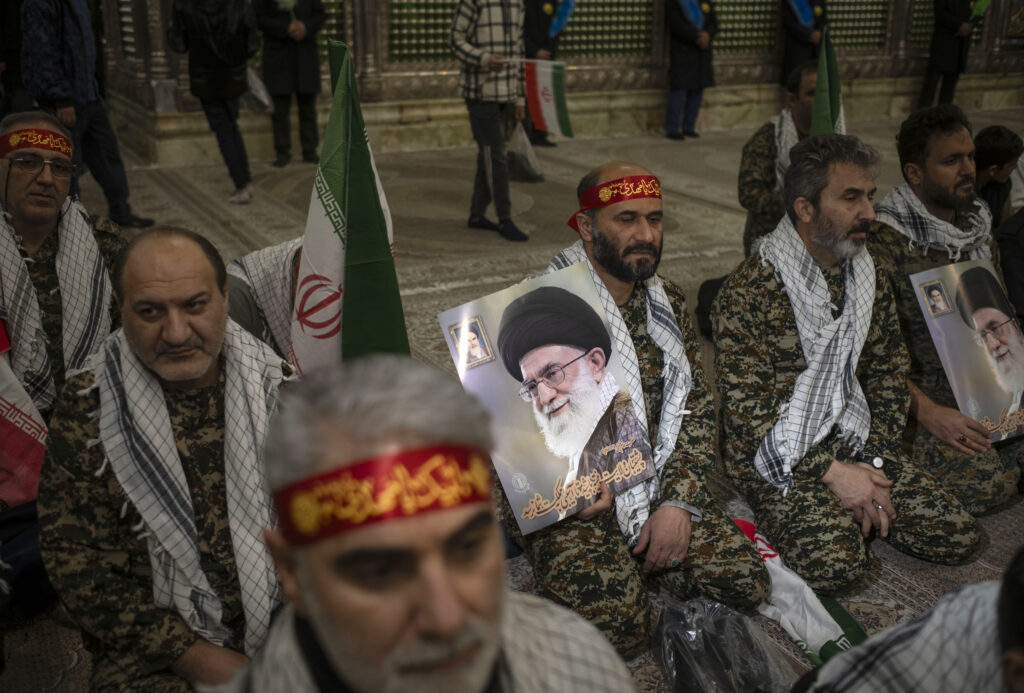
Image: Two uniformed members of the Iranian Basij paramilitary forces hold portraits of Iran's Supreme Leader Ayatollah Ali Khamenei during a ceremony marking the 47th anniversary of the victory of Iran's Islamic Revolution at the shrine of Ayatollah Ruhollah Khomeini in the Behesht-e Zahra cemetery in southern Tehran, Iran, on February 1, 2026, (Photo by Morteza Nikoubazl/NurPhoto)