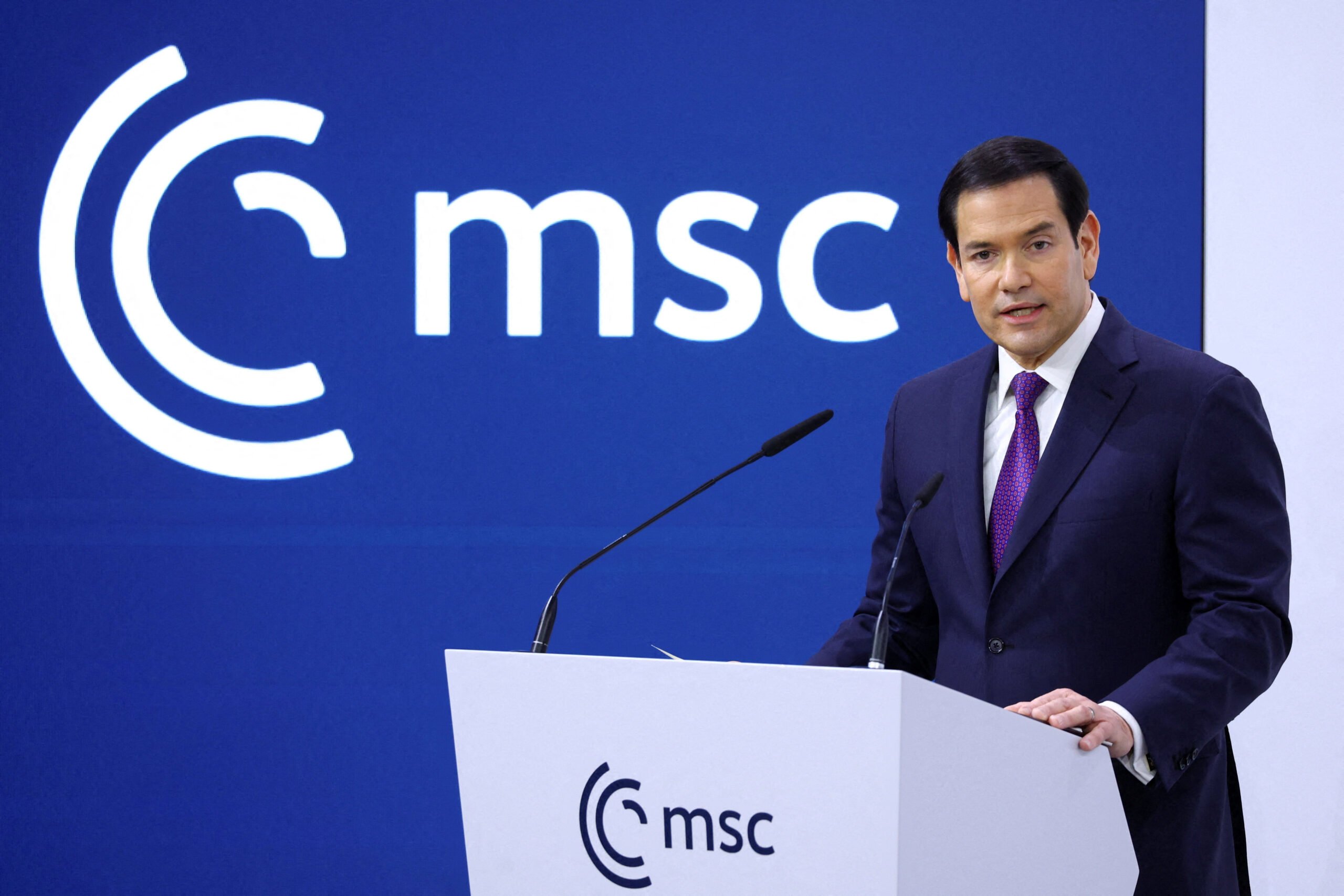
What Rubio said in Munich, what Europe heard, and what comes next
JUST IN
“Both our histories and our fates will always be linked.” On Saturday, US Secretary of State Marco Rubio delivered a notably positive message to allies at the Munich Security Conference (MSC), just a month after a transatlantic showdown over US President Donald Trump’s aims over Greenland and with many European leaders speaking more openly about a deteriorating alliance. Below, our experts, several of whom are working the halls at the MSC, look at what was said, what was heard, and what to expect next.
TODAY’S EXPERT REACTION BROUGHT TO YOU BY
- Matthew Kroenig (@MatthewKroenig): Vice president and senior director of the Scowcroft Center for Strategy and Security
- Daniel Fried (@AmbDanFried): Weiser Family distinguished fellow and former US assistant secretary of state for Europe
- Philippe Dickinson (@PhilGDickinson): Deputy director with the Transatlantic Security Initiative and a former career diplomat with the United Kingdom’s Foreign, Commonwealth, and Development Office
- Tressa Guenov: Director for programs and operations and senior fellow at the Scowcroft Center for Strategy and Security, and former US principal deputy assistant secretary of defense for international security affairs
What Rubio said
- Rubio “gave a great speech that was well received,” Matt tells us from Munich, where Rubio earned a standing ovation. The US secretary of state “did not repudiate anything in Vice President JD Vance’s more pugnacious speech last year, but he presented the same themes in a more positive light, focusing on shared challenges facing both Europe and the United States and how allies can work together to address them.”
- The MSC addresses by Vance and Rubio, Dan argues, display different impulses in the Trump administration: One is “to pick new fights or engage in unresolvable culture wars,” and the other is to “take the win” when it has won the larger argument, in this case on Europe needing to do more.
- Dan welcomes Rubio’s positive “free world” message that called for the reform, not the destruction, of institutions such as NATO. However, he adds, “Rubio could have been more explicit in identifying the free world’s adversaries Russia and China. There could have been more than a passing reference to Russia’s war against Ukraine.”
- “The substantive focus was on addressing the excesses of globalization,” says Matt. Rubio “argued that it was ‘foolish’ to offshore manufacturing, allow mass migration, become economically entangled with dangerous allies, and wish away the importance of national identities.”
Sign up to receive rapid insight in your inbox from Atlantic Council experts on global events as they unfold.
What Europe heard
- Before Rubio’s speech, “European leaders were dialing the geopolitical anxiety up to eleven,” Phil reports from Munich, where Europeans were talking about destruction, disorder, and the world order as we know it being “over.” Lingering tension over the recent Greenland episode was readily apparent in conversations on Friday, he adds.
- “Secretary Rubio’s speech in Munich cooled down the transatlantic temperature for now,” Tressa tells us from Munich. “But beneath the political churn and damaged transatlantic trust, there is a clear recognition in Munich that mutual security and defense industrial capacity questions simply need to be solved—and soon.”
- Dan notes that the Trump administration’s message to Europe was not only coming from Rubio: US Under Secretary of War for Policy Elbridge Colby “gave a similarly constructive speech” to NATO defense ministers earlier in the week, “in which he outlined terms for a renewed transatlantic alliance,” including a strengthened Europe and continued US commitment to NATO.
- Dan advises Europeans to take the opportunity that Rubio’s and Colby’s speeches provide to work with the administration to reform NATO. His message to skeptics: “Nothing is written. Work the problem. There is a potential path ahead to a better Alliance.”
What comes next
- “Europe’s fundamental mission now is to be credibly prepared to prevail in a protracted conflict should one ever come to pass,” Tressa says. “Europe must overcome endemic political fragmentation in order to boost its defense industry” and improve deterrence “at the NATO and national levels.”
- To be sure, Phil says, calls for Europe to “step up” will require “many years of steady, diligent work.” But, he adds, “The more encouraging message from Munich is that, away from the main stage, that work is underway,” as officials “are not paralyzed by fatalism.”
- “We want allies who can defend themselves so that no adversary will ever be tempted to test our collective strength,” Rubio said in his speech. “Deep down,” says Phil, “even the most alarmist Europeans know that they cannot afford to write off the United States as a partner, and that Europe being compelled to take a strategic grip of its own destiny will, in the long run, be a good thing.”
Further reading
Thu, Feb 12, 2026
Dispatch from Munich: Present at the destruction or the creation?
Inflection Points By Frederick Kempe
This year’s Munich Security Conference presents the transatlantic Alliance with two very different paths ahead.

Wed, Jan 21, 2026
By taking a win on Greenland, Trump set US and allied security in the Arctic on a better path
Dispatches By Daniel Fried
At the World Economic Forum in Davos, Switzerland, the US president pledged not to use force to take Greenland and rescinded planned tariffs against several European allies.
Thu, Jan 22, 2026
Trump may move on from Greenland. Europe won’t.
Dispatches By Jörn Fleck, James Batchik
Trump’s willingness to engage in brinkmanship with Europe over Greenland will have a lasting impact on how the continent’s leaders approach relations with Washington.
Image: US Secretary of State Marco Rubio speaks during the Munich Security Conference in Munich, Germany, on February 14, 2026. (REUTERS/Thilo Schmuelgen)