
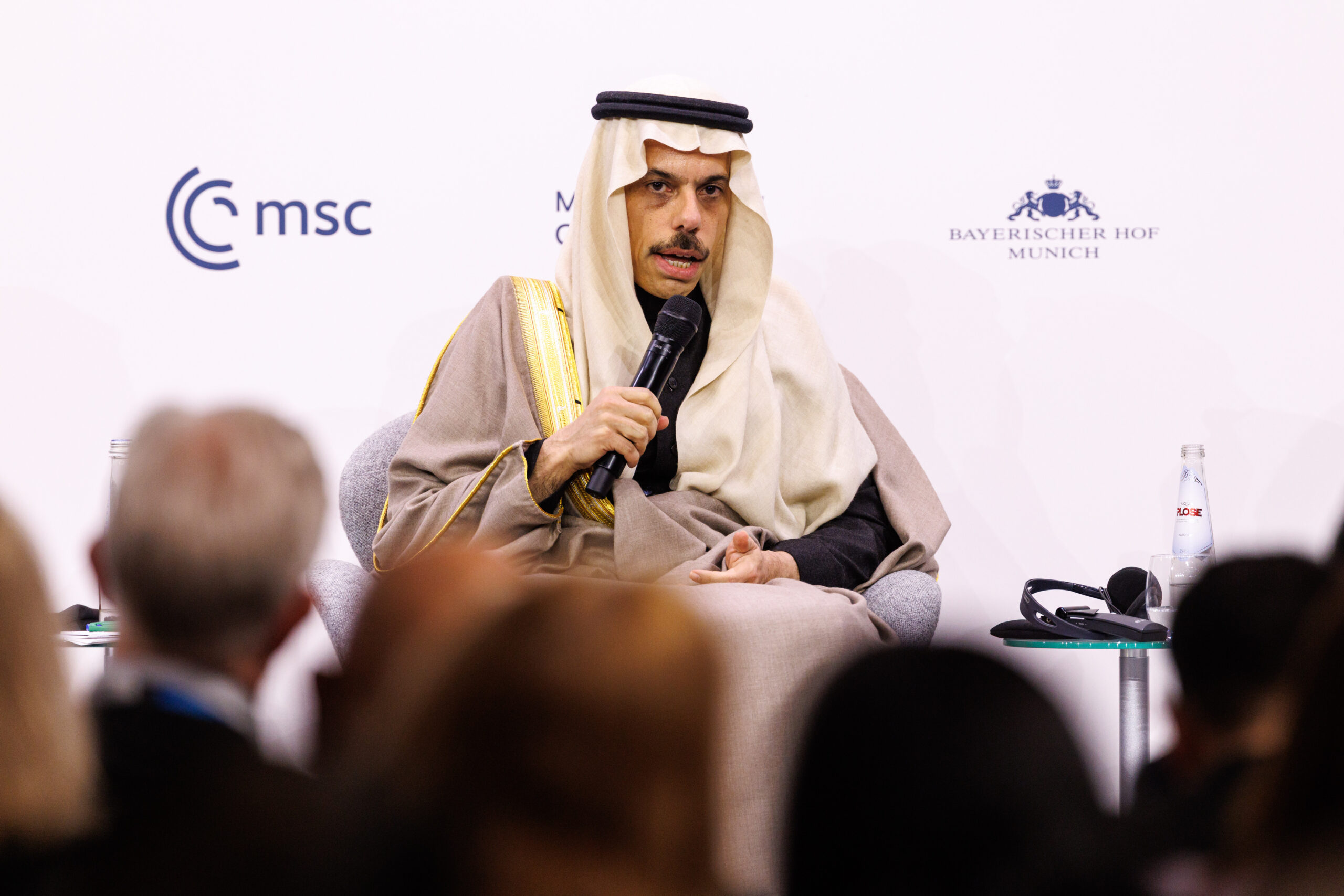
MUNICH—The spotlight at the Munich Security Conference (MSC) was fixed on the US-European relationship, but that was not the only issue discussed among the many leaders and policymakers who traveled to the Bavarian capital over the weekend. In fact, that the Middle East was not in the MSC’s limelight made it a unique platform for quiet but meaningful dialogue on the prospects for strengthening political and economic integration in the region. And at a time when Middle East integration is facing real challenges, the European setting provided a compelling reminder of how an ambitious integration agenda allowed Europe to escape centuries of conflict following World War II.
For these reasons, the Atlantic Council convened a private dialogue with senior officials from several Middle Eastern countries on the sidelines of the Munich Security Conference to discuss the best path forward for regional integration. In this and other engagements, it was clear that policymakers need to adapt the way they talk about Middle East integration in 2026 to respond to the turmoil the region has experienced in the past few years. At the same time, the discussions underscored that there are still strong economic and political imperatives supporting integration over the long term if steps are taken to preserve positive momentum during a time of turmoil.
Headwinds for regional integration
After US President Donald Trump unveiled the Abraham Accords in 2020, there was a burst of optimism about Middle East integration. In Washington, this optimism focused on prospects for expanding diplomatic relations between Israel and its neighbors. In the Middle East, officials often point to a broader integration agenda that is helping de-escalate tensions and facilitate stronger economic cooperation in one of the least economically integrated regions in the world. This broader integration includes the resolution of the Qatar rift, de-escalation between Gulf countries and Iran, improved relations between Gulf countries and Turkey, and the reintegration of Syria into the region.
Hamas’s attacks on Israel on October 7, 2023, and the war in Gaza that followed ruptured much of this optimism. But around this time last year, there was still a sense of forward momentum and prevailing belief that integration would continue once the war concluded. Positive political change in Syria, a brief Gaza cease-fire, and expectations that Trump would seek to build on the Abraham Accords in his second term buoyed this sense of momentum.
Attitudes are different in 2026. There is a real fear that the current trajectory is toward greater fragmentation and conflict, rather than toward integration and stability. While peace efforts in Gaza have progressed over the past year, the reality of implementation underscores the difficulty of a durable solution in Gaza, let alone a resolution to the Palestinian issue. Several of the leaders and policymakers I spoke with at the MSC fear that renewed conflict is inevitable in the face of Hamas’s unwillingness to disarm.
Arab countries are also shaken by the Israeli military’s actions in the region over the past several months, particularly the strike targeting Hamas leadership in Doha in September 2025. Arab officials question what Israel may do next and whether the Israeli government still prioritizes improved relations with its neighbors. And while the Trump administration has prioritized strengthening cooperation bilaterally across the Arab Gulf, it has not taken meaningful steps to expand or strengthen the Abraham Accords, beyond a statement from Kazakhstan on joining the Accords in November 2025.
Beyond Gaza and Israel, other regional developments are shaping the trajectory of regional integration. The eruption of a public rift between Saudi Arabia and the United Arab Emirates (UAE)—two influential regional players who were until recently close partners—risks dragging other countries into a new divide that is increasingly being framed in terms of ideological differences, including about regional integration itself. Excitement over the emergence of a pragmatic new Syrian government has been subdued by reminders of just how fragile that political transition is. And while the weakening of the Iranian regime may mitigate its immediate ability to support destabilizing proxy activities in the region, the potential for renewed conflict appears high, as the United States announced that a second US aircraft carrier would arrive in the region.
Charting a path forward
The Middle East is undergoing a period of significant turmoil. Most of the experts I spoke with at the MSC agree that things will get worse before they get better. This turmoil is making it difficult for countries that normally excel at long-term planning to see past the current storm and imagine a future of greater cooperation and stability.
No one should downplay the depth of the turmoil and how it is impacting past assumptions about the future of regional integration. As a result of this turmoil, many Arab officials now argue that the Abraham Accords as they were construed in 2020 do not provide a viable framework for brokering new normalization agreements between Israel and Arab countries. Future progress on normalization, particularly between Saudi Arabia and Israel, they add, will require a significant shift in the Israeli posture on the Palestinian issue. Further, achieving the kind of political and economic integration that can deliver tangible improvements in regional stability and prosperity will require addressing other regional fissures, beyond those between Israel and its neighbors.
The storm the Middle East is currently facing will pass, however, and there are still powerful undercurrents supporting integration that will persist after it does. As Arab Gulf countries diversify their economies away from oil, they will depend on a more stable regional environment that facilitates trade and investment, including stronger intra-regional trade. There is also a lasting fatigue from decades of war and extremist ideologies that is driving more pragmatic, cooperative approaches, most clearly embodied in the approach of Syrian President Ahmed al-Sharaa. And while the Saudi-UAE rift could pose a serious threat to regional integration, the muted nature of this rift compared to the 2017 Qatar rift is an illustration of the more cautious approach of Gulf leaders in recent years.
Start small now
My discussions in Munich helped to underscore the importance of taking small steps now that preserve past accomplishments and maintain forward momentum for Middle East integration amid the ongoing turmoil.
In the near term, the United States and its partners should focus on mitigating the impact of the Saudi-UAE rift and ensuring that political transition and reconstruction efforts in Syria, Lebanon, and Gaza foster stronger regional cooperation, rather than serving as arenas for competition and proxy battles. Washington should also seize upon opportunities to strengthen economic cooperation where it is still viable while recognizing that it will not serve as a replacement for resolving political differences.
Leveraging the Middle East’s strategic location between Europe and Asia will require supporting initiatives that look outward from the Middle East, such as components of the India-Middle East-Europe Economic Corridor (IMEC) and related trade corridors. And while it is not the right time to create a new institutional architecture for regional integration, now is the time to be planning for such an architecture. One of the most important lessons from the Abraham Accords is that without a formal structure, even the most promising agreements will struggle to translate into tangible cooperation beyond the bilateral level.