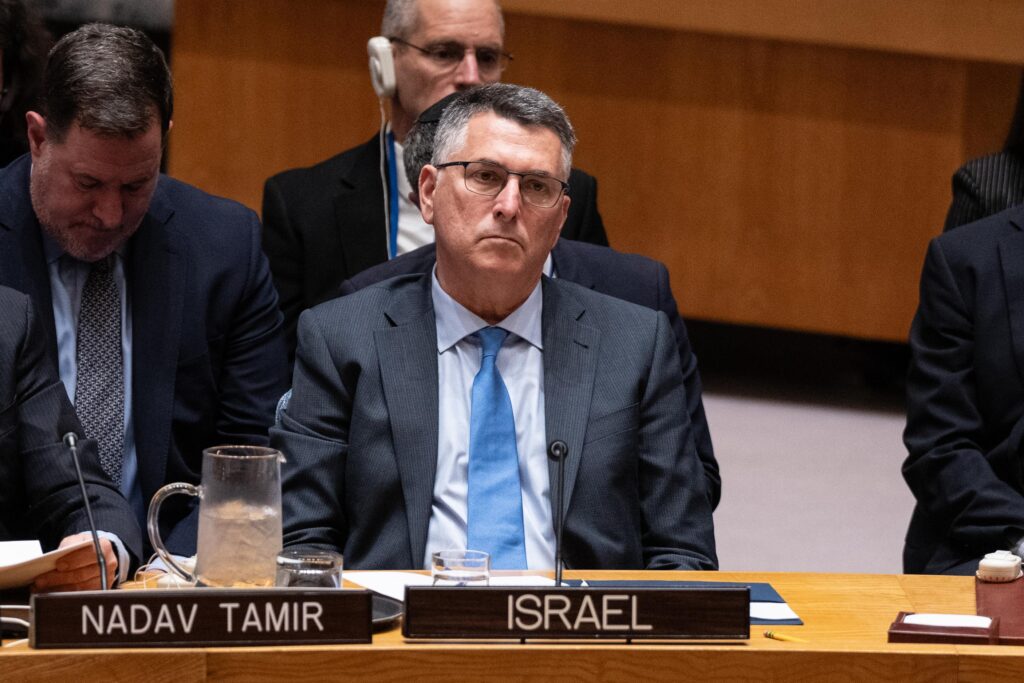
Israel will be there when US President Donald Trump’s Board of Peace convenes for the first time in Washington on Thursday, with a splashy pledge of five billion dollars to rebuild the Gaza Strip, as Foreign Minister Gideon Sa’ar will mingle among leaders from Gulf countries and others who are taking part in this new Trump project.
It may make for a nice visual, but there’s no mistaking the fact that Israel’s international reputation has been tarnished due to its conduct in Gaza since the launch of fighting after the October 7, 2023 Hamas attacks. This is evident in International Criminal Court indictments and United Nations resolutions, but even in the United States, a stalwart ally. According to Pew Research, 53 percent of US adults reported a negative attitude toward Israel last year, up from 42 percent in 2022.
Nonetheless, the apparent end of the war presents a unique moment for Israel to examine its present status and trajectory.
Building on its presence on the Board of Peace, Israel can begin to address international criticism by funding and leading the reconstruction of Gaza. While the current Israeli government and broader political culture are unlikely to permit serious consideration of such a proposal, a significant change in Jerusalem’s Palestinian policy is needed if it hopes to begin changing the widely held perception that Israel’s military was purposely targeting civilians. It would also demonstrate remorse for the loss of innocent life and property unconnected to militant groups. The obvious precedent here is US-led reconstruction programs in West Germany and Japan after World War II.
But that is just one step Jerusalem should consider to establish itself as a worthy partner to its neighbors and a responsible member of the international community. A closer examination of the past couple years shows how far it has to go.
The problem: Israel’s conduct in the Gaza war
After Hamas’s bloody attack against southern Israel in October 2023 that launched the war in Gaza, Israel targeted and killed Palestinian civilians rather than limiting itself to militants in the Strip, as Amnesty International and Human Rights Watch have concluded. The Palestinian Ministry of Health in Gaza estimate of overall numbers killed, now even accepted by the Israel Defense Forces, exceeds seventy thousand as of December 2025, more than 3 percent of Gaza’s pre-war population. Moreover, some 171,000 were wounded as of late November. In addition, since the cease-fire began on October 10, 2025, hundreds of Palestinians have been killed and over a thousand wounded in Israeli attacks. Although the health ministry numbers do not distinguish between militants and non-combatants, civilians in Gaza comprise 83 percent of total casualties, according to a leaked Israeli military estimate.
During its Gaza campaign, Israel killed health care professionals, first responders, aid workers, and journalists. Moreover, the UN’s Office of the High Commissioner for Human Rights reported that, as of mid-July 2025, 875 people were killed while seeking food, including 674 who were targeted near sites of the Israel-backed Gaza Humanitarian Foundation.
The UN estimates that some 92 percent of Gaza’s residential buildings have been damaged or completely destroyed. The Israeli military has also attacked educational, medical, religious, and international facilities in Gaza. While Israel correctly points to Hamas’s use of civilian facilities to conceal weapons caches or operational centers, it is improbable that 92 percent of Gaza’s residential buildings had a militant presence. Even in cases where Hamas operatives had a presence at a civilian site, it remains Israel’s operational—and moral—determination whether to use air power to destroy the entire facility, including its civilian residents, or to target operatives more surgically.
Finally, Israel impeded necessities of life as collective punishment for Gaza’s population—food, water, medical supplies, as well as tents made necessary by the mass destruction. Following the current cease-fire starting October 10, Israel continued to, in the words of Oxfam, “arbitrarily reject” scores of shipments of humanitarian assistance to Gaza. It may never be known how many sick or injured Gazans died or are dying as a result of restricted medications or inadequate nutrition. A team of independent experts commissioned by the UN Human Rights Council concluded that Israel was committing genocide in Gaza.
Other ways Israel alienates the international community
Another reason for Israel’s growing isolation is its behavior elsewhere in the region. In Syria, Israel conducted attacks and captured more territory east of the Golan Heights, despite the absence of attacks against it, alleging that the new regime could become a threat. In Lebanon, Israel has continued attacks despite a cease-fire dating back to November 2024, claiming that strikes are necessary to prevent Hezbollah from reconstituting its capabilities. In both Lebanon and Syria, civilian casualties have triggered accusations of possible Israeli war crimes from Amnesty International and Human Rights Watch, respectively. A major turning point was Israel’s attack in Doha, futilely targeting the Hamas political leadership with which it was negotiating. The United States correctly perceived the strike as threatening its vision of regional integration and moved to rein in Israeli Prime Minister Benjamin Netanyahu’s adventurism.
On the West Bank, since October 2023, a full military siege has resulted in tens of thousands of Palestinians being forced out of their homes in a pattern that Human Rights Watch characterizes as “war crimes, crimes against humanity, and ethnic cleansing.” Moreover, with the support of government ministers and protection from the Israeli military, Israeli settlers have conducted nearly three thousand attacks against Palestinians on the West Bank in the past two years, resulting in casualties, destruction of property, and “arrests.”
When settlers attack Palestinian villages, Israeli forces frequently detain Palestinians to restore order, usually without due process. Approximately one thousand Palestinians—including about two hundred children—were killed by Israeli troops and settlers between October 2023 and October 2025 in the West Bank, including in East Jerusalem. Israeli officials say their actions are intended to uphold security in the territory where both Palestinian militancy and settler attacks have surged since October 2023. Jerusalem’s recent steps to bring West Bank land sales in line with the process used in Israel—eliminating any distinction between the sale of Israeli and West Bank lands—are likely to lead to increased friction between settlers and Palestinians in the territory.
Israeli soldiers have also been credibly accused of torturing Palestinian prisoners, including sexual violence, beatings, malnutrition, and willful medical neglect. A Physicians for Human Rights-Israel report from November documents ninety-eight Palestinian prisoner deaths due to abuse. The Israeli human rights organization B’Tselem also detailed the abuse of Palestinians in Israeli prisons in a 2024 report. A recent video showed Israeli soldiers executing two Palestinians in Jenin after they seemed to surrender. Israeli official statements denied systemic prisoner abuse as attempts to “demonize” Israel. Itamar Ben-Gvir, Israel’s national security minister—who himself joined Israeli police attacks on the West Bank town of Umm al-Fahm–defended the crimes committed by Israeli guards, soldiers, and settlers, calling the latter “sweet kids.”
The result: Israel’s isolation
Israel is growing increasingly isolated in the most important international forum, the United Nations. In September 2024, 124 nations voted in the UN General Assembly for a resolution calling for Israel to comply with international law, withdraw its military forces from the Occupied Palestinian Territories, cease settlement activity, evacuate all settlers from occupied land, and dismantle the separation wall in the West Bank; only fourteen voted against, with forty-three abstentions.
Israeli leaders, including Netanyahu, have been indicted by the International Criminal Court due to the conduct of the Gaza war. A growing number of countries (145) have recognized a Palestinian state; nineteen countries, including fifteen European states, recognized Palestine in 2024 and 2025.
Two years of the Gaza war with its attendant humanitarian catastrophe have fractured the pro-Israel consensus that shielded the country from international pressure prior to the most recent Gaza war. Growing calls to boycott businesses with ties to Israel, to ban the country from sporting and cultural events, and to cut ties with its academic institutions are gaining traction. Pro-Palestine activists are vowing to keep up the pressure despite the cease-fire. Israel has also begun to lose political support in the United States, having seen its backing from the electoral bases of both political parties decline, particularly with young people.
Netanyahu and Israel’s most extreme parties in the government have dismissed international condemnation, ineffectually characterizing it as anti-semitic. While Jerusalem’s claims of anti-semitism have had little impact internationally, it is possible that those claims were intended primarily to resonate with Israelis and Jews abroad.
The solution: steps to reverse the decline
Rather than expecting the Gulf Arab states to rebuild what it destroyed—something they are reluctant to do without guarantees that Israel will cease its destructive attacks—Jerusalem would demonstrate itself as a responsible regional actor by taking the lead in Gaza reconstruction. It would also demonstrate strategic thinking about the future, including improving Gazans’ quality of life after a devastating war, and the failure of the punishing blockade that Israel enforced against Gaza, with Egyptian support, the past two decades.
Funding Gaza’s reconstruction will not by itself fundamentally change negative international perceptions of Israel’s conduct of the war and broader treatment of the Palestinians. A genuine paradigm shift in Israel’s approach to the Palestinian issue aimed at altering international opinion of Israel would include actions such as cracking down on West Bank settler terrorism, prosecuting soldiers who tortured Palestinian prisoners, committing to never withhold food or medical supplies as collective punishment, and restraining racist policies and incitement to violence in by government ministers including Ben-Gvir, Finance Minister Bezalel Smotrich, and Energy Minister Eli Cohen, among others.
By taking these steps—some of which, like the cessation of incitement, are similar to Israel’s demands of Palestinians—Jerusalem would demonstrate itself to be a more reliable and fair-minded partner to its neighbors. Instead of assuming that Arab states will fund reconstruction or police Gaza, Israel would be taking responsibility for the territories it has occupied since 1967 and demonstrating that the conflict is not against Palestinian civilians. Reconstruction of the Gaza Strip would also represent a form of compensation for the damage Israel wrought to the socio-economic fabric of Palestinian society in Gaza, both through the blockade and the war.
Jerusalem needs to stop being perpetually in conflict with world opinion with regard to military occupation, the conduct of its wars, detentions without due process, treatment of prisoners, and collective punishment. It is unlikely that international norms of warfare, justice, and human rights will be adjusted to accommodate Israel.
The broader outlook
Although none of the prescribed steps would resolve the larger Palestinian-Israeli conflict, they would set Israel up as a responsible player that adheres to international norms, given its critics’ belief that, like Hamas, it targets civilians, imprisons and executes individuals without due process, and incites violence.
US support is not as reliable as it once was, and Israel’s regional integration, including formal relationships with neighboring Arab states, is unlikely to develop further so long as it continues to offend Arab populations with its treatment of the Palestinians. The region’s Arab leaders must take popular opinion into account as they seek to preserve their regimes, as Saudi Crown Prince Mohammed bin Salman did when he rebuffed Trump’s pressure to normalize relations with Israel without progress on Palestinian statehood.
The 2026 Israeli general election may offer a natural transition point for a new Israeli government to adopt new policies that are more conducive to its reintegration into the community of nations. The Israeli body politic and electorate need to consider Israel’s current plight, how it got there, the failure of its recent policies, and the importance of international norms.
Amir Asmar is a nonresident senior fellow at the Scowcroft Middle East Security Initiative in the Atlantic Council’s Middle East Programs. He is an adjunct professor of Middle East issues at the National Intelligence University. He was previously a senior executive and Middle East and terrorism analyst in the US Department of Defense.
Related Reading
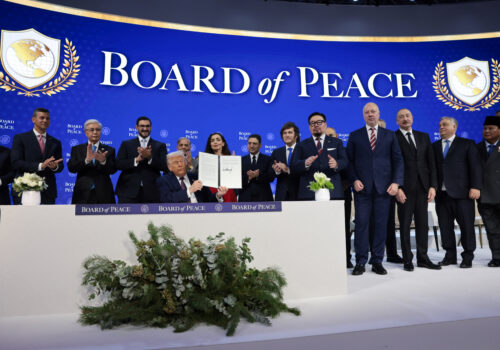

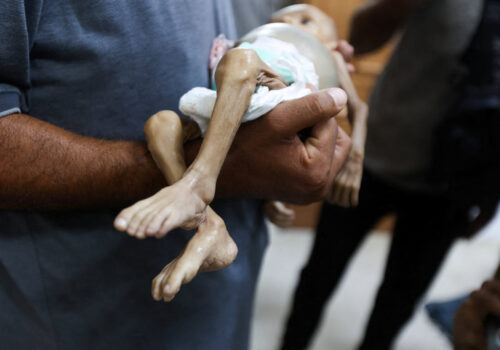
Image: February 18, 2026, Bronx, New York: Gideon Sa'ar, Minister for Foreign Affairs of Israel attends Security Council meeting on the situation in the Middle East, including the Palestinian question at UN Headquarters, in New York, NY on February 18, 2026. (Credit Image: © Lev Radin/ZUMA Press Wire)