JUST IN
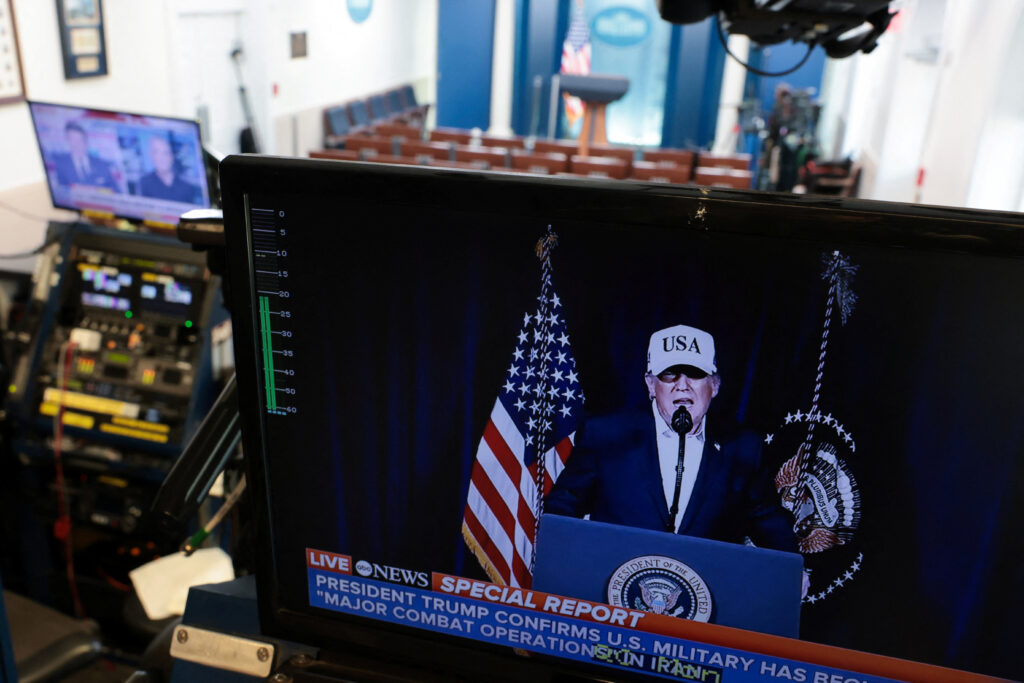
Operation Epic Fury has begun. This morning, US President Donald Trump announced a “massive and ongoing” attack on Iran, jointly conducted with Israel and designed to exert enough pressure on the regime that it will crumble. Iran quickly retaliated against US bases in the region and Israel. With the goals, duration, and outcome of this emerging war still unclear, we deployed our experts to make sense of the conflict’s early hours.
TODAY’S EXPERT REACTION BROUGHT TO YOU BY
- Nate Swanson: Resident senior fellow and director of the Iran Strategy Project at the Atlantic Council’s Scowcroft Middle East Security Initiative, and former Iran policy adviser to the Trump and Biden administrations
- Jennifer Gavito (@fsjen): Nonresident senior fellow with the Scowcroft Middle East Security Initiative and former deputy assistant secretary of state for Iraq and Iran
- Jonathan Panikoff (@jpanikoff): Director of the Scowcroft Middle East Security Initiative and former deputy US national intelligence officer for the Near East
What the US is thinking
- By going with this sweeping campaign, “Trump is gambling that he can inflict enough damage on the Islamic Republic’s core security and political institutions that the regime will fall,” Nate tells us.
- For the US president, it’s a break “from his past pattern of decisive actions with immediate and pain-free off-ramps,” such as the surgical strike against Iran’s nuclear facilities last summer and the capture of Venezuela’s Nicolás Maduro in January, Nate says.
- The pain may be accumulating, with Iranian counterstrikes killing at least one civilian in the United Arab Emirates and causing an economic impact. “Already, air traffic in the region has ground to a halt and shipping flows through the Strait of Hormuz are slowing,” Jen notes.
- How much pain will Trump tolerate? Nate points out that polling consistently shows that the American public is opposed to war with Iran: “If there are significant US casualties or impacts on global energy prices, will Trump stay committed to this campaign?”
- The close US-Israeli coordination on the attack, Jonathan says, reveals that “whatever tensions might exist” between Trump and Israeli Prime Minister Benjamin Netanyahu, they agree on one important thing: “achieving peace—or at least long-term stability—in the Middle East requires a fundamental change in Iran, and diplomacy was not going to achieve that end.”
What Iran is thinking
- “The regime believes this to be an existential crisis,” Jen tells us. While the region has become accustomed to “de-escalatory responses” in Iran-Israel conflicts over the past couple years, those “are at least for now off the table.”
- One of the big questions of the moment, says Jen, is “the intent and preparedness of Iran’s proxies to join the fray.” She notes that Iraq’s Kataib Hezbollah has said it will attack US forces, and Yemen’s Houthi rebels are expected to target Red Sea shipping lanes, while it’s unclear how Lebanon’s Hezbollah will respond.
- Meanwhile on the ground, the swelling protests of recent months indicate that “something fundamental has changed in Iran,” Jonathan tells us, noting that the 1979 revolution that birthed the Islamic Republic took a year to play out. “This iteration of protests, therefore, should be viewed as the start of a new era, not another failure to bring change to the country.”
Sign up to receive rapid insight in your inbox from Atlantic Council experts on global events as they unfold.
What could happen next
- As Iran targets US bases in the region, Jen is watching “whether Middle Eastern countries lift their restrictions on US use of their airspaces” to carry out the war “or offer even more direct support.”
- If the regime were to fall, Jonathan says the most likely outcome is not liberal democracy but “what some are calling ‘IRGCistan’—a military-controlled state that might offer a new supreme leader as a symbolic token to millions of conservative Iranians, but with power firmly vested in the hands of the Islamic Revolutionary Guard Corps (IRGC).”
- An IRGCistan outcome will require whatever leaders that emerge to consolidate power. This could play out in three ways, Jonathan surmises:
- 1. an even more hardline regime that poses “a bigger regional and domestic threat”;
- 2. a group that prioritizes getting the Iranian people’s support and thus shows “greater flexibility for a deal with the United States to reduce sanctions”;
- 3. “a period of confusion and jockeying for power in which Western states will have to decide how much to try to jump into the fray and influence the outcome.”
Related Reading
Image: A television monitor shows U.S. President Donald Trump's earlier announcement in the otherwise empty press briefing room at the White House, while U.S. President Trump is away at his Mar-a-lago Club in Palm Beach, Florida, on the day the United States and Israel led attacks on Iran, in Washington, D.C., U.S., February 28, 2026. REUTERS/Jonathan Ernst
