Washington’s UNRWA report shows how public discourse is divorced from reality
The United States Government Accountability Office (GAO) last month released a comprehensive report examining US funding, oversight, and monitoring of the United Nations Relief and Works Agency for Palestine Refugees in the Near East (UNRWA), with particular attention to its education programs in the West Bank and Gaza between 2018 and 2024. Established in 1949, UNRWA provides humanitarian and social services to Palestinian refugees across five fields of operation: the West Bank (including East Jerusalem), Gaza, Jordan, Lebanon, and Syria.
Contrary to widespread public allegations, particularly those asserting systemic incitement, radicalization, or misuse of US funds, the GAO report concludes that there is limited evidentiary support for many of these claims with respect to UNRWA’s education programs during the period under review. While the report confirms that problematic content existed in some host-authority textbooks used in UNRWA schools, it also finds that UNRWA implemented multiple review, mitigation, and monitoring mechanisms, and moreover that US funds did not finance the production or purchase of problematic content.
These findings are consequential given that during the reporting period, the United States, historically UNRWA’s largest donor, provided an estimated $375 million in education-related support to the agency. But after the October 7, 2023, Hamas attack on Israel, then US President Joe Biden suspended that funding, and the US Congress later passed legislation that banned UNRWA funding entirely after Israeli allegations that UNRWA staff was involved in the attacks. Though the United Nations completed its own investigations that found some staff involvement in October 7, the findings were nowhere near what the Israeli allegations included, and some of the allegations were dropped from the investigation due to a lack of evidence.
The takeaway from the GAO report is more an indictment of how unmoored the public debate has become from reality and available evidence. Questions of reform, restructuring, or replacement should focus on what the agency does and does not do, rather than arguments that conflate humanitarian provision with political causation. In the absence of a political settlement, it has become clear that UNRWA has become a proxy theater for unresolved political questions of responsibility, sovereignty, and accountability. The GAO report makes it clear that eliminating UNRWA will not resolve the political issues at stake and should be a guide to policymakers in addressing the real issues at hand.
Exceptional origins
To better understand the controversy surrounding UNRWA, it is necessary to examine its institutional origins. UNRWA was established prior to the creation of the Office of the UN High Commissioner for Refugees (UNHCR) and was never integrated into the UNHCR system. As a result, it remains a functionally unique organization, and the only UN agency dedicated to a single refugee population.
As of 2023, UNRWA employed approximately thirty thousand staff, around 99 percent of whom were Palestinian, making it one of the largest operational agencies within the UN system. In the absence of a political resolution to the Palestinian refugee question, its mandate has been repeatedly renewed by the UN General Assembly. Over time, this has transformed UNRWA from a temporary relief body into a de facto public service provider in environments where no sovereign authority fills that role.
This seeming exceptionalism has long fueled criticism, but it is more a product of history than politics. Some argue that UNRWA’s continued operation perpetuates Palestinian refugee status and entrenches political stagnation. Others counter that the agency exists because diplomatic failure persists. The GAO report does not attempt to adjudicate this debate. Instead, it narrows the inquiry to whether UNRWA’s education programs, as supported by US funding, were operated in accordance with stated neutrality and oversight requirements.
Critiques that attribute the persistence of refugee status to UNRWA often conflate service provision with status determination. Refugee status is defined independently under international law and UN General Assembly resolutions, not by UNRWA’s operational presence. While some contend that UNRWA’s services allow host governments or Palestinian leadership to defer responsibility for refugee integration or political resolution, the termination of UNRWA’s operations would not, on its own, confer legal status, citizenship, or rights on refugee populations. These outcomes remain contingent on unresolved diplomatic negotiations involving Israel, host states, and the broader international community.
Education, textbooks, and allegations of incitement
Prior to October 7, 2023, the most persistent and politically salient criticism of UNRWA concerned its education system, particularly the use of Palestinian Authority textbooks. UNRWA uses host-country curricula as a matter of institutional policy to ensure accreditation and enable students to transition into local secondary and post-secondary education systems. The GAO confirms that no US funds were used to purchase these textbooks, which were provided free of charge by the Palestinian Authority (PA).
Recognizing concerns that some textbook content did not align with UN values or United Nations Educational, Scientific and Cultural Organization (UNESCO) standards, UNRWA implemented layered review mechanisms, including curriculum framework reviews, semester-based rapid reviews of revised textbooks, the development of supplementary teaching materials, and a self-described “critical thinking” approach designed to contextualize or counter problematic content in classrooms.
PA textbooks provide the baseline materials, and then the critical thinking approach aims to highlight UN values and encourages discussions that explore different perspectives on an issue, while offering teachers techniques, concepts, and activities to support such classroom discussions.
During the 2024–2025 academic year, UNRWA reviewed more than thirteen thousand textbook pages and identified “issues” on approximately 3.85 percent of pages. The majority of these issues related to terminology, maps, or political framing, rather than explicit incitement, according to the GAO report. For example, identified issues include a “reference to Jerusalem as the capital of Palestine,” or “mathematics problems that compare the number of prisoners across two years and use the number of martyrs to teach a mathematical concept.” The GAO notes that both internal and external audits acknowledged UNRWA’s commitment to neutrality while also identifying persistent implementation challenges, including teacher resistance, community pressure, and resource or access constraints. Some of these constraints include that the teachers are already overwhelmed, and asking them to create new critical thinking-led approaches has been challenging, as many of them were not able to receive direct training. Moreover, challenges include students and teachers questioning the relevance of learning about human rights when they feel they do not experience those rights themselves.
Importantly, the GAO finds no evidence that UNRWA systematically ignored identified concerns or that US oversight failed to detect widespread incitement during the funding period under review.
Clearly, this does not render all criticism invalid. It does suggest, however, that claims linking UNRWA’s education, like those by UN Watch—a prominent watchdog organization that also functions as a pro-Israel lobby group—directly to political violence are often overstated. This is particularly true when considering the education content as a primary explanatory or causation variable for political violence, despite the reality students face of prolonged conflict, displacement, and humanitarian deprivation. Similarly, the European Union-funded findings by the George Eckert Institute show that there is little evidence to establish a link between textbooks’ content and students’ world views.
Critics of UNRWA are not wrong to identify real vulnerabilities. The agency operates under extraordinary political pressure, relies on host-authority curricula it does not control, and faces genuine challenges enforcing neutrality among a locally recruited workforce of Palestinians living largely under conflict conditions in Gaza and the West Bank. Oversight mechanisms, while extensive, are imperfect, and implementation gaps are real. There is evidence to suggest that there is influence by staff members who are aligned with Hamas, something that UNRWA has attempted to address, but cannot avoid due to the political realities of the population from which it draws its employees, particularly in Gaza.
Where critics often overreach is in treating these constraints as evidence of institutional intent or systemic failure. House Foreign Affairs Committee Chairman Brian Mast, for example, claimed that UNRWA “is literally funneling American tax dollars to terrorism,” while Rep. Ritchie Torres called UNRWA “long a purveyor of anti-Israel, and anti-Jewish hate.”
The GAO tells a different story. Through their interviews with UNRWA educators, administrators, students, and diplomatic leaders in the US Embassy, the Israeli Ministry of Foreign Affairs, the PA Ministry of Education, and UNRWA leadership and field staff, GAO staff collected significant data and input. Their report, analyzing US funding for assistance, the extent to which UNRWA and the US State Department identified and addressed problematic content, and the extent to which the State Department reported accurately to Congress, does not find sufficient evidence to substantiate claims that UNRWA’s education programs functioned as vehicles for incitement during the period reviewed, nor that US funds were misused.
Post–October 7 allegations and funding consequences
Following October 7, Israeli authorities alleged that some UNRWA employees participated in or supported Hamas’s attack. Subsequent investigations by the UN confirmed that a small number of current or former staff had ties to Hamas or involvement in the events. UNRWA dismissed implicated employees and cooperated with external reviews. While serious, these findings did not substantiate claims of institutional complicity nor did it find evidence of systemic infiltration.
Still, the UN’s self-investigation garnered criticism that it failed to address the wider problem of Hamas ties, and the US Agency for International Development later said UNRWA refused to provide further information about the fired personnel.
The political consequences were swift, with the Biden administration’s suspension of funding to UNRWA and the subsequent complete prohibition of funding from Washington. According to the GAO, this decision contributed to a significant budget shortfall, placing core education and humanitarian programs at risk and exacerbating financial instability that predated the funding cutoff.
The unresolved political question
What remains unresolved is whether defunding UNRWA meaningfully advances US foreign policy objectives. Ending US support does not alter the legal status of Palestinian refugees, nor does it resolve the political questions that underpin UNRWA’s continued existence. What it does do is remove a major service provider in environments where alternatives are limited or nonexistent and encourages the shifting of costs and risks onto host governments, other donors, and vulnerable populations themselves, all of whom, without a political resolution, are unable to absorb these costs or added economic burden.
The GAO report does not argue for or against UNRWA’s future. It does, however, underscore how far the public debate has drifted from the evidentiary record. If UNRWA is to be reformed, restructured, or eventually replaced, those decisions should be grounded in a clear-eyed assessment of what the agency does and does not do, rather than in claims that collapse humanitarian provision into political causation. In the absence of a political settlement, UNRWA remains a proxy for unresolved questions of responsibility, sovereignty, and accountability in the Israeli-Palestinian conflict.
Removing UNRWA does not resolve the dispute and will certainly deepen humanitarian consequences. The US withdrawal of funding is not only a disservice to the humanitarian realities on the ground, but also decreases possible US influence over the education system and the impacts UNRWA can have. While there is good reason to consider other politically viable options for assistance and refugee support to the Palestinian people, the US decision to withhold funds only exacerbates many of the existing problems, while solving none of them.
Melanie Robbins is the deputy director of Realign for Palestine, a project of the Atlantic Council’s Rafik Hariri Center and Middle East programs.
Further reading
Fri, Dec 19, 2025
Employment needs to take center stage in Gaza security plans
MENASource By Melanie Robbins
The best way to undermine Hamas’s power in Gaza is to employ the people Hamas pays today.
Tue, Nov 18, 2025
How Trump can leverage the Saudi crown prince’s visit to help secure Gaza’s future
New Atlanticist By Melanie Robbins
Trump should work with Saudi Arabia and the UAE on a Gaza stabilization fund and a more cohesive plan for implementation.
Tue, Jul 29, 2025
‘I can barely stand or make it through the day’: First-hand views of Gaza’s starvation
MENASource By Arwa Damon
Israel has systematically denied aid entry into Gaza, and perpetuated false narratives intended to discredit the humanitarian community.
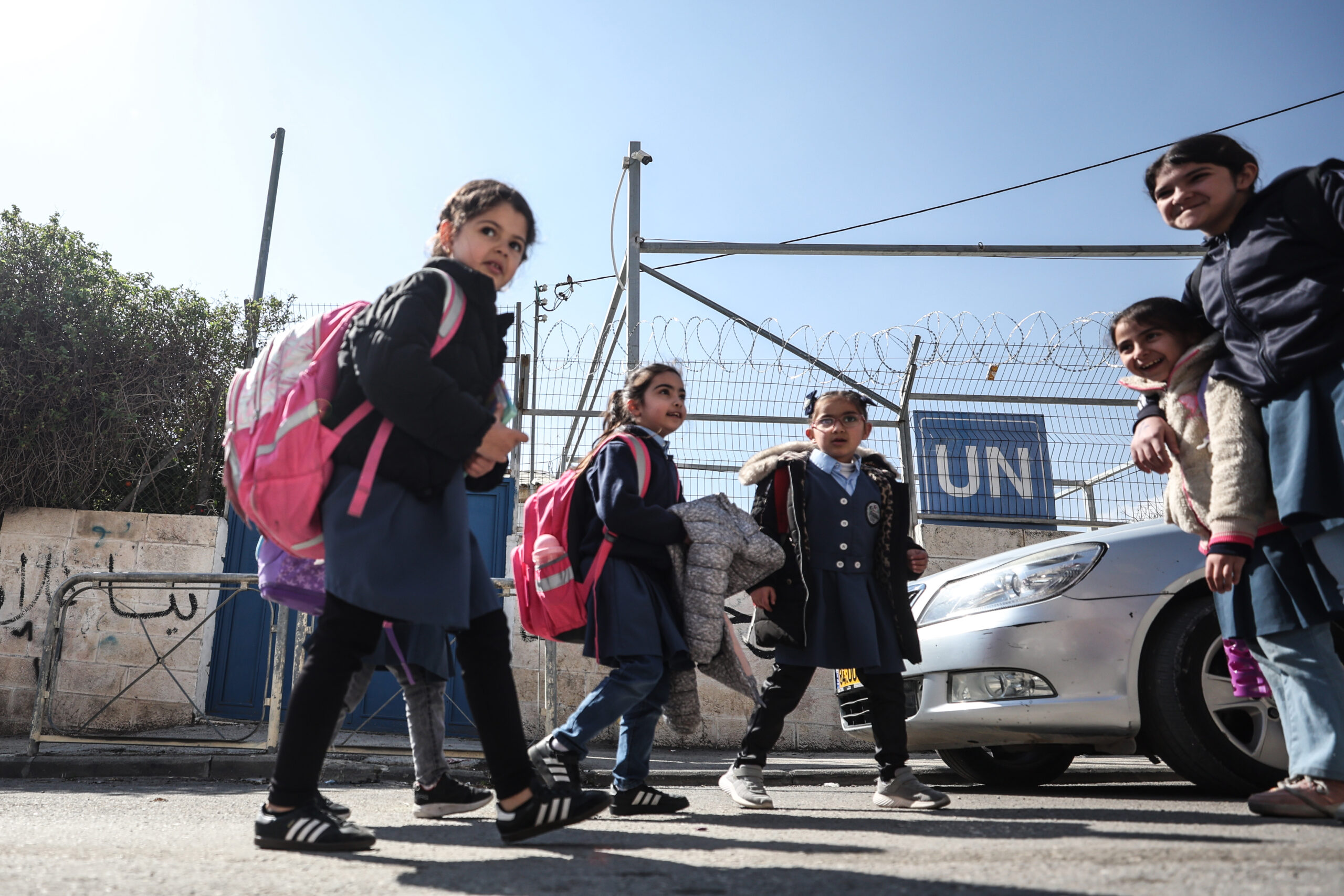
Image: Students walk past one of the United Nations Relief and Works Agency (UNRWA) schools in East Jerusalem, as local media report that police forces raided several UNRWA schools in the city and informed them of a decision to close and evacuate the schools within a week. Jerusalem, February 18, 2025. (Photo by Saeed Qaq/NurPhoto)NO USE FRANCE