Western policy must include Iran’s neglected peripheries
Who nowadays remembers the “1384 Intifada,” the wave of unrest in the Arab areas of Iran in 2005? Few outside the country, certainly. Yet twenty years later, individuals arrested for involvement in the demonstrations are still languishing in jail with no furlough, excluded from the government pardons that are eventually granted to most other political prisoners.
Accounts of human rights abuses in Iran are so frequent and so well-documented that it’s easy to gloss over how much worse things are for the country’s minority populations. They face both official discrimination and day-to-day prejudice. Moreover, after June’s Twelve Day War between Israel and Iran, the United Nations’ Independent International Fact-Finding Mission on Iran found that Kurds, Balochis, Arabs, and other minorities faced disproportionate arrests, penalties, and executions inside the Islamic Republic. This follows a predictable pattern: Whenever the regime feels under threat internally or externally, it tightens the screws on minorities. This intensifies resentment felt in those communities, thus creating a vicious circle. The regime’s paranoia about threats to national security from these groups risks becoming a self-fulfilling prophecy.
As Western policymakers and analysts try to discern possible futures for Iran—be it after the leadership of Supreme Leader Ayatollah Ali Khamenei or potentially post-Islamic Republic—they should pay attention to the peripheries of the country. Most analysts point out that a regime overthrow or a revolutionary uprising remain unlikely scenarios. The regime is powerful, despite its unpopularity—and the state is more deeply established than in most Middle Eastern countries. Nevertheless, instability cannot be ruled out, and it is worth considering scenarios for Iran’s minority regions should the highly centralized security state become distracted by a power struggle or an external conflict.
Iran’s minority communities
The experiences and aspirations of Iran’s minorities are not all the same. How far people identify as Iranian and how much as another nationality varies widely, making population statistics imprecise. Broadly, ethnic Persians are believed to be between 50 and 60 percent, Azerbaijanis between 16 and 20 percent, Kurds 10 percent, Baloch and Arabs 2 percent each, and there are also small populations of Turkmen, as well as others. Minorities can be counted in many different ways.
Of these groups, Kurdish national identity in the northwest of Iran has a long history, including in the modern era with the short-lived Republic of Mahabad in 1946 and the violent suppression of Kurdish autonomy after the revolution in 1979. Meanwhile, Arabs in Khuzestan are keenly aware of how little they benefit from the province’s oil wealth and that government mismanagement has left their water resources depleted. The Baluchi population, which is largely concentrated on the border with Pakistan, suffers socioeconomic deficits, as well as structural exclusion (as both an ethnic and religious minority). Hundreds of thousands of them have no official documents, which excludes them from school and the workplace, as well as political life. And the largest linguistic minority, the Azeri-speakers, have a complicated relationship with the majority Persian population. Under the Islamic Republic, this previously well-integrated community has developed an increasingly separate identity—energized by the independence of the Republic of Azerbaijan in 1991 and its successive bouts of conflict with Armenia. When fans of the Tractor Tabriz football team riot, as they regularly do, they chant not only the phrase “death to the dictator,” but also jibes against ethnic Persians. Yet Azerbaijanis are not excluded from the inner circles of power in Iran—President Masoud Pezeshkian is one, and even Khamenei hails from that community, although he does not identify as such.
The response to the Twelve Day War
The Islamic Republic’s internal messaging in the wake of the Twelve Day War was somewhat confused. On the one hand, the regime singled out minorities for repression and allegations of espionage. On the other, it sought to portray a nation united and defiant under attack. In the rather heavy-handed propaganda after the war, this has even extended to drawing on pre-Islamic Persian national myths.
Ironically, the prevalence of this very Persian nationalist iconography risks looking mono-ethnic and further alienating minority populations. Yet senses of identity are hard to pigeonhole in Iran as elsewhere: Anyone who has talked to people from these areas knows that it’s possible to be, for example, Kurdish, Arab, or Azeri, resentful not to have schooling in your mother tongue, and mistrustful of the centralized Islamic Republic, and yet still identify proudly as an Iranian.
In recognition of these tensions, Pezeshkian and his government have stressed inclusiveness in Tehran’s nationalist messages since the Twelve Day War. In an interview with Al-Jazeera, Pezeshkian said, “even if we had made no achievements in this war, the fact that it united the nation in defense of territorial integrity was the greatest achievement for us.” And interestingly, the government has also announced plans for a decentralization of powers to provincial governors.
That latter initiative is significant: Anything that looks like federalism has been stamped out by the Islamic Republic (right from the early days when it was on the agenda of some of the groups who joined the revolution). The constitution is firmly unitary, so even figures like former President Mohammad Khatami, who mused about the virtues of federalism during his term, concluded it was not possible. And sure enough, even Pezeshkian’s timid moves towards allowing governors more powers to implement policy locally have been condemned as “federalist” by hardline critics. Yet, these moves are evidence of a nervousness at the center about the risks of unrest and the need to appease minorities.
There isn’t much true separatism or irredentism in Iran’s minorities, although their ethnic identities are cross-border. The Kurdish Democratic Party of Iran, for example, contains a spectrum of views about what self-determination looks like, but its mainstream aspiration has shifted over the years from independence to some form of autonomy within the framework of the Iranian state. Cultural and linguistic rights are particularly important for all of these minorities.
The local development agenda is also relevant here. For example, the staggering mismanagement of Iran’s water usage over the years has recently led to acute problems across the country. While this has long been a problem in underdeveloped provinces, only now is water scarcity impinging on the capital. For local Iranian Azerbaijanis, for example, the drying up of Lake Urmia and its environs is blamed on national policies and is thus intertwined with their political grievances towards Tehran. It would be natural for populations that already feel marginalized by the center to believe that they could do a better job if they managed their own affairs.
The Islamic Republic did, in fact, make progress in its early decades in leveling up regional inequalities by investing in rural education and development, but more recently, centralization, corruption, the domination of the economy by the Islamic Revolutionary Guard Corps (IRGC) and sanctions have overwhelmed any sense in the peripheries that Tehran has their interests at heart. That is the context in which Pezeshkian’s initiative to devolve powers to governors makes sense.
Growing distrust of the regime’s competence
The greater risk for the regime may be the general collapse of belief in the regime’s competence and political will to do more than look after its own survival. That is true across the country. But in areas with strong local identities and long-standing grievances, it likely would not take much for charismatic local leaders to emerge and challenge the center—not necessarily on an overtly ethnic or cultural platform, but on one of good governance.
A number of things would need to apply for that to happen. If the central government remains united and the IRGC and Basij militia stay loyal to whichever regime is in place, these centrifugal tendencies will have little scope to grow. Genuine steps towards decentralization could take the heat out of local resentments. A rapprochement with the West and a degree of sanctions relief could bring a new lease of life for regime legitimacy. But analysts and Western policymakers should not assume any of these.
And if the regime’s central authority does indeed falter and bonds holding the unitary state together are loosened, the situation could snowball rapidly. All these groups have, or have had, armed factions willing to take on the regime in one way or another. On the one hand, Iran might be set off on a pathway to a new, federal settlement that allows greater civil and cultural rights to all its people. But perhaps more likely, a forceful reaction from the center could lead to prolonged conflicts and more radicalization on both sides. In that case, it is easy to imagine support coming from over Iran’s borders to support specific resistance groups, whether from governments or nonstate actors.
Few would want to see such a situation. Regional governments would rapidly feel the effects of instability in Iran and may well prefer a unitary, if threatening, Islamic Republic to a failed state on their doorstep. Europe could face a refugee flood dwarfing the earlier waves from Syria during its decade-long war. The emergence of ungoverned space in Iran would invite the emergence of radicalization and terrorism, and the history of Iraq, Syria, and Afghanistan suggests this would lead to transnational threats. Nevertheless, for those in the diaspora whose ideological commitment is to the end of the Islamic Republic regime at all costs, or for some in Israel who might see a failed state as a satisfactory outcome, this scenario may not be unwelcome.
All of which suggests that now is the time for Western and regional policymakers to form a clear-eyed view of what such a fragmentation would mean, and how they should engage with Iran’s minorities—both now and through any regime transition.
Rob Macaire is a member of the Atlantic Council’s Iran Strategy Project advisory committee and a former British ambassador to Iran.
Further reading
Tue, Sep 23, 2025
A geography of protest: Inside the rise of Iran’s minority factor
MENASource By
From the death of Mahsa Jina Amini to the Twelve Day War, the ethnic question has emerged as a significant dimension of Iran’s politics.
Tue, Sep 23, 2025
Iran’s minorities and policy complexity: A look at two communities
MENASource By
Iran plays a significant role in Middle Eastern geopolitics. Policymakers should develop a sober, accurate mapping of its population.
Fri, Sep 19, 2025
Snapback sanctions threaten to further derail Iran nuclear deal hopes
MENASource By
Now would be the best time for the West to negotiate a deal with Iran—but snapback sanctions threaten a derailing into further confrontation.
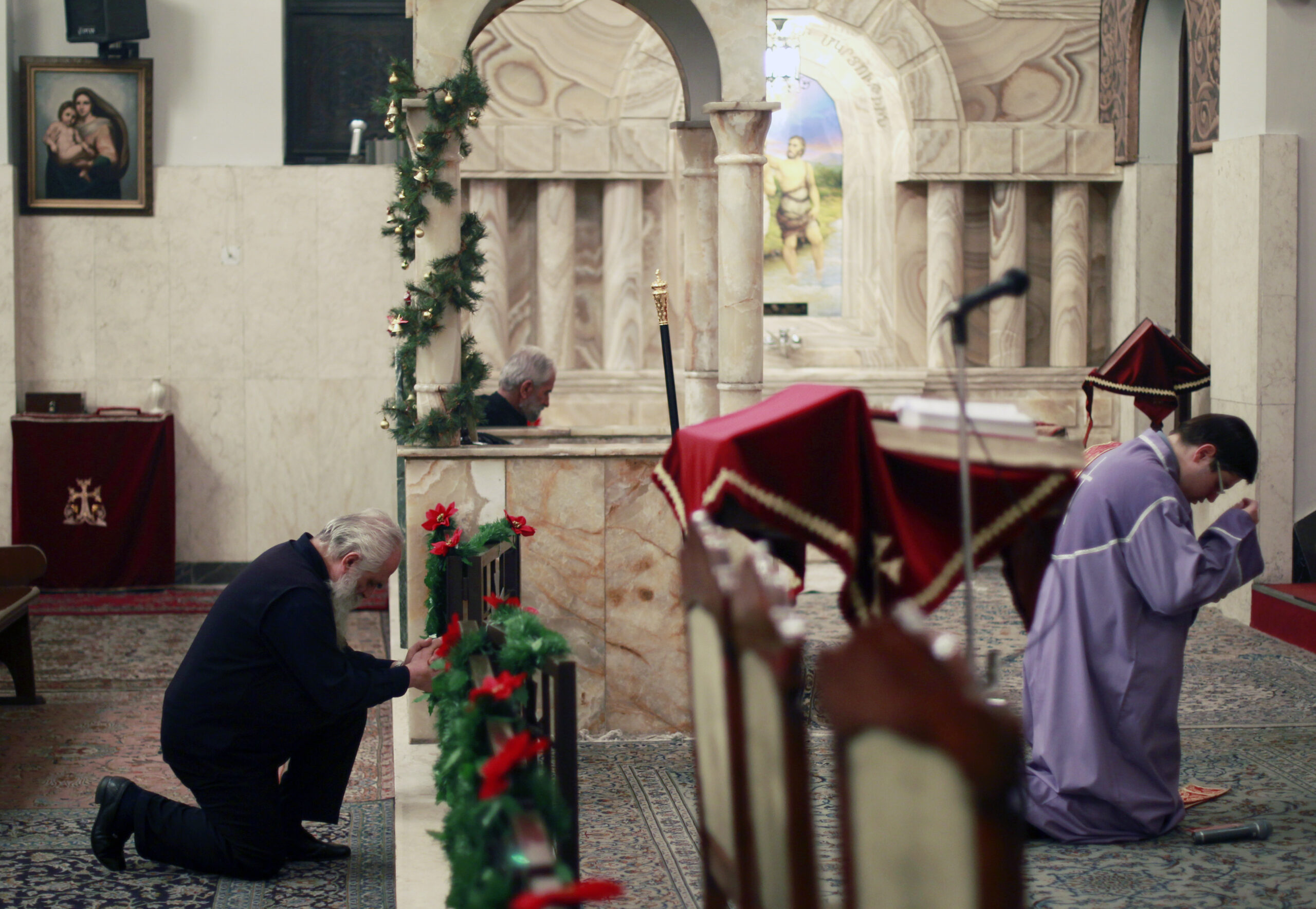
Image: EDITORS' NOTE: Reuters and other foreign media are subject to Iranian restrictions on leaving the office to report, film or take pictures in Tehran. A Christian man and a cleric pray during a New Year mass at Saint Serkis church in central Tehran January 1, 2011. New Year is celebrated by the Assyrian and Armenian minorities in Iran, where a majority of its citizens are Muslim. REUTERS/Morteza Nikoubazl (IRAN - Tags: RELIGION SOCIETY)