
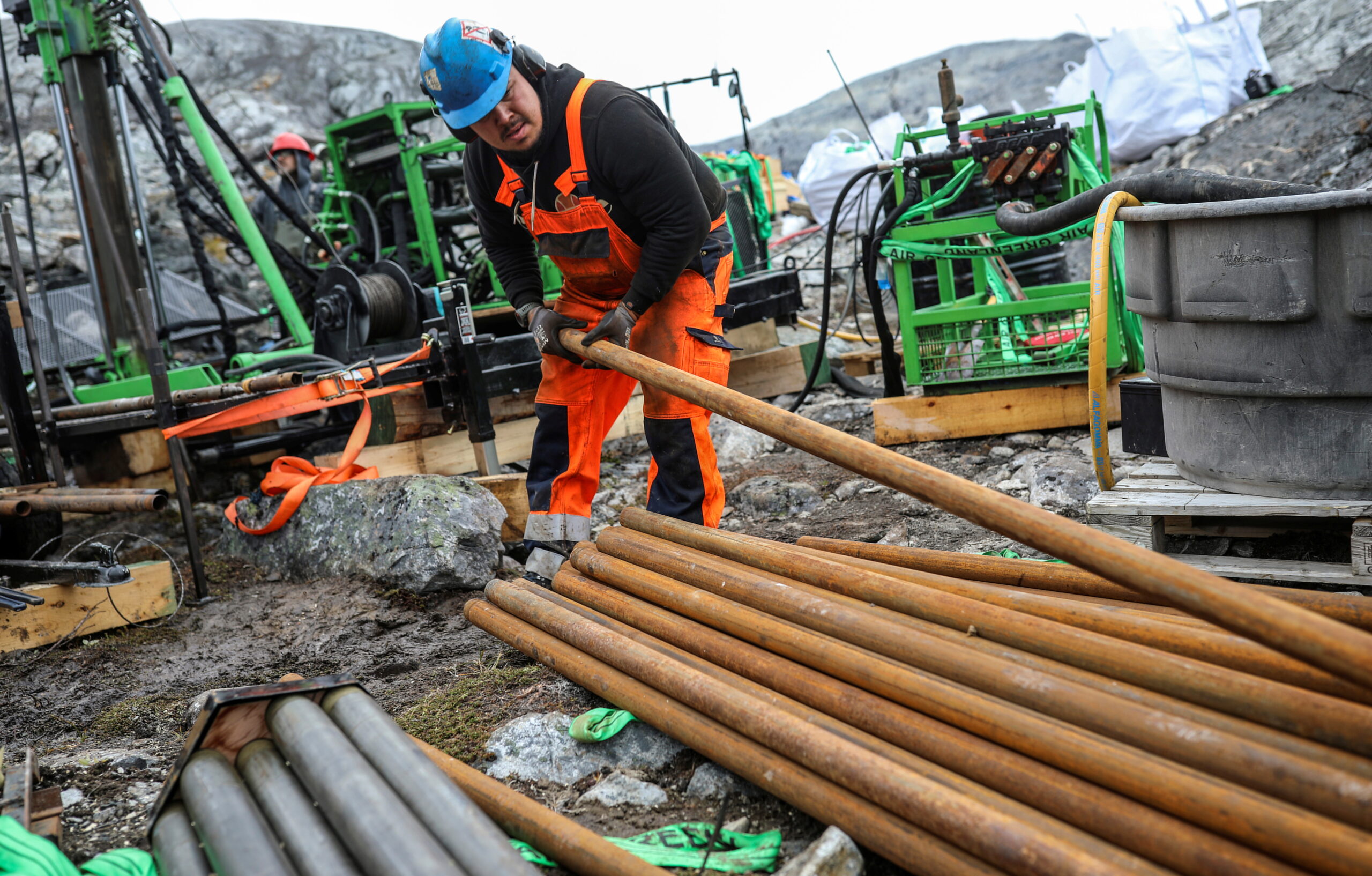
WASHINGTON—Greenland is a land of stark contrasts. Larger than Mexico and Saudi Arabia but home to only 56,000 people, this autonomous Danish territory has an economy traditionally built on fishing and substantial subsidies from Denmark. Yet beneath its ice and rocky coasts lies mineral wealth that has attracted growing international attention—including from US President Donald Trump. Greenland has firmly rejected notions of being “for sale,” and European allies have responded with alarm at US overtures about seizing the territory. Regardless of the rhetoric, the United States has compelling opportunities for commercial and diplomatic partnerships with Greenland.
As a mineral frontier, Greenland offers clear advantages: Its geological endowment is significant and comparatively unexplored, and it presents relatively low above-ground investment risk as a stable democracy aligned with Western institutions. However, these advantages come with major caveats. With fewer than one hundred miles of road on the entire island and significant local resistance to mining, Greenland lacks both the basic infrastructure and social license needed for large-scale mining operations. As a result, the path from exploration to production is likely longer, riskier, and more expensive than in more developed mining jurisdictions.
Yet, as US Secretary of State Marco Rubio prepares to meet with Danish officials in the coming days, these challenges inform how the United States can most effectively engage: through collaboration rather than confrontation.
What critical mineral reserves does Greenland have?
Greenland’s mineral wealth presents a geographical puzzle. The country’s ice-free area, which is nearly double the size of the United Kingdom, represents less than 20 percent of the island’s total surface. Vast areas of the interior remain unexplored beneath ice that can exceed a mile in thickness.
Nonetheless, Greenland possesses an impressive array of critical minerals, from traditional commodities such as copper, lead, and zinc that have been mined on a small scale in ice-free coastal areas since 1780, to modern critical minerals essential for energy and defense technologies.
Greenland’s most geopolitically significant resources include:
- Rare earth elements (REEs): Greenland is estimated to hold approximately 36 million tonnes of rare earths, though only 1.5 million tons are currently considered proven, economically viable reserves. Greenland is generally ranked around eighth globally in reserves, placing it among the most significant undeveloped REE holders; with further exploration and feasibility studies, it may be proven to contain the world’s second-largest reserves after China.
- Uranium: Greenland has one of the largest uranium deposits in the world, which is notably co-located with major REE deposits. However, Greenland reinstated a ban on uranium mining in 2021 following sustained local opposition. This prohibition has had direct implications for projects where uranium is present alongside other minerals.
- Other strategic minerals: Greenland holds known deposits of copper (essential for electrical infrastructure), graphite (key to battery production), gallium, tungsten, zinc, gold, silver, and iron ore. It also holds various specialty metals with high-tech and defense applications, including platinum, molybdenum, tantalum, and vanadium. While many of these resources are geologically promising, few have progressed beyond early exploration.
To date, exploration activity has focused primarily on coastal and southern Greenland, where logistics are more feasible. The latter half of the 2010s saw an explosion of exploration permits in this region; by early 2020, exploration permits had been granted across almost the majority of southern Greenland. Despite this explosion of interest, there are only two active mines on the entire island, Nalanuq (a gold mine) and White Mountain (an anorthosite mine). To date, no rare earth, uranium, or other high-profile critical mineral projects have entered commercial production.
Though further exploration and feasibility studies may foster additional interest, the sites currently receiving the most attention include:
- The Kvanefjeld project on Greenland’s southern tip, one of the world’s most significant deposits of both rare earths and uranium.
- The Tanbreez mine in the same fjord network, which contains substantial deposits of eudialyte ore rich in rare earth elements (in particular heavy rare earths) and gallium.
What are the main obstacles to developing Greenland’s mineral resources?
Greenland’s mineral deposits are globally significant, particularly for rare earth elements. However, unlike established mining regions in Australia, Canada, or even emerging sources in Africa and South America, Greenland has minimal production infrastructure and no large-scale operating critical mineral mines.
From a supply perspective, Greenland’s reserves are largely theoretical. Though it represents a substantial reserve in a politically stable, Western-aligned jurisdiction, bringing that potential online faces several notable challenges:
Infrastructure deficits: Outside of Greenland’s few small cities, roads and railroads simply do not exist. Transport depends almost entirely on ships and aircraft, greatly increasing costs and complexity. This infrastructure gap extends the typical decade-long timeline from discovery to production and dramatically increases capital requirements. While mining projects can spur infrastructure development, the initial infrastructure investment represents a significant barrier to entry—especially since it is generally too cold in Greenland to construct durable roads from concrete and asphalt. This poses a significant challenge to project economics. Transportation of minerals can sometimes be even more expensive than the mining process itself, and Greenland’s remoteness, limited economies of scale, and harsh Arctic conditions make it one of the world’s most expensive mining jurisdictions.
Social and political opposition: Though the government has periodically promoted mining as a tool for economic development, mining remains politically contentious. All land in Greenland is publicly owned and administered, making closed, privately controlled mining sites culturally unfamiliar and politically sensitive. Local opposition reflects deeper concerns about environmental impacts, changes to traditional ways of life, and the terms under which mining would proceed. Most significantly, in 2021, Greenland’s parliament passed legislation prohibiting uranium exploration and limiting uranium content in mined resources, effectively halting rare earths development at the Kvanefjeld project given the presence of uranium.
Geopolitical complications: Recent US rhetoric about acquiring or annexing Greenland has naturally generated diplomatic friction and intensified local sensitivities around sovereignty, complicating social license for mining. At the same time, broader US-China competition has played out in Greenland’s mining sector. In one notable example, US officials reportedly successfully lobbied the Tanbreez mine CEO to sell to American bidders for less than Chinese-linked competitors. The Kvanefjeld project is owned by Australian company Energy Transition Minerals (formerly Greenland Minerals Limited)—but China’s Shenghe Resources is its second-largest shareholder, raising concerns in Washington, which sees the mining sector as a backdoor for Chinese encroachment in the Arctic. Though Shenghe only holds a 6.5 percent stake, a nonbinding 2018 MOU reflects the intent to have Shenghe “acquire all rare earth output produced at the Project,” positioning it as the primary prospective offtaker and downstream processing partner.*
What are viable paths for US engagement?
Greenland’s strategic value lies in its role as a long-term diversification partner in a concentrated global market, rather than an opportunity for immediate production. While annexation rhetoric has drawn attention to Greenland’s resources, a unilateral US approach would limit their potential value. More effective alternatives include:
Strategic partnerships with Greenland and Denmark: Rather than pursuing ownership, American companies and the US government could support mining development through direct investment, financing mechanisms, and technical assistance—tools well suited to institutions such as the US Development Finance Corporation and Export-Import Bank. Coordination with European partners could amplify these efforts, as seen in the Lobito Corridor, where European capital helped bridge infrastructure gaps. Diplomatically bundled investment could help de-risk projects that might otherwise fail to attract private capital, an approach far less viable under a confrontational strategy.
Competing effectively with Chinese investment: The Tanbreez case demonstrates that US diplomatic engagement can influence ownership and investment outcomes, but effective competition requires more than lobbying against Chinese involvement. It demands credible alternatives such as competitive financing, technical expertise, market access, and partnership structures that align with project needs—all of which are more successful in concert with a wide pool of partners. One complementary step could be the development of an investment screening mechanism in Greenland, akin to a Committee on Foreign Investment in the United States–style review, to assess national security and strategic risks associated with foreign capital. Such a framework would strengthen Greenland’s own security and governance while providing greater assurance to US and allied markets that upstream assets are not vulnerable to strategic capture. However, even with successful mining development, rare earth ores from Greenland would likely still be processed in China absent expanded allied processing capacity, underscoring the need for parallel, collaborative investment in downstream infrastructure.
Supporting responsible development: Projects that lack local legitimacy are unlikely to succeed. Emphasizing environmental safeguards, indigenous rights, and meaningful benefit-sharing is both ethically and commercially essential. Greenlanders have consistently expressed a much stronger interest in independence than in joining the United States. An overly aggressive US approach would likely further complicate social license for mining.
Note: This article was updated on January 29 to more accurately reflect Shenghe Resources’s role in mining operations in Greenland.