
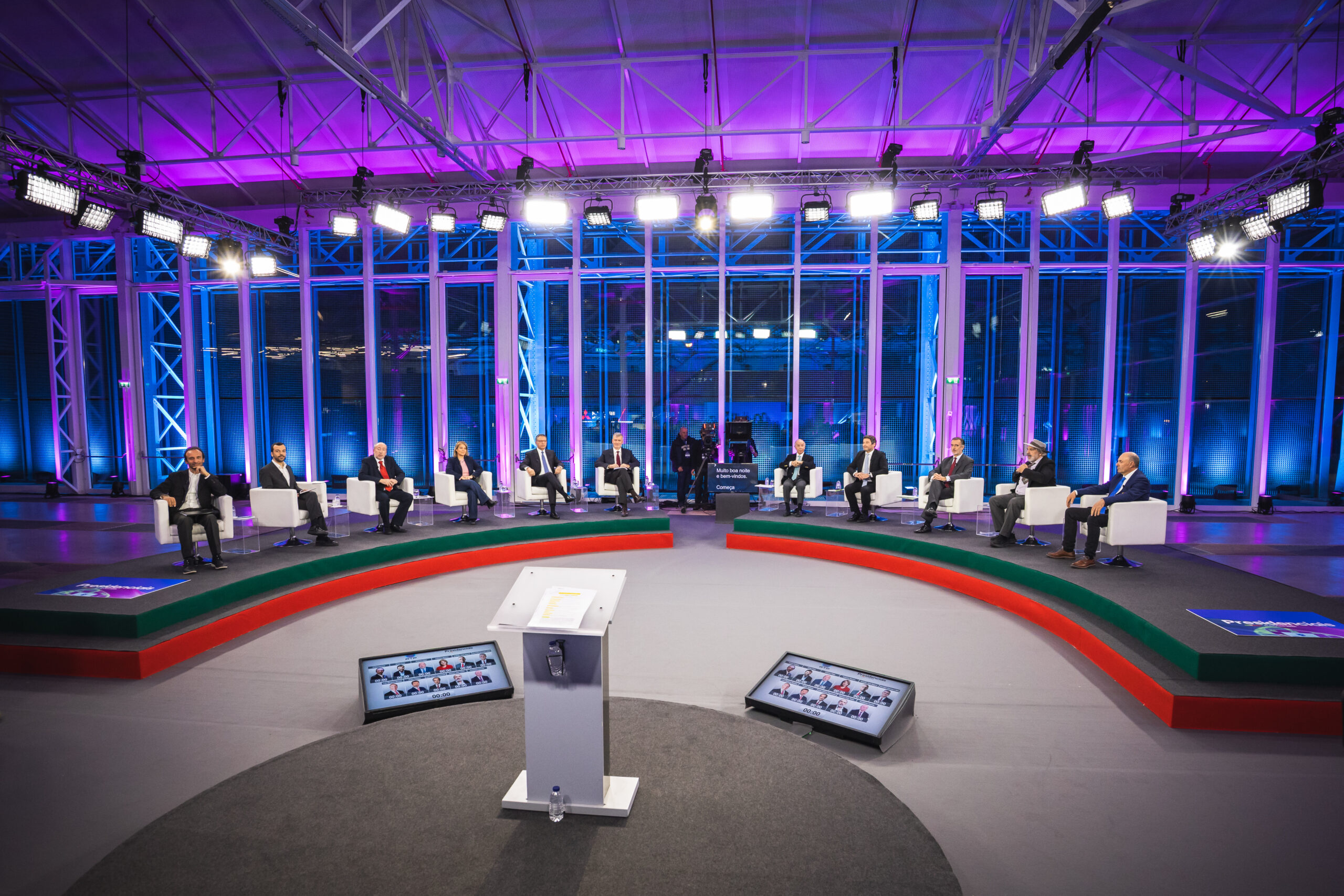
Another year, another election in Portugal. In a country that has weathered three parliamentary elections since 2022, the Portuguese will again go to the polls on Sunday, January 18, to elect their next president. Current president Marcelo Rebelo de Sousa will finish his second five-year term this spring and, under the Portuguese Constitution, cannot run for a third consecutive term. This year’s campaign has been the most unpredictable presidential race that Portugal has seen in the past three decades.
Foundations of the Portuguese presidency
Portugal, a parliamentary democracy under the nation’s constitution, also elects a president to serve as head of state. While many presidential functions are semi-ceremonial, the Portuguese system bestows on the country’s president several important responsibilities. These include veto powers, the role of supreme commander of the nation’s armed forces, and oversight of the country’s democratic institutions. While not a requirement, most candidates from established political parties renounce their party membership to show a commitment to the entire Portuguese population. However, this does not prevent Portugal’s political parties from supporting certain candidates.
Portugal’s presidents serve a five-year term, as compared to a four-year mandate for the government in power. If one candidate does not secure greater than fifty percent in the initial vote, then the top two candidates will compete in a runoff election. This has only happened once since Portugal’s transition to democracy in the mid-1970s, with a runoff election taking place in 1986. Since then, a candidate has captured the necessary majority to be elected president in the first round. But it looks unlikely that this will be the case this time.
Who are the leading candidates?
Although there are eleven candidates for the presidency, it has been primarily a five-candidate race among the following politicians:
António José Seguro is a senior voice of the center-left Portuguese Socialist Party (PS). Seguro served as a member of the Portuguese Parliament, the European Parliament, and was the PS secretary general from 2011 to 2014 until he lost an election for party leadership to former Prime Minister (and current European Council President) António Costa. Following the loss to Costa, Seguro stepped away from politics to teach and became a regular commentator on Portuguese television. His candidacy is still supported by the PS, but he vows to serve independent of party interests should he be elected, promising to lead a “modern and moderate” presidency.
João de Cotrim Figueiredo is a businessman and a relative newcomer to Portuguese politics. In 2019, he joined the newly formed, pro-business Liberal Initiative (IL) party. Cotrim (as he prefers to be addressed in the media) served as IL’s first member of Parliament following its creation, and he subsequently held the position of party leader from late 2019 to 2023. He is currently a member of the European Parliament, with his national IL party aligned with the Renew Europe group in the Parliament. Cotrim has appealed to younger voters, and his sustained and strong performance in the presidential campaign demonstrates changing dynamics within the Portuguese electorate. However, a late-breaking sexual harassment allegation from a former adviser to the IL’s parliamentary group could derail his campaign.
André Ventura is the president of the far-right populist Chega party (“Enough” in Portuguese). Ventura founded Chega in 2019 and has guided its meteoric rise. The party went from having only one member of Parliament in 2019 to becoming the second largest force in Portuguese politics during the 2025 parliamentary elections. He unsuccessfully ran for the presidency in 2021 and continues to use anti-corruption and anti-immigration as the foundations of his political platform.
Luís Marques Mendes is a long-time member of the center-right Social Democrat Party (PSD), serving in various capacities throughout his career since the 1980s. Marques Mendes, who was deputy prime minister from 1992 to 1995 and led the PSD from 2005 to 2007, still garners strong support from Portugal’s center-right parties. His candidacy, though, has not attracted a larger slice of the Portuguese electorate despite the center-right’s current minority government. Marques Mendes’s campaign has emphasized his political experience and his ability to build consensus.
The candidacy of Henrique Gouveia e Melo, a retired admiral in the Portuguese Navy, is one of the more fascinating stories of the campaign. Gouveia e Melo was a career naval officer, serving in the Portuguese Navy’s submarine fleet and rising to lead the Navy from 2021 to 2024. He gained national popularity when he was chosen to lead the government’s COVID-19 vaccination task force during the pandemic. Under his leadership, Portugal had one of the highest vaccination rates in Europe. As a result, Gouveia e Melo gained national popularity practically overnight, and he hoped to ride this momentum once he declared his candidacy for president following his retirement from military service. The admiral is not supported formally by any political party and claims to be above “partisan disputes.” Critics cite Gouveia e Melo’s lack of political experience as a major weakness, while the admiral champions his problem-solving experience and his ability to serve independent of political influence.
A fractured political field with a likely runoff to come
For most of the campaign, the top five candidates were in a virtual tie, with polling showing each within the margin of error of the others in the polls. But as the campaign draws to a close, there are signs of a divergence within the top five. According to CNN Portugal, the PS-supported Seguro, Chega’s Ventura, and the liberal Cotrim are all polling above 20 percent as of January 15, with Seguro polling the highest at 24.2 percent. Polls show the candidacies of the center-right Mendes and the independent Gouveia e Melo falling to the low-to-mid teens. The rest of the candidates are polling below two percent.
For most observers, it is a near certainty that the presidential election will move to a second round on February 8, but it’s not yet clear which two candidates will advance to the likely runoff. However, polling does show, that should the populist Ventura progress to the second round, he would lose to each of the other four top candidates in the various runoff scenarios.
Impact on foreign policy and transatlantic relations
Although Portuguese presidents’ responsibilities are principally semi-ceremonial, they can still influence foreign policy. While there is some divergence among the top candidates on issues such as European Union integration, defense spending, and immigration, none of them would be likely to divert from the nation’s preference for a strong US-Portuguese relationship.