Watch the event
Event transcript
Uncorrected transcript: Check against delivery
STEPHEN J. HADLEY: Good morning. Thank you all for being here for this highly anticipated Atlantic Council Front Page event. I want to welcome our distinguished visitors here with us today, including many members of the diplomatic corps, and our viewers watching online.
I’m Steve Hadley, one of the executive vice chairs of the Atlantic Council Board of Directors. And today I have the distinct honor and privilege of introducing the 20th US Trade Representative Ambassador Jamieson Greer. We could not ask for a better guest as we conclude this year of significant transformation of the global economy.
As we look back on the first year of President Trump’s second term, there’s no doubt that trade and tariffs have dominated the economic agenda. The effective US tariff rate has gone from 2.5 percent last January to above 15 percent today—the highest in eighty years. President Trump has set out to remake the global trading system. And Ambassador Greer has been at the center of those efforts. From Geneva to Madrid to Kuala Lumpur, over the past year, he has helped shape this new policy. This summer, writing in The New York Times, Ambassador Greer said that we are at the beginning of a new global trading system. He called it the Turnberry system, named after the resort in Scotland where the US-EU trade deal was brokered.
He wrote, and I quote, “In the past, we subordinated our country’s economic and national security imperatives to a lowest common denominator global consensus. This approach harmed American workers, their families, and communities by undermining a manufacturing sector that creates high-wage jobs, fosters innovation, and catalyzes investment across the country. What began at Bretton Woods as a necessary effort to rebuild a global trade system shattered by war evolved over nine rounds of trade negotiations into something unrecognizable.”
The question we hope to answer today with Ambassador Greer, the question that animates our work here at the Atlantic Council, is what comes next? The Atlantic Council Front Page Event Series was created for conversations like these with leaders like Ambassador Greer. Before taking on his current role, Ambassador Greer served as chief of staff at USTR during President Trump’s first term. In that role, he helped negotiate the Phase One US-China Agreement and the US-Mexico-Canada Agreement, the USMCA. Ambassador Greer has had a distinguished career in private legal practice, focusing on international law and national security. He also served in the US Air Force, in the Judge Advocate General’s Corps, including a deployment in Iraq. Ambassador Greer, we thank you for your many forms of service to our nation.
To moderate today’s conversation, we are pleased to welcome Greg Ip, chief economics commentator at The Wall Street Journal. I’m sure everyone in this room and watching online agrees that Greg’s analysis of the global trading system and his writing on the US and Chinese economies are simply unmatched. Those of you joining us today will have the opportunity to join the conversation, asking questions via AskAC.org. Before I turn the floor over to Greg, let me note that today marks the fifth anniversary of the founding of the Atlantic Council Geoeconomic Center. It was created thanks to the vision of Chairman John Rogers to help define the shape of the new global economic system. Through its new tariff tracker and its data-driven work on trade, digital currencies, China’s economy, sanctions, and more, it is doing precisely that. We could not ask for a better event to mark this milestone.
Ambassador Greer, the Atlantic Council floor is yours. And, Greg, over to you.
GREG IP: Thanks very much, Stephen. And thank you, everybody here. And, Ambassador Greer, thank you so much for coming today.
Now, I’ve known you for a while, and I know that you keep a busy schedule, but even by your standards, it’s been exceptionally busy. I understand that this is actually your third meeting of the day. You’ve already met with delegations from Jordan and the UK.
I also understand that there’s an AI avatar of you out there with a song put to you, too. So do you think that in the future you’ll be doing—you’ll allow your AI avatar to take over some of the negotiation?
JAMIESON GREER: Maybe. That would allow me to multitask.
GREG IP: That’s right, yeah. Catch up on your sleep.
Look, I want to start out by going back to a speech you gave in Detroit at a reindustrialization summit. And in that speech you laid out, you know, some of the goals of the Trump administration’s trade plan, and you also laid out a three-part test—three things that you thought would tell us if you were achieving what you wanted to. They were smaller goods trade deficit, higher median real incomes for households, and rising manufacturing share of GDP. I want to ask you, give us a report card. How has the agenda—how is it delivering so far? And what more do we need—needs to be done?
JAMIESON GREER: Thanks. And thanks for having me today. Thank you to the Atlantic Council and to, you know, Adrienne Arsht for your patronage here, and for the audience.
The president has a great line where he says, you know, a lot of you I really like and some I don’t like as much, and I’m not going to tell you who. I have a reputation for liking everybody, so I’ll just leave it at that.
With respect to the report card, you know, I give those metrics when I’m talking about our goals in the administration and at USTR. The goal is not to simply have a trade deal or to simply to have tariffs for tariffs’ sake; it’s to have a trade policy that leads to these kinds of outcomes. So where are we on all of these?
The trade deficit. Right now the trade deficit globally is tracking higher than it was last year. You know, why is that? Well, there were a lot of people frontrunning the tariffs, all right? They knew this was going to happen. So if you look—if you look on a monthly basis, you know, early on, you know, we had higher imports than normal. People were frontrunning the tariffs. If you look since August, we’ve seen a significant decrease. Notably, our bilateral trade deficit with China has continued to decrease. It’ll be about—it’ll be down by about a quarter this year, I think, if it continues at this pace. So overall on the year, of course, it’s going to—you know, the first half of the year is going to track a little bit what happened last year and the frontrunning, but when you look at what’s happening more recently it’s clearly going the direction we want it to go and we expect it to go.
You know, second, on wages, blue-collar wages are up. So we’re seeing the right direction there.
And then on the—on the last one, manufacturing as a share of GDP, it’s about the same. You know, some folks measure it a little less. You know, what I would say, though, is we’re seeing a lot of positive numbers there. And you have to forgive me, I actually just brought the numbers because I can’t remember everything. I remember a lot. But you know, some of the metrics I’m looking at are shipments of core capital goods, which rose to an all-time high in July, remained high in August, remained high in September. Real private fixed investment was 5.7 percent in the first half of the year; in 2024, it was about 1 percent. So some of those indicators of new investment, more capital goods. You know, construction of new factories and facilities is also up by a large percentage. So all of those are going the right direction that we want. You know, I think we’ll see it show up in, you know, early next year. Secretary Bessent said the same thing.
You know, we also have, accompanying the trade policy are, you know, good tax policies, energy policies. You know, we’re pumping more oil a day than we ever have. We have expensing in the One Big Beautiful Bill that’s going to help folks with their capital equipment and things like that. So a lot of the indicators we’re looking at are going exactly the right direction.
GREG IP: Manufacturing employment has been weak this year. I think it’s been down in the last few months. What do you make of that? Is that a sign that the reshoring has yet to happen?
JAMIESON GREER: Well, again, it’s something we track, and we’re—you know, we’re aware of those numbers, of course. And I look at it in the broader context of some of the figures I just talked about—you know, more capital equipment, more construction, more private fixed investment. Those are all good numbers.
The employment number overall, our numbers overall, are interesting because we have this phenomenon as well of the administration’s immigration policies, you know, really changing the fundamental employment numbers in the United States. And I’m looking into that, honestly, because I see that number and it seems a little out of step with what we’re seeing in the other numbers.
So we’re watching that. I mean, it’s not been a huge drop, but obviously, we want it to be higher.
GREG IP: Last night in Pennsylvania, the president talked somewhat about his tariff plan, and one line that caught my ear was that he talked about—you know, I think he said something about how we don’t need thirty-five—so many pencils and Barbie dolls, and he’s said this in the past. But explain to us the theory of the case about reshoring. Is it the case that we want to bring back the production of everything, including pencils and dolls? Or do you—does the administration have an overarching theory about which manufacturing is most important to bring back?
JAMIESON GREER: Sure. The first thing I’ll say on, you know, Christmas and all of that, you know, we had the National Retail Federation vice president come out, you know, recently and say stores are stocked up and ready for a record holiday season. So I think we’re—you know, I’m not the Grinch just yet.
GREG IP: No doll shortage?
JAMIESON GREER: No. No, there’s no shortage.
GREG IP: That we’re hearing from—OK.
JAMIESON GREER: What I would say is manufacturing—and not just manufacturing, but the associated research and development—it moves in ecosystems. And so when you reshore—when you’re focused on reshoring the things that matter most—automotive, pharmaceuticals, semiconductors, robotics, steel, fertilizer, all of these things—you tend to naturally get a lot of other manufacturing that comes along with it. Could that be toys and pencils, et cetera? I mean, we’ve made those things here before.
And by the way, manufacturing jobs in America on average pay more than services jobs. You know, we talk a lot about services jobs and how great they are, and they certainly are, but manufacturing on average pays more. So I don’t think we should turn up our nose at making pencils in the United States or other things. I don’t know if American Girl is made in America. It says American Girl. I have four daughters, so I’ve, like, got these things.
GREG IP: Yeah.
JAMIESON GREER: So what I would say is I’m not turning my nose up at this other manufacturing. I think all manufacturing jobs are good jobs, and they typically feed into the broader ecosystem.
GREG IP: All right. Let’s talk a little bit about the agenda. I think last week you had a series of hearings on USMCA—US-Mexico-Canada Agreement—and I believe the treaty or the agreement says renegotiation must begin sometime in the coming year. You were, of course, a part of the team that negotiated that treaty back in 2018. What are the flaws that have since become apparent to you and what do you want to fix? What’s your priority for altering or fixing this agreement?
JAMIESON GREER: So one of the things we really wanted to do with USMCA—and remember, when you look at North American trade you have—you have big—you know, big sectors. You have automotive transportation and everything around it. You have energy trade. You have agricultural trade. You have other important sectors, too. You have services trade. But those drive a lot of trade in North America and in the United States. And remember, it’s a $31 trillion deal, $29 trillion of which is in the United States, when it comes to GDP.
And so in the first term we were quite focused on, you know, securing and improving ag access, because I think a lot of our agricultural producers are big winners of the North American economy. On the automotive side and related manufacturing that was more challenging, where we saw a lot of that production go to Mexico and also to Canada. And a lot of people will say, well, that was the point; we wanted to, you know, have lower-wage, you know, manufacturing in Mexico. But if you go back and look at the history, the narrative around NAFTA was, well, it’s actually going to raise wages in Mexico; we’re going to export more because they’re going to buy more from us. So it played out quite differently than how it was sold.
What we did there is we changed the rules of origin. We wanted to incentivize more content from North America, particularly from the United States. One of the drawbacks is that the most favored nation rate for automobiles in America is 2.5 percent. And so we had a very narrow range to play with where we wanted to incentivize more production in North America, but we only really had 2.5 percent to play with. And that’s a problem. If our MFN rate for autos had been 25 percent like it is for pickup trucks, it’s a lot easier to create incentives to produce in America. We make a lot of pickup trucks in America. It’s because of that 25 percent chicken tax, as it’s called.
So one of the things we’ve already done in this administration, as you know, is we’ve imposed the Section 232 on autos. We’ve to some degree fixed that. I think going forward with USMCA we need to look at non-auto rules of origin to take a similar approach. Especially now that we have the reciprocal tariff overlay of Section 232, I think we have more incentives to create more US and North American content.
GREG IP: Do you have a view on whether this is best done trilaterally, as was done last time, or that it’s best done as two separate bilaterals?
JAMIESON GREER: Well, I—our economic relationship with Canada is very, very different than our economic relationship with Mexico. The labor situation’s different. The import-export profile is different. The rule of law is different. So it makes sense to talk about things separately with Canada and Mexico.
We have the underlying agreement. There are certainly areas where—
GREG IP: When you say underlying, are you referring to CUSFTA, the one that preceded NAFTA?
JAMIESON GREER: Well, I’m talking about USMCA.
GREG IP: Oh, OK. Sorry. All right. OK.
JAMIESON GREER: We have USMCA, which is a trilateral agreement. My sense going forward is we’re going—you know, we’re already talking to them separately.
GREG IP: Sure.
JAMIESON GREER: I have not—I have not had a meeting this year where I sat with Canada and Mexico in a room and we sat together and talked about USMCA.
GREG IP: So it sounds like, if I could sort of infer what you’re saying, is that, yeah, we could end up with simply two rather than one agreement.
JAMIESON GREER: You could have—you could have a couple of protocols attached to the agreement, you could have a replacement. I mean, there are a lot of things that you could do. Now, there are going to be certain areas where a trilateral discussion could make sense. Rules of origin being one of them. Do we align on external trade policies to some extent? That could be another one. Critical minerals could be another area.
GREG IP: Under this—under this scenario does USMCA plausibly go away altogether and is simply replaced by new agreements?
JAMIESON GREER: So we put, and Congress agreed, to have this sunset review clause. And the whole purpose was to review, revise, or even exit USMCA. That’s the purpose, because NAFTA did not have such a clause. And so for twenty-five years, it persisted without change, without a driving factor to force political accountability for the deal. And it lost political support over the years, to the point where, you know, presidential candidates from both parties regularly would run against NAFTA, when it’s fully in the power of the US government to change this and revise it. So we put in the forcing function. So, you know, could it be exited? Yeah, it could be exited. Could it be revised? Yes. Could it be renegotiated? Yes. I mean, that is the purpose of that clause. And all of those things are on the table.
GREG IP: Do you anticipate submitting the finished product to the Senate for ratification?
JAMIESON GREER: So, if you—if you have something where we require an adjustment to US laws, then you have to go to Congress. That’s just how it works. If I have a situation like with some of our reciprocal trade agreements that we’re doing, where there’s not really a congressional change to be made and it’s mostly just changes on the other side of the table, you don’t necessarily have to go to Congress. Now, all that being said, go to Congress, we consult with them. I was there last night in the hearing. Our people talk to them all the time. With respect to a vote, if we need to have a vote to change something in US law, of course we’re going to go to Congress.
GREG IP: OK. Let’s turn to the International Emergency Economic Powers Act. As you know, there is a case pending in the Supreme Court—
JAMIESON GREER: I’m familiar with it.
GREG IP: That’s right, yeah, because you’ve been reading The Wall Street Journal, I would hope, yes. On the legality of this thing. So there is—I’d say the betting markets are saying that the Supreme Court will rule against you. What’s your contingency for dealing with that situation?
JAMIESON GREER: So I would say that since the first term, President Trump and the policy people surrounding him have been thinking about ways to achieve his goals with respect to trade. And even this year, in January, when we were preparing the America first trade policy and options for the president to decide from, there are many statutory delegations that Congress has granted to the president or to other—to agencies to take action. Now, remember the Section 232 actions on steel, aluminum, autos, et cetera, those aren’t at issue in the case. So all of that stays.
The question is, you know, imposing the global tariff and ensuring that the biggest offenders when it comes to trade deficits and unfair trade practices are addressed. And, you know, you have a lot of familiarity with Section 301, with—obviously, I referred to Section 232. There are people out there talking about Section 122, which is a balance of payments power. And the courts have even talked about Section 122. So, you know, all of this is kind of in the ether and people are talking about it. I’m under strict instructions from my general counsel not to reveal the backup plan.
GREG IP: The Atlantic Council—they have a lovely visual, and I hope you can put it up right now, showing the IEEPA tariffs versus the 232 tariffs. Can we get that picture put up somewhere? Oh, there we go. So, as you can see, by their estimates the IEEPA tariffs are raising an annual run rate of around $200 billion a year. That’s a lot of money. Do you think that you can basically recreate that revenue stream using alternative instruments?
JAMIESON GREER: Yes.
GREG IP: Yes? Is that—
JAMIESON GREER: Short answer, but yes.
GREG IP: Is that, in fact, one of the policy goals? Will it be one of the considerations?
JAMIESON GREER: I mean, listen, revenue—tariff revenue is a byproduct of the policy. And you’ve heard the president talk about it a lot. And as this group knows, I think, and anyone who follows trade, the default position for a long time in the United States was to raise revenue to fund the government, and then we switched to an income tax early in the twentieth century. So it’s not crazy to have revenue helping to fund your government. And a lot of countries actually still do to this day. So it’s certainly, you know, a byproduct of the policy. The policy is to reshore the things that matter. It’s to get our trade deficit down. It’s to raise in real income, all those things I discussed.
GREG IP: Well, the reason I bring up the revenue is that’s, in some sense, a proxy for the tariff burden or the tariff incidents, right? I mean, divide the tariff revenue by the imports and there’s your rough proxy, right? So the reason—what I’m trying to get at in that question is, do you think that you can create more or less the same tariff incidents, the same policy outcome using alternative instruments?
JAMIESON GREER: I mean, so I would say, roughly yes. And here’s why—
GREG IP: And is that something that would be under a consideration? Would that be one of the policy objectives that you think about in that contingency?
JAMIESON GREER: I am focused—here’s what we’re focused on, getting the trade deficit down. So when you look at where we are right now, what does the trade landscape look like? The countries that have the largest surpluses with us and the world, have the largest problems with overcapacity or subsidization, they’re largely Asian countries but, you know, the EU has a giant surplus with us. You know, those countries currently have the highest tariffs, right? China has an all-in rate of about 45, if you add the 301s and what we’ve done this year. You know, Southeast Asia has high rates, you know, 18, 19, 20 percent. You know, and then we have a variety of, you know, closer allies that we trade with, but with whom we have real trade problems. This is Japan, Korea, EU. I keep pointing here because the EU ambassador is, like, right there.
You know, and then when you get to the Western Hemisphere we’re generally at about, you know, 10 percent. This is our this is our backyard and we have surpluses with these countries. The reason why some of those countries have a higher tariff is because they have a variety of unfair trading practices that they pursue. And so I’m confident that with other tools we have related to unfair trading practices we can—we can produce the tariff rates we need.
GREG IP: If, in the event the Supreme Court also orders a refund of tariffs paid, do you anticipate any difficulty in actually facilitating or advancing those refunds? It’s a lot of money. Could the people who—a lot of companies have lined up asking you—you know, preparing to ask for their money back. How long would they have to wait?
JAMIESON GREER: Well, it is a lot of money. And, I mean, this is part of the reason why the president’s been so vocal about this case. Obviously, he wants to have the leverage that is afforded by IEEPA to be able to take care of the emergency we’re facing, the offshoring of manufacturing and the deficit. You know, and he’s raised this point too, right? You leave a hole in our finances if you do this. So it’s a big deal, right? And hopefully the Supreme Court, you know, follows the plain language of the text, which is in our favor.
You know, one fortunate thing—and this is probably the only question I’ll dodge—is I’m the USTR. I’m not CBP. I’m not the Treasury Department. And so, you know, I’ll refer you to Secretary Bessent. But, listen, I had the commissioner of CBP in my office yesterday. And we were talking. And, you know, obviously people think about, you know, how this might work. I don’t know what the timeline looks like, though.
GREG IP: So don’t expect them to thank you for basically telling us to go ask them the answer to that question.
JAMIESON GREER: Well, they send people to me all the time.
GREG IP: OK. Fair enough. You mentioned the EU ambassador. Obviously, you know, we’re still sort of, I think, working on some of the details there. Your colleague, Commerce Secretary Howard Lutnick, recently suggested that, for example, the outcome on steel and aluminum tariffs might depend on the treatment of US tech companies. There was recently a very large fine imposed on X, and I think that obviously creates some friction. Are those two things linked, in your view? Will how the EU essentially implements their various digital legislation have—affect how they are treated in tariff negotiations?
JAMIESON GREER: In our joint statement from the past summer, which was really important, right? And Stephen Hadley referred to our statement and what happened at Turnberry. It was an incredible moment for the EU and the US to agree to look at the facts on the ground and say, listen, there are other things going on in global trade that, you know, maybe aren’t accounted for by the current system. And we need to address them, and we’ll do it together. So I give huge credit to President von der Leyen, her staff, and everybody for being super pragmatic on that point.
In that joint statement, there is language about no discrimination against US digital actors and making sure that they have fair treatment. You won’t be surprised to know that what we think is fair treatment and what they think is fair treatment is quite different. And I’ve been, frankly, disappointed over the past few months to see zero moderation by the EU and its implementation of the DMA and now the DSA. You know, I don’t purport to control any other country’s, you know, regulatory schemes, or their sovereignty, or anything like that. I understand that. But with respect to our companies, we’re going to regulate our companies.
You know, the challenge with the digital—in the digital trade space is that, due to the nature of the internet and digital trade itself, is it transcends boundaries. And so if you have one jurisdiction that says, well, we’re going to impose this super-draconian set of rules, or we’re going to limit your business models in certain types of ways, because these are naturally, you know, cross-border companies, it affects them everywhere, right? This is the equivalent of California setting the emissions rules for cars for the whole country, right, for what they do, right? The EU is essentially trying to do it, you know, for global digital operators.
And it would be one thing if they had their own champions, right? But they don’t. So it’s a real problem. And, by the way, we haven’t even quite settled this in the US, right? There’s a—there’s a lot of discussion in Congress and among policymakers on how to do digital tech regulation, and people are a little bit all over the place. What I will say is, we’re not going to allow that regulation to be outsourced, and so I’m hopeful we’ll have constructive discussions with our friends in the EU on this.
GREG IP: Yes, it’s been observed that the one thing the Europeans export a lot of is regulation, so looks like they might need to find some different comparative advantage.
JAMIESON GREER: This is why they gave the EU ambassador a front row seat here, to hear this again.
GREG IP: Going back to the revenue situation, how do you feel about going to Congress and saying, let’s legislate some of these tariffs, let’s go and amend the harmonized tariff schedule to create some permanence to this revenue stream?
JAMIESON GREER: Yeah. I mean, listen, if I were Congress, I’d be quite interested in that. You know, I’ve had members of Congress come up to me who I would not characterize as fans of tariffs, but they’ve said things like, this is real money. This is real money. We have actual priorities we’d be interested in legislating. I’ve had people come up and say, we understand exactly what you’re talking about when it comes to the supply chains that we need to reshore and the trade deficit we need to get down. You know, why don’t we legislate some of this? So I’ve had some interest. You know, we’ve had discussions in the White House about the viability of this. Obviously, any bill like that is really challenging, and I’ve been in Washington long enough to be jaded at the prospect of legislation, but I think it makes sense. I think that it would provide a new baseline for companies to understand, you know, this is not just President Trump or maybe the one person who comes after President Trump, but it truly is a bipartisan expression of what I think a lot of people agree with.
GREG IP: So could that involve, for example, raising the MFN tariff, which I believe is the first schedule?
JAMIESON GREER: Yes. I mean, my own view is, if I were—you know, if I were Congress, I would want to have something like a global baseline to help get the—
GREG IP: Ten percent?
JAMIESON GREER: For example, to get the deficit under control, and then you have higher tariffs based on, you know, whether it’s the deficit or unfair trading practices or something, and you give the president enough discretion to adjust that, to incentivize countries to, you know, come into the fold.
GREG IP: There’s even been interest, and I think there might actually have been a bill in Congress on creating a separate China tariff schedule. Is that something you’d be interested in?
JAMIESON GREER: I mean, I guess my view is you don’t need something China-specific if you have a broader kind of global approach, right? You can fold whatever your approach to China would be into that same legislation.
GREG IP: Sure, OK.
One thing we hear a lot about, and we at the Journal hear a lot about from our business readers, is complaints about the complexity, the uncertainty, the compliance burden of tariffs. Tariffs have changed a lot this year, and there’s a lot of interaction, you know, between the different—for the 232s, the 301s, the IEEPA tariffs. You know, the question is, do they stack, do they not stack? There are anecdotes out there of like an importer getting three different quotes on what tariff they raised, and there was a Fed study that suggested additional compliance costs are roughly equal to a tariff of like 1 to 2.5 percent. So do you agree complexity is an issue? And if so, what’s the solution, and can American businesses look forward to a period of stability?
JAMIESON GREER: So I’m sensitive to the complexity question, because I’m an international trade attorney, and in my private life, I spent many years helping navigate what’s already a complex system, by the way. So I mean, let’s level set, right? It’s not like before this it was like all roses and hugs in customs world. It’s always been quite challenging. You know, but we are sensitive to this.
So early on, there were questions about stacking. How do you relate 232 to the reciprocal tariff? And so, you know, there was guidance and executive orders to help clarify that. And as a general matter, if something’s under the 232 regime, that’s where it is. If it’s another reciprocal tariff regime, that’s where it is. There’s some exceptions to that.
You know, I understand on, you know, steel and aluminum, there are derivative products, and there’s some complexity there. We’ve heard from that on a lot of folks. So the goal is not to introduce complexity for its own sake. Naturally, when you are moving trade policy that’s been more or less the same for seventy years to a new outcome, and you’re changing the tariff regimes, there’s going to be challenges in making it operational, right?
GREG IP: Yeah.
JAMIESON GREER: It’s one thing to kind of have big ideas at the administration level. But again, I had the CBP commissioner in my office yesterday, and we discussed this very issue. So we’re committed to making it as smooth as possible, and so we’re very open to feedback on complexity.
GREG IP: By the way, as the Atlantic Council people, I know they had a slide they wanted to show. It’s really cool with a slider that shows the changing tariff levels that—feel free to put it up now if you have it, but that sort of like visually explains how much tariffs have changed. And so now you could say, wow, that’s a great, you know, like piece of work product there. But, you know, like, if you were in your old job, you’d be, like, rubbing your hands at all the work that’s been created, I’m sure.
But yeah, anyway, I get what you’re hearing, and I presume that you’ve gotten—it looks like a lot of the heavy lifting has been done in terms of just rebuilding and reframing, restructuring the system. All else equal, will 2026 be a quieter year than 2025 on tariffs?
JAMIESON GREER: Well, that’s a question for President Trump.
GREG IP: OK.
JAMIESON GREER: But what I would say is, you know—and I see the graphic, and obviously, again, we’re in the middle of a project. I’m sure you’re going to see things changing over time. And there’s a lot of focus on April 2 and Liberation Day and things that happen since then. I would really focus on August 1st, because that is when the president really set in place a lot of what the reciprocal tariffs are going to be, we announced a bunch of deals, and then in the couple months since then we’ve kind of fleshed out what those deals are. And you’ve really seen, you know, the structure play out that I talked about, right? The highest, you know, over capacity, you know, trade deficit, countries with the highest rates, and the farther you get away from that, the lower the tariffs are.
GREG IP: Yeah, yeah.
JAMIESON GREER: I mean, that’s the structure. There are outliers: Brazil, India. We’re working on that.
GREG IP: Yeah.
I want to turn to China now. And I believe you have a visual also that shows some interesting patterns in the trade between the United States, China, Mexico. So this is interesting. As you pointed out, we’re seeing the big drop in the China number and diversion behavior, but China now drops to third place in terms of its importance as a supplier to the United States.
And I bring that as background, because I think that one of the things that has remained constant between the Trump first term, this term, and even the Biden term in between was the view that China is different. And when I read the national security strategy—and I understand you contributed to this, right? USTR actually had some role in helping draft the national security strategy?
JAMIESON GREER: We got to see it and give input.
GREG IP: OK. So I’m just going to quote a little bit from it: “We must work with our treaty allies and partners to counteract predatory economic practices, use our combined economic power to safeguard a prime position in the world economy and ensure that allied economies do not become subordinate to any competing power.” It discusses encouraging our partners to rebalance China’s economy toward household consumption, forming coalitions that use our comparative advantage to pursue growth through managed cooperation tied to strategic alignment.
So, conceptually, all of this seems to be pushing us in a direction where, whatever other differences, the United States and its like-minded partners would benefit from a common approach to China. Is that true? And how do you actualize it? Can you talk about how the United States can actually—given there’s been a lot of tension, and a lot of you know, you know, friction between our partners—given all that, how does the United States, or should the United States, even want a common approach towards China?
JAMIESON GREER: Yeah, so first of all, I think, you know, I would characterize our view on China—and I’ve mentioned this, you know, recently. So it’s not, it’s not news or something. People in Washington like to talk about China hawks and China doves, etc. That’s a distinction that doesn’t really resonate with the Trump administration because we’re just pro-American, right? We’re just pro-American. We’re not anti-anybody. You know, we’re pro-American, America first, as they say. So, so first of all that, that’s our position.
And we hear this sometimes when partners say we should align on China. Oftentimes, that is code for don’t put tariffs on me.
GREG IP: Yeah.
JAMIESON GREER: Right? So that’s like its own thing.
I mean, my own view is it’s in every country’s interest to take action against overcapacity and distortions, whether that’s from China or that’s from Vietnam or Indonesia or other folks, right? You know, we talk about the EU. We have real issues with some of the EU’s, you know, regulatory approaches. So, you know, we’re not really in a position of telling everybody you’re either with them or you’re with us. I mean, that’s really not how it is. I mean, our view is the United States has taken a lot of unilateral actions since the Trump administration. The Biden people kept a lot of this. We’re doing things now.
A lot of it has to do with China simply because we have a giant deficit with them, and their economy doesn’t fit in very well with ours. We’re just quite different economies. It doesn’t mean we can’t trade together. We should trade together. I mean, I think the landing zone with China is really we just have more balanced trade. I think we have to manage it. I think we have to talk to each other about what we do want to buy and sell from each other, and just make it, frankly, quite managed. Is that ideal? Not for a capitalist, but, you know, we aren’t dealing with capitalists on the other side.
I think with respect to, you know, other countries, I think a lot of it is organic, right? You can see other countries already taking action against overcapacity, whether it’s from China or elsewhere. You know, I think it’s not really a situation where you have, like, the Justice League coming together and, you know, doing all this. This is not how it is. We’re taking unilateral actions. It always takes longer for other countries to, you know, get behind it or do things. And I understand that everyone has different politics and policies. You know, if we align in a way that helps America, great. If not, we’re going to take our own actions.
GREG IP: So we learned just this week that China ran a trade surplus, I think, of a trillion—more than a trillion dollars just through the first eleven months of the year, an all-time high. There’s growing concern—we wrote about it this week in the Journal—that China’s export-driven model is actually hurting other countries by deindustrializing them. And so that essentially—so where that’s heading towards is that it’s—the China challenge is not strictly a bilateral challenge; it’s global. And we can try and keep out China’s exports bilaterally, but they’ll find some other home somewhere else and it will redound to the United States in some way. And this brings folks to the idea that there’s some value in this common approach.
And I noted, for example, in the Malaysia deal there’s a section there that obligates Malaysia that if the United States imposes restrictions on a third country, such as China, Malaysia must sort of copy those. So what’s the driving thought behind that? And is there some willingness to consider, for example, in USMCA maybe the United—Canada and Mexico sort of mimic the American external tariff on China in exchange for maintaining some of the preferential access in that agreement?
JAMIESON GREER: Well, I would say, first of all, it’s really important to acknowledge that President Trump is very focused on having a constructive relationship with China. We certainly had tensions earlier this year. And you know, when China really escalated the situation through rare earth controls and all these different things, the United States certainly had an option to elevate our own export controls or other things. We have—we have a lot of leverage, you know, over all kinds of—China and everyone else. But the president’s interest is not in blowing up everything, right? And that includes our relationship with China. And so we’re quite focused on trying to find a path forward to have an exchange of goods and services between China and the US that makes sense for both of us and that is fairly balanced.
Now, you referred to some of the provisions we have in our trade agreements with Malaysia and agreements from others. You know, it makes sense in a bilateral trade agreement to want to ensure that the benefit of that agreement goes to the two parties involved, right? And that helps us control all kinds of things—control for transshipment, et cetera. And if you’re ever in a situation where we think that broader action is necessary with regard to third countries—and it’s not China-specific, right; if you look at the agreement, it doesn’t say anything about China specifically—you have that option. You have that option to be able to go to countries and say, listen, you agreed to work with us on these issues, and we’re seeing an effect in your market that affects us.
I mean, that’s a—that’s a pretty—I think a normal, natural thing. I think saying it out loud is new. I think writing it down is new. And I think it signifies the importance of economic security. That’s all new, and I think we should be commended for it.
You know, again, I think it’s there if we need it. Right now we’re really trying to have a constructive relationship with China.
GREG IP: OK.
I’m being told that I need to start asking the audience for questions. There’s a few other things I wanted to ask. But any questions out—OK. My friend Gavin Bade from The Wall Street Journal has a question.
Q: Moderator’s prerogative.
JAMIESON GREER: It’s kind of a plant.
Q: He doesn’t know what I’m going to ask, I promise.
GREG IP: It’s true.
Q: Ambassador, thanks for being here. I appreciate it. As you said, Gavin from the Journal.
I wanted to ask you about some recent recalibrations in some of these IEEPA tariffs. You all have rolled back some tariffs, especially on foodstuffs, recently. Some of that was in relation to trade deals or agreements that you signed with some nations, but some of it was outside of the trade negotiations. I wanted to ask you why you’ve recalibrated in that way. And is there kind of a tacit admission there that maybe some tariffs were applied to some goods that, you know, had raised prices for consumers in a way the administration didn’t want to see going forward?
JAMIESON GREER: Yeah, so I think you’re referring to stuff like coffee and bananas and stuff like that. And so from the—you know, from the outset of these negotiations, you know, at least internally, you know, there had been a view that there would be calibrations at some point. And some of these tariffs you have because you want to reshore, you want to protect, you want to take care of the deficit; and some you have for leverage.
And so in early September the president put out an executive order saying, you know, listen, you know, here’s a bunch of stuff where we can—you know, I’m going to authorize USTR and Commerce and all these folks to eliminate the tariffs contingent on progress on the deals. And so, you know, a couple months later, after we had announced deals—a swath of deals in Asia, obviously the EU, other places in Europe, Western Hemisphere, et cetera—we were in a position to feel like we finally had really had a critical mass of progress that we could—we could remove the tariffs on these items, which he had been signaling he was going to do. And several weeks later, we did. It’s no coincidence that when we announced deals with, you know, Ecuador and Guatemala and, you know, Vietnam and Cambodia and these places, places where we get banana and cocoa and coffee, like, there’s just no coincidence that we announced these deals and then we released this stuff.
You know, with respect to the incidence of tariff increases, I mean, listen, there’s a lot of stuff that goes into pricing. If you look at coffee, the coffee price had been going up for two years, right? I can’t control the weather in Brazil with a tariff.
That being said, I think it’s more likely that you have an incidence—a tariff incidence on a price for something that we just don’t make in America than something we do make in America. Also, when you think about the incidence of tariffs, you often get a situation—you know, particularly with manufactured goods or commodities that are broadly produced. If you’re trying to sell into the most valuable consumer market in the world, you want to keep your market share. And so you’re going to compete with other exporters to eat the tariff. And so that’s why you see the tariff effect really diffuse throughout the supply chain.
GREG IP: There was a—yes, right here. Introduce yourself, please. Wait for the mic, and then introduce yourself.
Q: Thank you so much. How are you, Ambassador? I just wanted to ask you a couple of specifics and then a general question.
So specifics—
GREG IP: Let’s see if we can compress it into one question.
Q: Sure. It’s all trade related, you know.
On Indonesia, there’s reporting that you are unhappy about what’s happening with Indonesia. If you could give us an explanation on what’s happening there and what they’re trying to push back on? And what does that mean about these other agreements that you’ve already sort of negotiated? And are you seeing that kind of same recalcitrant attitude from other players?
But then, the other issue is the chips issue and the ruling that came—or the decision that was made by the president. We understand that there’s some, you know, sort of pushback. Obviously, we’re seeing that on the Hill yesterday in the hearing. But can you tell us your view on allowing those chips to go? Thanks.
JAMIESON GREER: So I’ll just do the first one, because you said one question. So on Indonesia, yeah, we saw that report in the FT. And, you know, we have confidentiality agreements between us and Indonesia as we proceed. You know, what I will say, I think it’s meaningful that we had signed agreements at the ASEAN conference in October with Malaysia and Cambodia. I would love for Indonesia to be in that same position. I think it’s a great export market. There are things we import from Indonesia that we want to import. You know, I think that we’re always ready to move forward, and to move forward quickly. And I’m going to have a conversation with my counterpart in Indonesia tomorrow morning. I’m, like, looking at my staff. Tomorrow morning? You know, to talk about progress. You know, I’d love to see that deal finished and done. I think it’s in their interest, and in ours.
GREG IP: I’m going to go to a question from the online audience. And, by the way, if you are waiting to add a question you can go to AskAC.org and there will be an opportunity there, if you want to ask a question. Let me see. How do I do this? This is the part where my age starts to catch up with me. I’ll read the—well, I guess you can all see the question now.
JAMIESON GREER: So everyone can see it?
GREG IP: Yeah.
JAMIESON GREER: Yeah. So Brazil. All right. So with Brazil, we have a lot of issues going on with Brazil. Historically, they have been a challenging trade partner in a lot of ways. An important trade partner. We have a trade surplus there. A lot of good import-export trade that happens. But there are a lot of barriers to the United States, tariff, non-tariff barriers, regulatory barriers. On top of that, they’re a competitor for the United States, especially in agriculture. You know, whenever we are trying to sell our commodities overseas we’re always competing with the Brazilians. We’re concerned about some of their practices with respect to agriculture. So we’re conducting a Section 301 investigation that covers a number of practices in Brazil, including what we think could be illegal deforestation in the Amazon, you know, for their soybean production, a variety of digital practices.
The president also, kind of separate from the trade world, has had foreign policy concerns with respect to the weaponization of law and judicial system in Brazil with respect to officials in Brazil. We’ve seen them detain Americans. We’ve seen them issue, you know, secret orders to American tech companies. We’re concerned with all of these. Some of these are identified in our Section 301 investigation that we’re conducting. Some are identified in the executive order that empowers the State Department and others to take action. And so we essentially have a mix of tariffs on Brazil due to both trade issues and foreign policy issues.
President Trump has had several very constructive interactions with President Lula recently, in the process of relieving tariffs on coffee and cocoa, which we were discussing earlier. Brazil was included in that. And part of that is a recognition of progress we’ve made with them. You know, we would like to in the near term have some kind of deal with Brazil. It may not solve every problem, but I think that there are things they can do. They seem to be quite willing partners. They’re in the Western Hemisphere. You saw the National Security Strategy. Western Hemisphere is very important to us. We want to have a better trade relationship with them. And I think we’re—we kind of have a structure set up to do negotiations to achieve that. Of course, it takes both sides’ willingness to actually make concessions.
GREG IP: Thanks. Yes, there. Wait for the mic and then introduce yourself.
Q: Hi. Logan Wright, Rhodium Group.
You mentioned that the administration is favoring a more constructive relationship with China at this point. Is that inconsistent with other objectives to bring down the US trade deficit, given that China’s strategy remains export-oriented and, you know, continuing to increase global trade surpluses? And is that—does that reflect a change in the approach toward longer-term strategic competition with China?
JAMIESON GREER: So I don’t think it’s inconsistent at all. I mean, we’ve really—frankly, since May, since our Geneva talks, we’ve been on this path with China to be more constructive. And since May, we’ve seen more balance come into the relationship on the good side. So we’re doing both of these things at the same time. As I mentioned earlier, I think that US-China trade, just I think it needs to be managed. I think we need to figure out, you know, what do we want from you? What do we not want from you? What do you want to buy from us? And there’s always going to be this, you know, upper area of the highest tech—you know, the highest tech items, which, you know, folks have referred to and asked about. And that’s always going to be, you know, some stuff obviously, and other stuff is a gray area. You have to figure that out.
But there’s a lot of area where we should trade with China, right? There’s a lot of, you know, consumer goods or low-tech items. You know, we certainly should be selling ag, and airplanes, and medical devices, and things like that. I mean, I think we should focus on where do we agree where we should be trading, and what types of volumes, to try to have balance? And then if there are stickier issues we can address those down the road. I don’t think it’s inconsistent at all.
GREG IP: We’re almost out of time. And I’m going to do the moderator prerogative to ask the last question. You know, we heard the phrase “rules-based international order” so many times, but I think the only thing we all agree on now is that it’s dead. Is that it died sometime between 2016 and 2017, but it might have already been dying by that point. What is your vision of what replaces that order, if anything? I mean, I could have explained that when it was a WTO and nested in that were a group of bilateral and prolateral treaties. What will govern the rules of international trade going forward, if, in fact, there are such rules?
JAMIESON GREER: Well, first of all, I’d say, from what I would think is a realist view, the question is was it ever alive at all, right?
GREG IP: Yeah.
JAMIESON GREER: I think sometimes we kind of have white lies we tell ourselves in international relations to paper over the actual power politics that really control everything. I would say, with the WTO, it has a baseline set of commitments that were agreed to many years ago. There hasn’t been a lot of development there. That’s why we, as the United States, are layering over the WTO commitments bilateral agreements that we believe put America’s interests first and are also in the interest of these other countries to be able to maintain access to the US market in ways that are beneficial to them.
So, I mean, I think we have some of those underpinnings, but where they can’t—I mean, the WTO can’t fix overcapacity, right? They can’t even be transparent among their own members and publish notices of new rules. You know, they can’t fix overcapacity. So we’re going to have to deal with that, either on our own or with willing partners. So I think it’s going to be interest-based.
GREG IP: OK. Ambassador Greer, thank you very much. Very interesting conversation. Really appreciate your time.
JAMIESON GREER: Thank you very much.
GREG IP: Thank you.
Watch the event
Further reading
Fri, Nov 7, 2025
The Supreme Court might slow Trump’s strategy. But he still has other tariff options.
New Atlanticist By
If the administration’s primary objective is to preserve tariff revenue and counter unfair practices, sections 301, 232, or 122 remain viable alternatives.
Wed, Nov 5, 2025
How might the Supreme Court reshape Trump’s tariffs?
Fast Thinking By
The Supreme Court expressed skepticism of the Trump administration’s sweeping tariff authority during oral arguments on Wednesday.
Thu, Oct 30, 2025
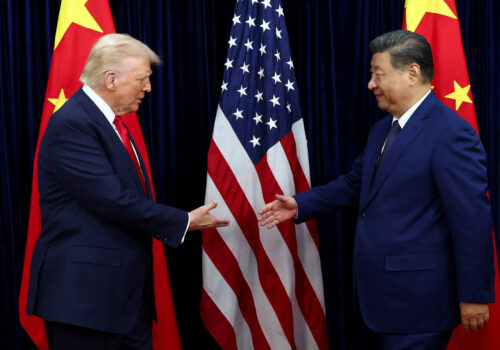
Trump and Xi brokered a truce in the trade war. Will it hold?
Fast Thinking By
The Chinese and US presidents met on October 30 in South Korea, where it appears tensions over tariffs and other economic measures have calmed.
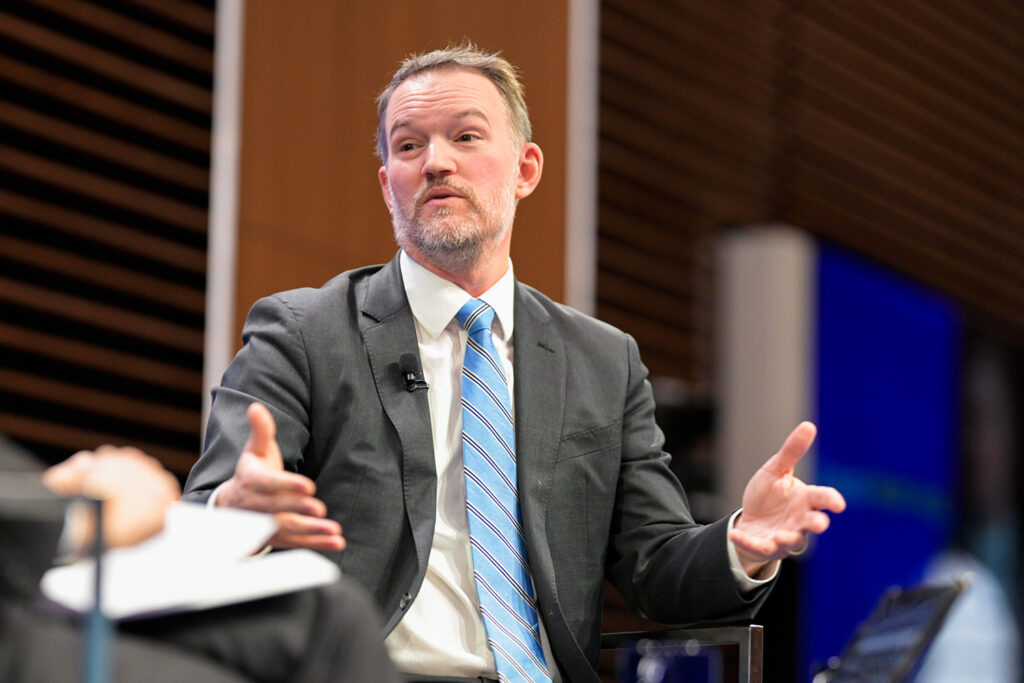
Image: US Trade Representative Jamieson Greer speaks at the Atlantic Council on December 10, 2025.