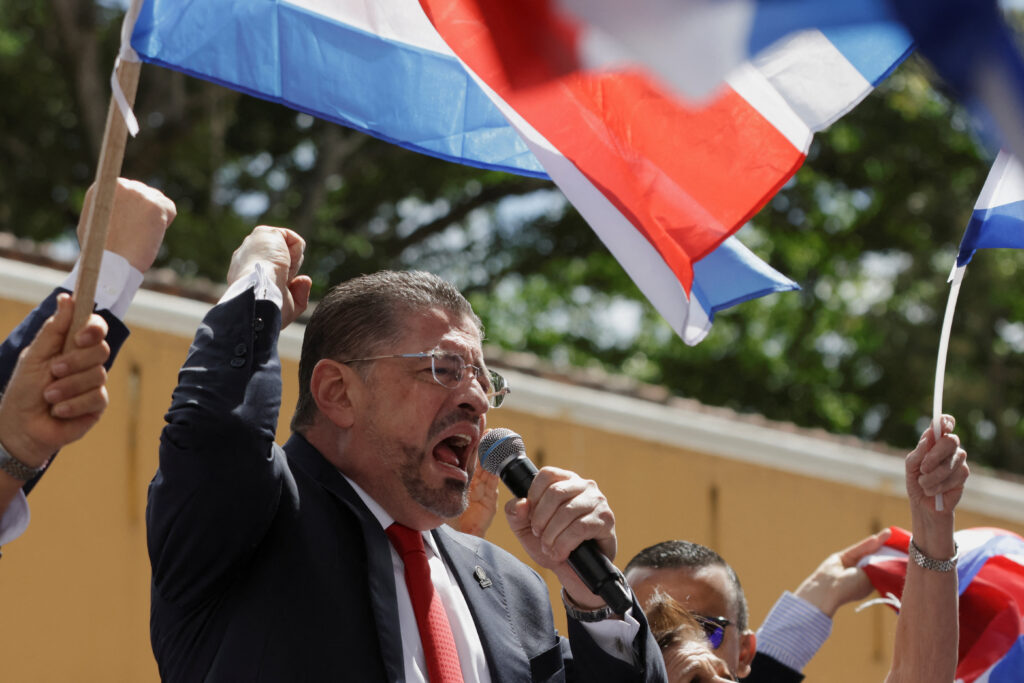
Costa Rica has long prided itself on democratic stability and a strong rule of law. But the nation of some five million people now finds itself in an exceptional—yet constitutionally permitted—confrontation between its executive branch and its independent electoral authority, the Supreme Electoral Tribunal (TSE).
The situation—a second vote in fewer than five months on whether to strip the president’s immunity—caught the attention of a sitting US Congress member as well as former and current heads of state in the region. Judging by their statements, it’s clear that there is confusion about what exactly is happening. Is Costa Rica really in crisis? Is an institutional coup underway?
A decisive vote in Costa Rica’s Legislative Assembly will take place by December 18, before deputies head out on vacation, on whether to lift President Rodrigo Chaves’s immunity so prosecutors can pursue alleged electoral-law violations.
US efforts to strengthen democratic resilience in its own neighborhood must be accompanied by support for processes and procedures—not specific players.
Less than a week into the formal campaign period, on October 7, the TSE asked the Legislative Assembly to lift Chaves’s immunity so it can pursue alleged violations related to political belligerence and interference, including participation in campaign-related activities. While it is true that many of the complaints put forth for consideration of the TSE are from leaders of opposition parties, the TSE unanimously accepted fifteen out of twenty-four as admissible for “unwarranted interference.”
This request to lift Chaves’s immunity is not the first such instance. In July, the Costa Rican Supreme Court requested the national assembly lift the president’s immunity in a corruption case tied to a communications contract financed by the Central American Bank for Economic Integration. In September, lawmakers fell short of the two-thirds supermajority needed to strip Chaves’s immunity in the corruption case. That vote, regarding a sitting president, was a first in Costa Rican history. Now, considering stripping the president’s immunity twice in one calendar year is even more remarkable.
But it is important to note two things. First, none of these moves constitutes an impeachment: lifting immunity (desafuero) merely opens the door to investigation and a trial while the president remains in office. Second, under Costa Rican law, Chaves is not eligible for consecutive reelection, so to extrapolate that the TSE request for the assembly to consider the removal of the fuero is an institutional coup of some sort is a stretch.
Soon after the Costa Rica ambassador spoke with US Representative Mario Díaz-Balart (R-FL-26), the congressman toned down his stance on the country’s political situation. Meanwhile, the process in Costa Rica rolls ahead, with a vote on the fuero expected by December 18. Will the deputies at the asamblea entertain a second vote on Chaves’s immunity? The president already appeared before the national assembly’s special three-member commission (two members of the opposition and one “officialist” member) on November 14. Chaves left that hearing before it concluded.
Should the two-thirds majority be reached this time, it will be uncharted territory for the “Switzerland of Central America.” A successful vote would authorize prosecutors and the attorney general’s office to open a case through criminal proceedings. Importantly, it would not amount to impeachment, nor would it remove the president. The courts, rather than politics at the asamblea, would determine whether charges advance. The presidency will continue to function, and the electoral calendar will continue to advance, as well. And regardless of the outcome, the term-limited Chaves will leave office and a new government will be inaugurated come May 8, 2026.
Costa Rica’s confrontation is, so far, a stress test of checks and balances operating within its constitution and electoral laws.
For Washington, the attention to Costa Rica reflects the recognition that Central American stability matters for the world’s largest economy. US efforts to strengthen democratic resilience in its own neighborhood must be accompanied by support for processes and procedures—not specific players. Doing so effectively would help advance US interests in the hemisphere.
María Fernanda Bozmoski is director, impact and operations and lead for Central America at the Atlantic Council’s Adrienne Arsht Latin America Center, where she leads the center’s work on Mexico and Central America and supports the director with the center’s operations.
Related Reading
Image: Costa Rica's President Rodrigo Chaves Robles delivers a speech for his supporters following his appearance before the Legislative Assembly, where lawmakers are considering a request from the Supreme Electoral Tribunal (TSE) to lift his immunity and investigate him for alleged political belligerence, in San Jose, Costa Rica, November 14, 2025. REUTERS/Mayela Lopez.
