The recent Hollywood movie “Nuremberg” provided a timely reminder of the role played by Soviet consent in the creation and legitimacy of the International Military Tribunal established to prosecute Nazi leaders after World War II. The broad outlines of the tribunal had been agreed before the end of the war during the February 1945 Yalta Conference, with both Churchill and Roosevelt noting Stalin’s readiness to support the initiative.
The Soviet leader’s stance should probably not have come as such a surprise. His apparent enthusiasm for prosecuting Germany’s wartime leadership was not a reflection of faith in international justice or the rule of law, but due to his own personal experience with show trials during the 1930s. For Stalin, the trial of the Nazis was another political performance with a preordained outcome.
Several generations later, the Kremlin’s attitude appears to have changed little. Russian President Vladimir Putin stands accused of imprisoning his domestic opponents on politically motivated charges, but regards any attempt to hold Russia legally accountable for the invasion of Ukraine as unacceptable. This includes the efforts of Ukraine and its allies to create a Special Tribunal for the crime of aggression, and extends to investigations conducted by the International Criminal Court in The Hague.
Stay updated
As the world watches the Russian invasion of Ukraine unfold, UkraineAlert delivers the best Atlantic Council expert insight and analysis on Ukraine twice a week directly to your inbox.
One of the most striking provisions in US President Donald Trump’s recently unveiled 28-point Ukraine peace plan was a full amnesty for all parties for their actions during the war in Ukraine and an agreement not to make any claims or consider any complaints in future. While Trump’s initial plan has already been subject to multiple revisions, the idea of a blanket amnesty has sparked alarm and outrage among Ukrainians, with critics viewing it as a move to pardon all Russians responsible for war crimes in Ukraine.
The Trump peace plan first emerged just days after a Russian missile strike on a residential building in Ternopil that killed more than thirty people including seven children. Many Ukrainians recalled this attack following the publication of Trump’s plan, noting that it served to highlight the injustice of offering an amnesty for the vast quantity of crimes committed since the start of the full-scale invasion almost four years ago.
Some have also pointed out that failure to prosecute war crimes in Ukraine could have disastrous implications for the future of global security. “It would ruin international law and create a precedent that would encourage other authoritarian leaders to think that you can invade a country, kill people and erase their identity, and you will be rewarded with new territories,” commented Ukrainian Nobel prize winner Oleksandra Matviichuk.
Eurasia Center events

Addressing Russian war crimes in Ukraine is not only a matter of providing justice for victims. It is also essential in order to prevent further Kremlin aggression. While the legitimacy of the Nuremberg Tribunal continues to provoke discussion, few would argue that it provided important lessons for Germany and sent an unambiguous message that international aggression ends in defeat and accountability.
Russian society has never experienced anything comparable to Nuremberg. They was no accountability for the Soviet invasion of Hungary in 1956, the crushing of the Prague Spring in 1968, or the invasion of Afghanistan. Since the fall of the USSR, there have been no systematic investigations into crimes committed during Russia’s Chechen wars, the 2008 invasion of Georgia, or the initial invasion of Ukraine in 2014.
This absence of accountability has fueled a sense of impunity in the Kremlin and throughout Russian society that has been instrumental in creating the political climate for the current attack on Ukraine. Unless addressed, this historically rooted sense of Russian impunity will inevitably fuel further aggression.
Advocates of the US-led peace initiative have suggested that the priority now should be securing peace rather than seeking justice. In reality, however, the two goals are interlinked. It is delusional to think that any future treaty obligations or declarations of non-aggression from Russia’s leaders can be trusted, especially if they are not held to account for the crimes of the past four years.
It is important to recognize that many of the 28 points featured in the United States plan are realistic and could serve as the basis for a viable peace settlement. At the same time, it is also abundantly clear that the proposed amnesty for war crimes will only embolden the Kremlin. If adopted, it would encourage Russia to continue the invasion of Ukraine or escalate elsewhere in the Baltic region, the southern Caucasus, or Central Asia. That is clearly not in the interests of the United States, Europe, or the wider international community.
It is therefore vital to thoroughly investigate all war crimes committed in Ukraine and establish the facts in a manner that challenges Russia’s sense of impunity and allows for the rehabilitation of victims. The Nuremberg Tribunal did not succeed in ending wars of aggression, but it did establish a precedent of legal responsibility. If we now forego this principle of accountability entirely, progress toward a safer world will not be possible.
Ivan Horodyskyy is an associate professor of the School of Public Management at the Ukrainian Catholic University.
Further reading
The views expressed in UkraineAlert are solely those of the authors and do not necessarily reflect the views of the Atlantic Council, its staff, or its supporters.

The Eurasia Center’s mission is to enhance transatlantic cooperation in promoting stability, democratic values, and prosperity in Eurasia, from Eastern Europe and Turkey in the West to the Caucasus, Russia, and Central Asia in the East.
Follow us on social media
and support our work
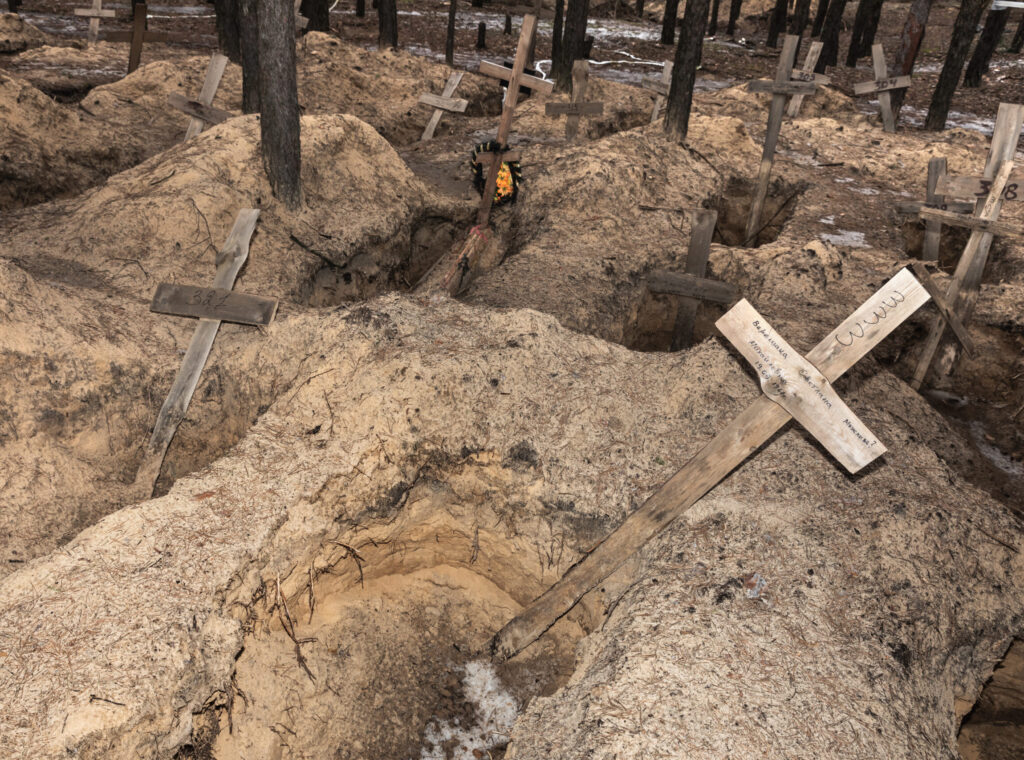
Image: Crosses are seen at a forest grave site after an exhumation in the town of Izium, recently liberated by Ukrainian forces. Only crosses and pits remain in the pine forest on the outskirts of Izium, where a mass grave was discovered after the town was liberated by Ukrainian forces. At the end of September, law enforcement officials completed the exhumation. They removed 450 bodies from the graves, mostly civilians. An employee of a local ritual service collected them from around the city and buried them in the woods near the old cemetery. (Photo by Mykhaylo Palinchak / SOPA Images/Sipa USA)
