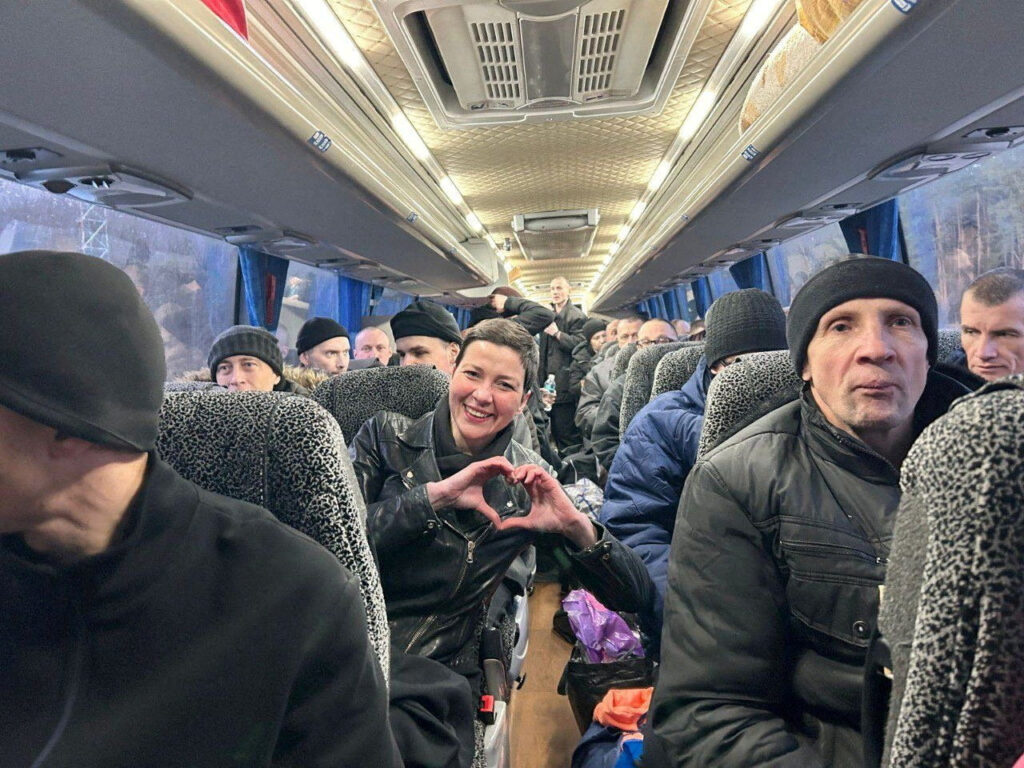
The freeing of 123 political prisoners in Belarus last week, including Nobel Peace Prize winner Ales Bialiatski and 2020 protest leader Maria Kalesnikava, must be seen as a major humanitarian win. Lives have been saved and families have been reunited. However, this large-scale prisoner release should not be interpreted as an indication of more fundamental change. On the contrary, it is a calculated move by Belarusian dictator Alyaksandr Lukashenka to extract concessions from the West without abandoning his reliance on domestic repression.
Commenting on the releases, US Special Envoy for Belarus John Coale confirmed that Washington planned to lift sanctions on Belarusian fertilizer exports. He also suggested that all remaining Belarusian political prisoners could be freed in the coming months, potentially in a single group. This prompted some talk of a potential thaw, but it is premature to draw such conclusions. In reality, the Lukashenka regime remains as authoritarian as ever and is not reforming. Instead, it is bargaining.
When assessing the significance of the recent prisoner releases, it is important to maintain a sense of perspective. The 123 people freed in early December represent only a relatively small portion of the more than 1100 political prisoners currently being held in Belarus. Meanwhile, more names are regularly added to the list. During November 2025, human rights group Viasna identified 33 new political prisoners in Belarus.
The Lukashenka regime has clearly learned from similar agreements with the United States earlier this year, which also saw prisoners freed in exchange for sanctions relief. This is fueling a transactional approach to what should be primarily a human rights issue.
While this year’s prisoner releases demonstrate that sanctions relief can produce welcome results, any further reduction in sanctions pressure by the United States should be approached with caution. If prisoner releases are rewarded without any expectation of broader shifts away from authoritarian policies, repression itself becomes a bargaining tool. In such a scenario, there is a very real danger that political prisoners could become virtually inexhaustible bargaining chips for Lukashenka.
Stay updated
As the world watches the Russian invasion of Ukraine unfold, UkraineAlert delivers the best Atlantic Council expert insight and analysis on Ukraine twice a week directly to your inbox.
In one if his first interviews following his release, Ales Bialiatski warned about the dangers of negotiating with Lukashenka without demanding wholesale change. He noted that releasing individual prisoners will not be enough to end repression in Belarus. The regime could easily exchange prisoners on a regular basis, he cautioned, freeing some and imprisoning others while asking for new concessions. Bialiatski’s insights should help inform international engagement with Belarus.
Looking ahead, the United States and European Union can play complementary roles in relations between Belarus and the democratic world. Washington’s sanctions tend to be intentionally more flexible. This makes it possible to offer targeted relief based on concrete humanitarian progress, while also allowing for an increase in pressure if Minsk backslides.
In contrast, European sanctions are more focused on systemic change. They are tied to ending policies of political persecution, embracing elements of democratic transition, and addressing Belarusian participation in Russia’s invasion of Ukraine. Any steps to weaken EU sanctions would reduce Europe’s ability to influence Minsk and rob Brussels of the tools to bring about more meaningful change.
Recent events have highlighted the lack of genuine progress toward constructive engagement between Belarus and the country’s European neighbors. Despite a number of goodwill gestures toward Belarus such as the reopening of EU border crossings, Minsk has continued to engage in provocative actions such as launching weather balloons into Lithuanian airspace.
Eurasia Center events
Lukashenka may have economic motives for seeking to secure sanctions relief in exchange for limited concessions. The Belarusian economy has benefited in recent years from a spike in wartime demand linked to Russia’s invasion of Ukraine, but this growth is now cooling. With less room to maneuver. the Belarusian dictator has good reason to engage in deals that can relieve the financial pressure.
He may also believe the time is right to reestablish his credentials on the geopolitical stage. As US-led negotiations to end Russia’s war against Ukraine continue, Lukashenka might see opportunities for a return to the mediator role he occupied during the initial stages of Russian aggression just over a decade ago. Many observers noted that during the latest prisoner releases, most of the freed detainees were sent to Ukraine rather than Lithuania, which has previously served as the main destination. This may have been an attempt to highlight ongoing cooperation between Kyiv and Minsk.
Greater engagement between the Lukashenka regime and the West could potentially be beneficial but a measured approach is essential. Future sanctions relief must be conditional and tied to verifiable steps such as the release of all political prisoners, an end to new politically motivated arrests, and the restoration of basic civic liberties. The rights of released prisoners must also be respected. This includes allowing them the option to remain in Belarus and providing them with full documentation.
Further steps to improve dialogue with Belarus should also be based on a realistic assessment of achievable goals. For example, it is wishful thinking to suggest that limited sanctions relief could somehow pull Minsk out of the Kremlin orbit. On the contrary, Lukashenka is now more dependent than ever on the Kremlin and will almost certainly never dare to distance himself from Russia, regardless of how skillfully sanctions are applied and relaxed.
What sanctions can do is constrain Lukashenka’s options and secure specific concessions. The ultimate objective should be an end to all human rights abuses and oppressive policies, rather than the targeted release of high-profile prisoners. Until that goal is within reach, the European Union in particular has a key part to play in maintaining pressure on Lukashenka.
Hanna Liubakova is a journalist from Belarus and nonresident senior fellow at the Atlantic Council.
Further reading
The views expressed in UkraineAlert are solely those of the authors and do not necessarily reflect the views of the Atlantic Council, its staff, or its supporters.

The Eurasia Center’s mission is to enhance transatlantic cooperation in promoting stability, democratic values, and prosperity in Eurasia, from Eastern Europe and Turkey in the West to the Caucasus, Russia, and Central Asia in the East.
Follow us on social media
and support our work
Image: via REUTERS