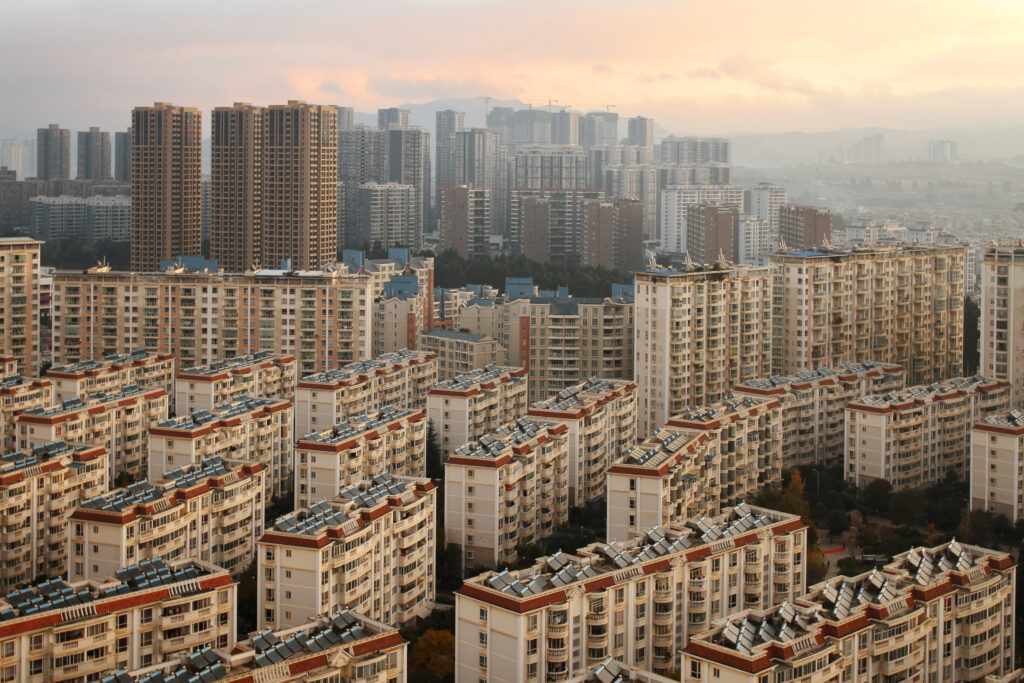
China’s real estate slump is in its fifth year, with no end in sight. Key indicators—sales, prices, construction starts and completions—continue to slide, while an estimated eighty million unsold or vacant homes clog the market. Many of the country’s largest private developers have defaulted on debts, and one of the largest state-backed firms, China Vanke Co., has been struggling for months to stave off a similar fate. One Chinese economist estimates that as many as 80 percent of developers and construction firms could “exit the market” in the coming years as the industry permanently contracts.
After leaning on regulatory changes and fiscal measures in a largely ineffective effort to put a bottom under the market, China’s leaders now appear to be shrugging their shoulders and moving on. Beijing has declared that the “traditional real estate model” of “high debt, high leverage, high turnover” has “reached its end” and instead is seeking to create a “new model of real estate development,” based on what one foreign bank has called “planned property supply.” In the future, China’s Minister of Housing, Ni Hong, recently wrote, the industry will be characterized by “affordable housing,” improved services, and “basically stable prices.” This marks the virtual abandonment of an industry that once accounted for about one-quarter of China’s gross domestic product and roughly 15 percent of the nonfarm workforce.
China’s housing plans collide with reality
A key problem with the new property paradigm is that it largely ignores market forces that are still very much at play. Real estate has been the primary repository of life savings for hundreds of millions of Chinese households. Yet according to Macquarie Group, roughly 85 percent of the price gains that underpinned that wealth creation have evaporated since 2021, when the government clumsily imposed credit restrictions to rein in a bubble it had tolerated for years.
Many of China’s current economic problems can be traced, at least in part, to this collapse: weak retail spending, nonexistent consumer and business confidence, declining investment, and falling prices. Without at least a partial recovery in the real estate market, the Chinese government will be hard pressed to make meaningful progress on its much-trumpeted goal of boosting domestic demand. That problem was underscored in the growth numbers for the fourth quarter of 2025, released last week, that showed weak consumer demand continuing to drag on the economy.
Zombie companies threaten the banking system
There is still a great deal that could go wrong—starting with China’s financial system. Banks so far have withstood the fallout from the defaults of several of the country’s largest private-sector developers. Many of these collapses have been well-documented, as more than sixty developers have either defaulted on offshore debt or entered restructuring negotiations, some of which have played out in Hong Kong courts. But focusing on these high-profile cases obscures a deeper and more pervasive problem. Beyond the major firms headquartered in Shanghai, Shenzhen, and other megacities lies a vast ecosystem of lower-tier developers and construction companies in smaller urban centers that are unable to service their debts—a dynamic that poses mounting risks to banks and shadow lenders alike. Recent research shows that many state-backed developers are being kept afloat with government support, including favorable funding and privileged access to undeveloped land in the biggest cities.
Researchers at the Dallas Federal Reserve Bank recently estimated that in 2024, roughly 40 percent of bank loans to the real estate sector were to companies whose operating earnings could not cover their interest obligations—up from just 6 percent in 2018. Most of these loans are being rolled over rather than recognized as losses, effectively turning the borrowers into “zombie” companies. Across the broader economy, the Dallas Fed researchers estimate, the share of such zombie firms reached 16 percent in 2024, up from 5 percent in 2018.
The shadow network behind China’s property bubble
Many of the loans weighing on the banks are tied to the massive buildup of local government debt, which has forced the central government to pony up some $1.4 trillion in refinancing over the past year. “The intricate and [tight] interconnections between financial institutions, the real estate sector, and local and central governments create a fragile environment,” AXA Investment warned in a prescient 2024 report. “In such a context, even a minor disturbance could potentially trigger a chain reaction, destabilizing the entire banking system.”
Unlike offshore debt restructurings, the troubles of most zombie firms are rarely visible. That opacity, however, has begun to crack. Bloomberg reported last month on a crisis in Hangzhou involving a shadow lender that failed to make $2.8 billion in payments to investors in wealth-management products. The underlying assets that the lender was relying on to generate income were loans to real-estate developers, at least ten of which had defaulted on commercial paper obligations. A nationwide web of such arrangements fueled the expansion of China’s property bubble—and now poses a systemic threat as it unwinds.
China’s six largest commercial banks, all of them state-owned, are widely regarded as financially sound, even as their profit margins have been squeezed by government-mandated interest-rate cuts. Analysts, however, are increasingly concerned about the health of regional banks and thousands of smaller rural institutions. These lenders have extensive ties to local government financing vehicles (LGFVs), which were established across the country to generate revenue for provincial, city, and county authorities. Many LGFVs became deeply enmeshed in real estate, often buying property at local government land auctions as private demand dried up in the latter stages of the bubble. At a recent roundtable organized by S&P Global, the chief Asia-Pacific economist for Natixis, Alicia Garcia Herrero, warned that these state-owned enterprises, “unable to generate adequate cash flows,” would force banks “to keep lending to them.” That dynamic is not a recipe for recovery. Instead, it risks locking the system into prolonged stagnation.
Hiding the numbers, facing the fallout
To make matters worse, the Chinese government has resisted opening its books to provide a clearer picture of the financial system’s true condition. In its periodic assessment of China’s financial system, released last year, the International Monetary Fund (IMF) reported that its “systemic analysis of risk in small banks (many of which are considered the most vulnerable) is hampered by lack of publicly available data and access to supervisory data. In addition, the authorities did not share institution-specific exposures to LGFV and property developers—which present the most conjunctural risk.” In recent months, Beijing has increasingly restricted information on the state of the real estate market by blocking the release of once publicly available sales data. This decision came right after the statistics for October showed the largest decline in home sales in eighteen months. Since last month, censors have also begun scrubbing social-media posts deemed “doom-mongering” about the real estate market and housing policy.
Chinese officials insist—including in their response to the IMF findings—that banking risks are well under control. And in the long run it is conceivable that the bureaucracy will muddle through and eventually restore a measure of stability to the property sector. But even in that best-case scenario, the likely outcome is a prolonged drag on the financial system and the broader economy.
Recent government plans do, for the first time, broach the possibility of developer bankruptcies, but they largely sidestep how the authorities intend to confront the full scale of household and institutional property losses. The Dallas Fed study draws an explicit comparison to Japan’s real estate-driven debt crisis of the 1990s, warning that “when there are few constraints on rolling over bad loans, the inefficient allocation of capital can lead to decreased productivity.” Similarly, Harvard economist Kenneth Rogoff—co-author of the definitive book on financial crises—and IMF economist Yuanchen Yang see troubling parallels with past episodes of financial instability. “Like many other countries in the past,” they write, China “too is facing the difficult challenge of countering the profound growth and financial effects of a sustained real estate slowdown.”
Even if the shockwaves from China’s collapsed property bubble eventually recede, the task of rebuilding will be daunting. It requires not only replacing a major pillar of Chinese economic dynamism, but also the revitalization of homeowners’ deeply damaged sense of financial security.
Jeremy Mark is a nonresident senior fellow with the Atlantic Council’s GeoEconomics Center. He previously worked for the International Monetary Fund and the Asian Wall Street Journal.
Related Reading