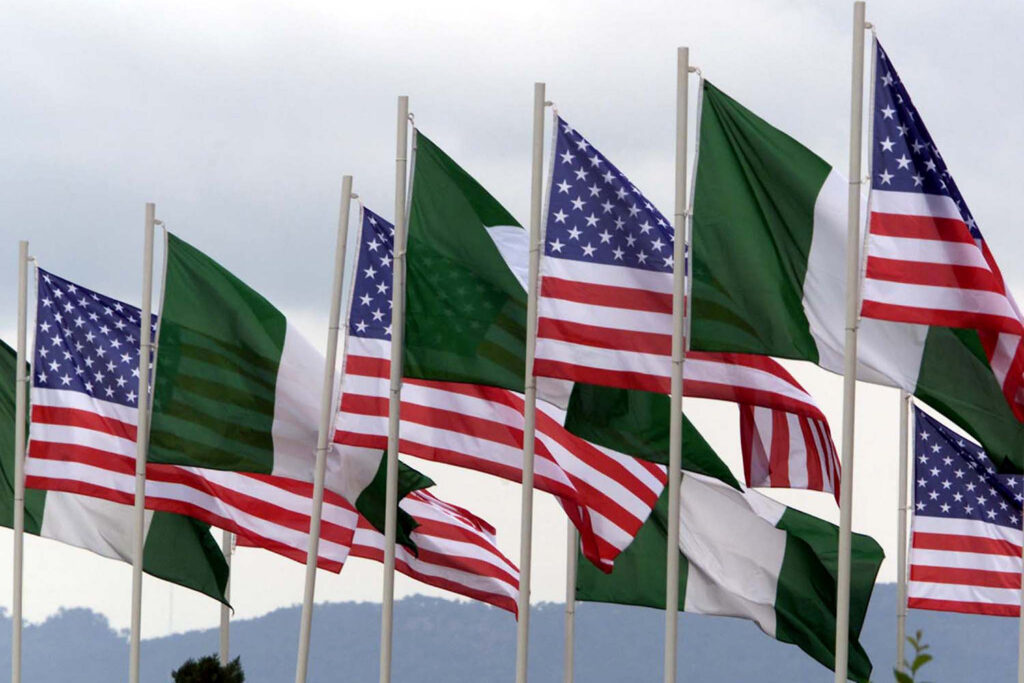
On Christmas Day, the US and Nigerian governments launched counterterrorism strikes in northern Nigeria, in the country’s northwest Sokoto State.
The joint counterterrorism operation followed months of heightened engagement between Washington and Abuja, as well as repeated public warnings from US President Donald Trump regarding potential military intervention and the redesignation of Nigeria as a “country of particular concern”—primarily over alleged violence against Christians. But soon after, Nigeria said it would welcome US assistance in addressing ongoing security threats, and, nearly two months later, the two countries engaged in their coordinated counterterrorism operation. The effort underscored how security cooperation, public perception, and diplomacy now intersect and affect each other more quickly and more publicly than traditional engagement frameworks were designed to manage.
The current moment in United States–Nigeria relations points to a broader conclusion: Sustaining this partnership will require a shift toward next-generation engagement, built on cooperation that extends beyond traditional diplomacy and is supported by new engagement architecture.
A crucial partnership worth maximizing in a new era
The relationship between the United States and Nigeria remains one of the most consequential bilateral partnerships involving the African continent. It links two actors whose economic power, security roles, demographic trajectories, and transnational commercial networks increasingly shape outcomes beyond their borders.
In 2024, bilateral trade in goods and services between the two countries reached approximately thirteen billion dollars, supporting private-sector growth, investment flows, and supply chains on both sides. For Nigeria, the relationship anchors market access, capital formation, and global integration; for the United States, it connects economic and strategic interests to Africa’s largest consumer market and most populous country, home to more than 235 million people.
Security cooperation further reinforces the partnership’s depth, with recent high-level engagements including the inaugural US–Nigeria Joint Working Group session in Abuja advancing coordination on counterterrorism, intelligence sharing, and maritime security. These efforts reflect shared interests in regional stability at a moment when diplomacy, security, and public perception increasingly intersect in real time.
Longstanding educational, professional, and commercial ties have also produced dense networks of entrepreneurs and executives operating across both economies, with Nigerian-founded companies such as Calendly illustrating how diaspora linkages translate into globally scaled enterprises connecting capital, talent, and markets.
At the same time, recent developments underscore how the scope of issues on the bilateral agenda—and the pace at which they shift—now extend beyond what traditional diplomatic instruments alone were designed to manage. Furthermore, the effectiveness of traditionally used diplomatic instruments is increasingly in question as the United States recalled its ambassador and Nigeria operated without a confirmed ambassador in Washington since recalling its diplomatic corps in 2023. Only recently, years after the recall, was a Nigerian ambassador to the United States approved.
Why Nigeria matters more than ever—for the US and Africa
What distinguishes the current moment for US-Nigeria relations is not a lack of shared interests but a growing divergence between the pace of global change and the engagement tools historically available to manage bilateral relationships, which remain largely intended for episodic and sector-specific engagement.
Recent transitions in US leadership (and the speed with which early rhetoric, policy signals, and public perception have shaped bilateral expectations) illustrate how quickly the operating environment can shift—often faster than existing diplomatic engagement mechanisms are designed to absorb.
When the engagement architecture for two countries has not evolved to match the speed and scale of their interaction, even well-intentioned actions can generate misinterpretation, hesitation, or unintended friction. Over time, this friction does not remain episodic; it begins to become a baseline upon which subsequent actions are interpreted, raising the cost of correction later.
Under these conditions, episodic responses do little for the durability of bilateral relationships. Instead, such durability depends on having architectures capable of absorbing shock, clarifying ambiguity, and countering rapid narrative formation on a continuous basis—particularly as policy signals, market shifts, and public sentiment more quickly translate into real economic and political outcomes.
Demography and digitalization significantly amplify this dynamic. Nigeria has more than 100 million internet users and over 150 million mobile connections, placing it among the largest digitally engaged populations globally. At this scale, connectivity is not theoretical; policy signals and market reactions travel almost instantaneously. Incremental changes in access, affordability, or policy rapidly draw tens of millions into formal commerce, financial systems, media ecosystems, and civic life, giving policy and investment decisions immediate and disproportionate impact.
Economically, Nigeria represents the largest concentration of consumers on the African continent and one of the few remaining large-scale consumption growth pools globally as demand growth slows elsewhere. Its trajectory increasingly shapes regional supply chains, capital flows, and investment logic, with growing relevance for global demand across energy, food systems, finance, technology, and entertainment.
Nigeria also anchors Africa’s digital services economy. Five of Africa’s nine technology unicorns, each valued at over one billion dollars, originated in Nigeria, including Flutterwave, Interswitch, OPay, Moniepoint, and Andela. These firms function not as isolated successes but as interconnected systems, positioning Nigeria as a central node in Africa’s economic architecture and digital future.
Cultural influence reinforces this structural weight. Nigeria’s cultural output now spreads globally through music, fashion, film, sports, and youth-driven creative expression. Nigerian music sits at the center of one of the fastest-growing global genres, generating sustained international consumption and rising royalty flows. Culture functions both as economic output and influence infrastructure, shaping how Nigeria is perceived, accessed, and partnered beyond formal diplomatic channels.
Yesterday’s diplomacy won’t work for today
Today, the US–Nigeria relationship will not fully realize its potential unless engagement practices adapt to a world in which markets, capital, and culture now shape outcomes as powerfully as governments do—often outside formal diplomatic timelines. Diplomacy remains central to the relationship, but the environment in which it is exercised has changed. Influence and economic consequence now move continuously, while diplomatic engagement has traditionally been structured around defined moments and cycles. In this landscape, bilateral political dialogue and security cooperation, while essential, cannot alone absorb or continuously translate rapid perception shifts, private-sector behavior, diaspora influence, or cultural legitimacy at scale.
What is required is an evolution in how diplomacy is executed—with an engagement architecture capable of operating with continuity across political, economic, and societal domains (as these domains increasingly intersect in practice) and of aligning statecraft with the systems through which influence now travels. Such an evolution could strengthen coordination, reduce friction, and sustain trust as conditions evolve.
Some bilateral relationships have begun to adapt to this reality by establishing standing engagement structures that operate alongside traditional diplomacy. The India-United Arab Emirates Comprehensive Strategic Partnership, for example, created mechanisms spanning trade, technology, mobility, and people-to-people exchange, designed to sustain coordination beyond episodic summits or political transitions. Similarly, the Saudi Arabia–United Kingdom Strategic Partnership Council provides a structured platform for ongoing dialogue across economic, social, and strategic domains, reducing reliance on crisis-driven engagement. While these arrangements differ in form, they reflect a shared recognition that complex, high-stakes relationships increasingly require durable architectures capable of coordinating across government, markets, and society.
The United States and Nigeria need to expand their existing engagement approaches. After all, structured engagement is increasingly essential to sustained coordination, clearer signaling, and shared clarity across policy, markets, capital, and perception—reducing volatility and room for misinterpretation for both governments.
In that sense, the United States and Nigeria need to pursue “next-generation engagement,” which unfolds across interconnected domains operating alongside formal statecraft. These include youth-facing platforms, capital and market ecosystems, digital and technology networks, creative and cultural industries, and sectoral arenas such as sport, which increasingly function as neutral convening spaces linking diplomacy, media, investment, and youth.
Meaningful engagement across these domains requires the deliberate inclusion of public-sector institutions, private-sector leaders and investors, technology and platform companies, policy institutions, and think tanks, as well as diaspora networks and cultural and civic actors who shape narrative and participation. This engagement is most effective when organized through structured, recurring dialogues, issue-specific working groups, and time-bound convenings aligned around shared objectives, instead of episodic diplomacy. Experience suggests such structured dialogues are most effective when anchored in recurring forums with defined mandates and clear lines of accountability.
The current moment in US–Nigeria relations is giving a structural signal: The relationship now demands tools capable of engaging people, markets, and culture alongside governments. This form of diplomacy recognizes that influence today is exercised as much through markets, mobility, and culture as through treaties. By coordinating across these domains through structured and trusted channels, the United States and Nigeria can reduce misalignment, strengthen confidence, and advance shared strategic objectives with greater resilience.
Next-generation engagement is not a departure from traditional diplomacy. It is its evolution. In a world where perceptions form faster than policy responses and markets move ahead of formal consultations, reliance on episodic engagement leaves too much to chance. Platforms that connect youth, capital, culture, and policy increasingly offer the only credible means to absorb signals early, reduce misinterpretation, and stabilize relationships before friction becomes fracture. The choice is not whether change is coming, but whether engagement evolves by design—or only in response to crisis.
Gbemisola Abudu is a nonresident senior fellow at the Atlantic Council’s Africa Center. She has worked across multiple sectors at the intersection of commerce, culture, policy, and international engagement in the United States, Middle East, and Africa.
Related Reading


Image: American and Nigerian flags fly next to each other in the center of Abuja August 24, 2000. PA/JRE via Reuters.