
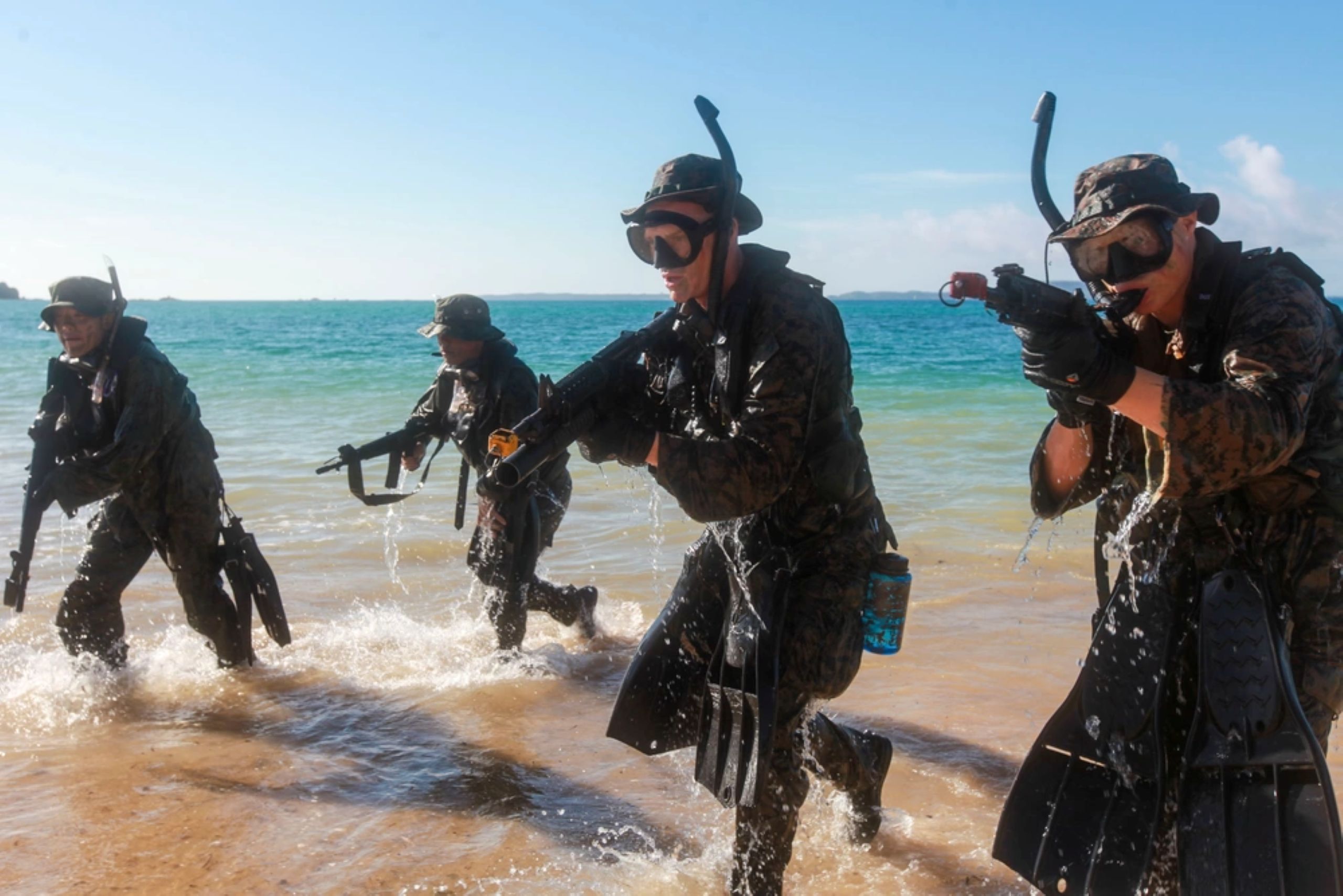
The US-Japan Defense Policy Review Initiative (DPRI), initiated in 2002 and signed in 2006, was designed to reduce the number of US servicemembers stationed on Okinawa for political reasons dating back thirty years or more. The plan now calls for shifting 5,000 Marines and 1,300 dependents from Okinawa to Guam, as well as a lesser number to other Pacific locations, and for building associated infrastructure over the next decade. But the United States only began moving the first tranche of one hundred Marines forces from Okinawa to Guam in December 2024. This move comes at a time when China is accelerating its bid for dominance in the Western Pacific and pressing its claim on Taiwan, which Beijing calls a “core interest.” This realignment undermines deterrence by pulling critical rapid-response forces from the First Island Chain, the first line of major islands running north to south along Asia. Now is the time to revisit the DPRI by providing Okinawa with economic incentives, reaffirming US commitments to its allies and the region, and restructuring the US plan for the Marines’ future force posture in Japan and across the Pacific.
Tension in the Western Pacific remains unabated, as China continues its bid for dominance over the East and South China seas. The People’s Liberation Army Navy controls several key islands and atolls, projecting influence over critical sea lanes. The Chinese Communist Party has clearly stated its intention to reunify Taiwan with the mainland, with Chinese President Xi Jinping tying unification to China’s “national rejuvenation” by 2049. These developments raise pressing questions about the United States’ ability to deter aggression in the near term.

Click on the banner above to explore the Tiger Project.
The importance of Okinawa
Since the end of World War II, the US armed services have maintained a stable and secure network of military bases, stations, and training areas in what would be the most critical area of influence in the event of a future military operation near Taiwan. The US military forces stationed in the First Island Chain, specifically in Japan, extending to Okinawa, are the bulwark of Western power in the Pacific—daily countering malign Chinese influence and deterring potential aggressors such as North Korea. Stand-in forces—small, lethal, mobile units that can operate within contested areas—need to be present there to allow for an effective response in the event of a conflict. If war breaks out, Chinese military planners will need to contend with the risk of intervention from nearby forces from bases and stations such as the Marine Corps camps Foster, Hansen, and Schwab, as well as Marine Corps Air Station Futenma.
US forces in Okinawa are known for rapid-response capabilities, demonstrated in major missions such as Operation Tomodachi and typhoon relief efforts in the Philippines and elsewhere. The III Marine Expeditionary Force and its new Marine Littoral Regiments are designed to operate within Chinese missile threat zones and emplace survivable expeditionary advanced bases through dispersion, concealment, and signature management to ensure they can’t be detected. They could delay enemy advances and buy time for US reinforcements as key elements of the stand-in force by holding combatant ships and maneuver elements at risk as the rest of the US military moves into place. Chinese military planners would seek every method to deny or otherwise distance these Marine Corps littoral forces from the immediate vicinity prior to any military operation. Unfortunately, if fully implemented, the DPRI would give Chinese military planners exactly what they want—a removal of US forces from the locations where they would be most essential in a First Island Chain conflict.
The background
The DPRI was put into place in very different political and security environments. Earlier phases of the plan resulted in significant construction of new infrastructure on and off Okinawa to facilitate consolidating, moving, and removing forces to alleviate the perceived burden of hosting elements of the US military. Over the long term, this plan will move certain key US Marine Corps forces from Okinawa to Guam, about 1,500 miles away, or a three-day uncontested ship transit. Today’s political and military context, with an emboldened China, North Korea remaining a threat (albeit quiet for the moment), and improved US-Okinawa relations, demands a reassessment of this plan. According to a 2024 assessment, US military felony crime rates on Okinawa are now far lower than in decades past*, a trend that runs counter to some of the original arguments for relocating US forces. Moving stand-in forces away from the First Island Chain now risks undermining their strategic deterrence at a critical juncture.
A resolution to this dilemma will not be easy. This is mostly due to the long-term commitment to the original DPRI tenets over the past twenty years by both the Japanese and US governments. But the time has come to rework this agreement. With the Pentagon’s willingness to make dramatic changes to long-standing programs and policies, along with the leverage now in place with the Trump administration’s tariff policies, Washington has a window of opportunity to rework old DPRI agreements in a new, substantial way. Both the United States and Japan share an interest in pushing back against Chinese influence in spaces that should be open for international commerce—in accordance with the 2016 ruling by the Permanent Court of Arbitration—and ensuring geographic proximity to any potential Chinese move on Taiwan. A solution will likely revolve around three main areas: enhancing incentives for Okinawa, renegotiating new terms with the Japanese government, and reorganizing the Japanese and US military footprint within Okinawa itself.
Renegotiating the DRPI
First, any renegotiation will need to adequately incentivize the people of Okinawa to continue to support the thousands of military servicemembers and their families that they have already supported for decades. Economic incentives will be important, as Okinawa is generally the most economically disadvantaged prefecture in all of Japan. A special dispensation by the US and Japanese governments could recognize Okinawa as a unique status location—which would exempt it from US tariffs—to boost Okinawa’s economic viability nationally and regionally. A reduced-tariff designation could strengthen Okinawa’s tourism sector, which buoys much of the prefecture’s economy. The 2024 Okinawa Prefectural Assembly elections show that economic issues are forefront on the minds of its citizens, as the “All Okinawa” faction, which is traditionally opposed to the US military bases, lost its legislative majority. Additionally, US bases should relax regulations to make it easier for Japanese businesses to operate on base. Making the facilities shared by both the United States and Japan would be one way to accomplish this, as Japanese-owned businesses could operate on a shared facility.
Second, building a foundation to renegotiate terms with the government of Japan will be essential. Academics have shared growing concern within the Japanese government over the United States’ commitment to shared defense, especially nuclear security. US President Donald Trump’s visit to Japan in October was a good start. Now, additional public statements by senior US officials reiterating that Washington is committed to the defense of Japan, including the US nuclear umbrella, and extended deterrence if Japan continues to increase defense spending, could help lay the foundation for a renegotiation of the DPRI. The Japanese government understands the need to continue to bolster defenses in the First Island Chain. In 2024, the Japan Air Self-Defense Force scrambled its jets 464 times in response to Chinese incursions, mostly around southern islands, underlining a clear need for enhanced military response capability.
Third, if done right, reworking the overall laydown of forces in Okinawa could result in more efficient and advantageous basing options for both the Japan Self-Defense Forces and the United States. The US Army may be able to use some of the facilities that were built on Guam for the Marines—the Army has been pushing more presence in the Pacific. It may make sense for the larger, heavier army units to position themselves in the vicinity of the Marianas, which are outside the range of many Chinese missile systems but close enough to push forward at the right time, adding backstop deterrence. While some argue that keeping Marines in the First Island Chain leaves them vulnerable to missile threat, the truth is that maintaining a rapidly disbursable, low-signature force-in-readiness inside Chinese missile range is the exact intent of having a Stand-In Force—to deter adversaries, defend US and allied bases and territory, retain forward staging locations, and give political leaders decision space. Additionally, China must then consider what a strike on bases within Japanese territory would do to galvanize an opposing alliance.
What about Futenma?
Next, the decision to close the still-active Marine Corps Air Station Futenma, based on past crimes committed by US troops and noise concerns, deserves reassessment. Futenma is a superbly capable, safe United Nations-designated airfield with an almost three-thousand-foot runway sixty meters above sea level, and the replacement ocean-front runway under construction at Camp Schwab isn’t nearly as long or capable. All US fixed wing basing operations at Futenma were moved to Iwakuni more than a decade ago during previous DPRI iterations, which means that Futenma is currently a safer, quieter, and underutilized location prime for use in the defense of the First Island Chain. Washington and Tokyo should keep both Futenma and the replacement facility in Schwab, and use Futenma for both US and Japanese forces. Keeping both Futenma and Schwab open would maximize operational flexibility and preserve a vital logistics hub for responses to regional crises. The new nearby US Naval Hospital and University of the Ryukyus medical facility makes Futenma an ideal disaster response hub, as well.
Finally, if some Marines still must be moved from the main island of Okinawa, the US military could work with Japan’s Western Army to increase their presence in other locations in the First Island Chain through exercises or training. One such place might be Yonaguni Island, where a Japan Ground Self-Defense Force base was established in 2016. Yonaguni is the westernmost Japanese island, and on a clear day one can see Taiwan from there. In 2015, island residents voted for a referendum supporting Japanese troops being stationed there. Making Yonaguni part of the special tariff-free zone, along with increased economic benefits from the additional personnel living there, may increase the appeal. Sending Marines to Yonaguni even on a rotational or temporary basis would send an undeniable message of support for Japan, push back against China’s intentions in the South China Sea, and clearly demonstrate US resolve in the region.
The way forward
This article was updated on February 18, 2026, to clarify that the data cited for lower rates of US military crime on Okinawa is for felony crimes as of 2024.
