How Iran’s water bankruptcy seeped into the protest movement
Unrest that began in Tehran’s Bazaar in January spread nationwide in recent weeks, and turned deadly. Early reports described security forces using live fire in multiple Zagros belt towns, including the Ilam province, and nearby communities such as Lordegan. Violence eventually escalated dramatically during the government’s nationwide crackdown of January 8 to 9, when by some accounts over thirty thousand protesters were killed in possibly the worst massacre in Iran’s modern history.
Many of these protest hubs overlap with areas where severe water shortages in recent years have made life increasingly difficult. The pattern matters: these are not isolated security incidents, but repeated episodes of escalation in regions already under acute water stress and economic strain, where basic service failure has been eroding public tolerance for years.
Iran is approaching what its own meteorological authorities describe as “water day zero”—the point where supply systems simply stop functioning. In that frame, “shortage” is the wrong word; this is system failure. Many scientists describe this as “water bankruptcy”—a condition, associated with researchers including United Nations University Institute for Water, Environment and Health’s Kaveh Madani, in which the damage becomes effectively irreversible on human timescales. And when system failure shows up at the tap, it turns a long-term resource crisis into an immediate legitimacy crisis—especially in provinces where people already live on the edge of service collapse.
The unifying force in these protests is not ideology. It is the erosion of dignity. When officials demand “endurance” while connected networks profit from scarcity, the issue stops being technical. It becomes a judgment about whether the state considers citizens worth serving. That is when water stress becomes a political risk-multiplier: it raises baseline pressure, broadens participation beyond organized activists, and shifts perception from temporary hardship to systemic neglect.
Related reading
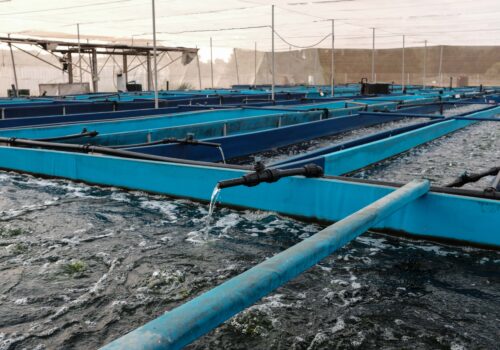
In Ilam, Abdanan, Lordegan, and much of southwestern Iran, the most visible marker of state failure is not a dry riverbed—it is the water tanker. Tankers are not just an emergency measure; they are a daily signal that the state can no longer deliver a basic public good. Once drinking water arrives by truck, life is reorganized around queues, uncertainty, and informal gatekeeping: who is served first, who waits, who is told “tomorrow.” That is where a technical shortfall becomes political—because people do not experience scarcity as a statistic. They experience it as humiliation.
That humiliation dynamic is not just “grievance,” it is a risk factor. When households depend on tankers, any additional shock—price spikes, fuel scarcity, electricity cuts that knock out pumps, or rumors of reduced deliveries—compresses the time between anger and mobilization. And because these protests emerge where services are already failing, the regime often meets them with faster, harder coercion—treating service breakdown as a security problem rather than a governance failure.
Ilam’s towns—Abdanan, Malekshahi, and the provincial capital—became flashpoints as protests spread and reports of lethal force, arrests, and fatalities mounted. The immediate catalysts are familiar—prices, repression, accumulated rage. Ilam’s deeper story is structural: unrest accelerates when a water system loses its buffers, and scarcity becomes routine rather than episodic.
Lordegan and other Zagros towns have followed a comparable path. For years, many analysts downplayed water as a decisive political factor in Iran, even as conditions worsened. That no longer holds. Water stress is now shaping events in real time. When household supply becomes unreliable, people experience it as a compounding burden that disrupts routines, drains incomes, and erodes dignity—conditions under which smaller shocks can trigger street-level mobilization. Water is not always the spark; it is the accelerant that makes every spark catch faster—and makes the state’s violent response more likely because the unrest is rooted in visible failure, not just political slogans.
Water bankruptcy is characterized by a persistent gap between societal demand and the hydrological system’s sustainable supply. In this condition, a wet year may slow deterioration, but it does not restore resilience. Groundwater—treated for decades as an emergency reserve—has been drawn down faster than it can recharge, with visible consequences including land subsidence and irreversible loss of aquifer storage in many areas. When scarcity is delivered through rationing, rotating cuts, and tankers, the pressure becomes daily, personal, and politically legible.
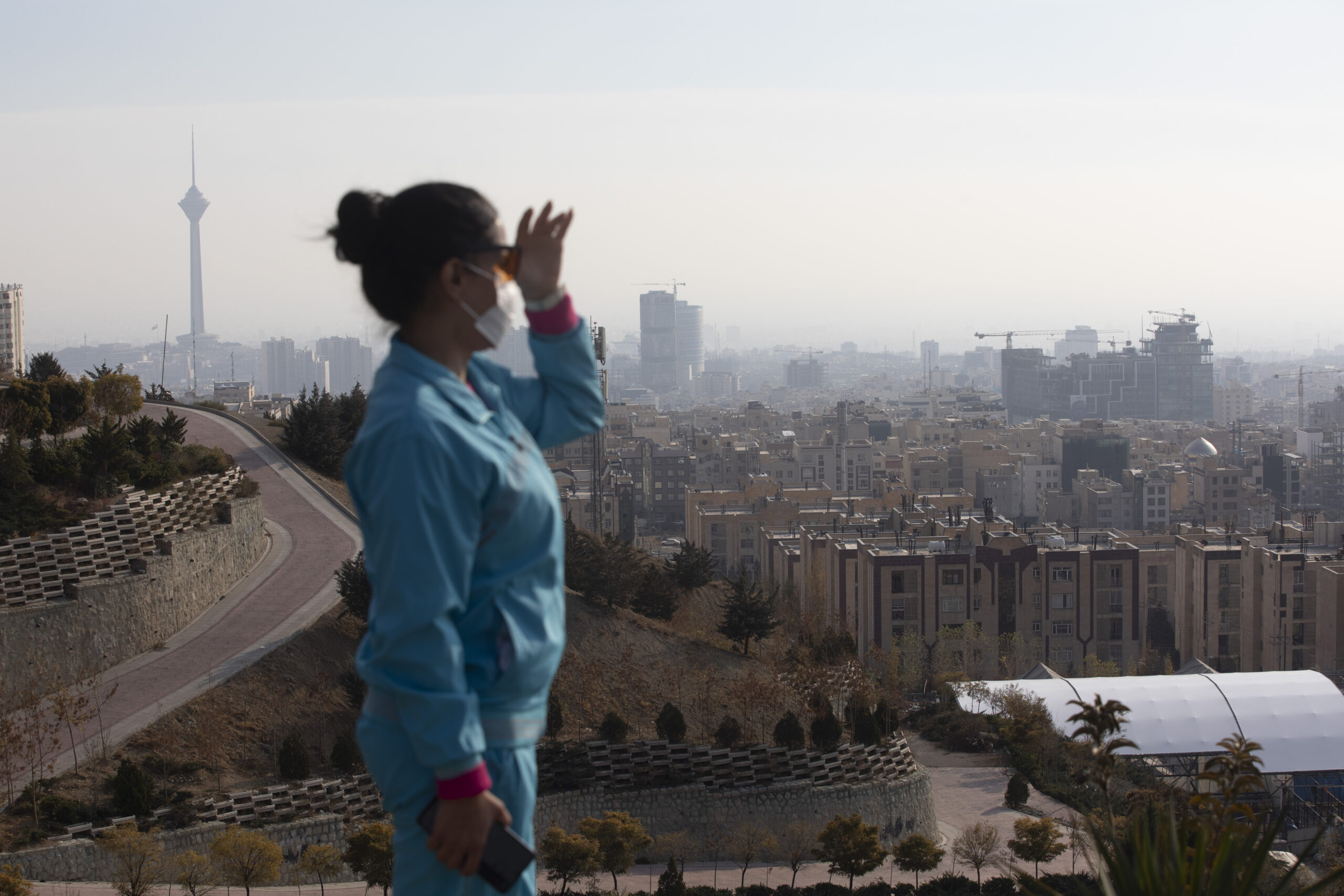
This water-driven vulnerability, affecting daily life, social cohesion, and the state’s ability to deliver basic services, amplifies other stressors. What changed in 2025 was stacking: water stress layered with energy shortfalls, international sanctions pressure, and security disruptions, while service delivery deteriorated and public trust continued to collapse. Under these conditions, shocks compress timelines. People move from frustration to action faster, because the margin for absorbing disruption has already been consumed. Recent reporting by major outlets ties this wave to prolonged planned cuts to water and electricity and to major air-pollution episodes that forced repeated shutdowns—conditions that make daily life feel ungovernable, even before politics enters the conversation. During severe smog episodes, authorities have shut schools and universities and repeatedly closed banks and public institutions for days at a time. In that setting, protests are not only sparked by single flashpoints, they are enabled, because normal routines have already been disrupted, and daily life starts to feel unmanageable long before politics enters the conversation.
Failure also persists because incentives reward the wrong outcomes: budgets, contracts, and political credit flow to visible mega-projects, while recharge, monitoring, pricing, and enforcement get treated as optional. Iran’s “water mafia” is not merely a slogan; it is a political economy. The pattern is that budgets and influence concentrate around big, ribbon-cuttable projects, dams, tunnels, and inter-basin transfers, because they create large contracts, subcontracting chains, and discretionary control, while quieter work like groundwater monitoring, enforcing pumping limits, pricing reform, leakage control, and managed aquifer recharge produces fewer rents and fewer photo ops.
Analysts have described the Islamic Revolutionary Guard Corps’s Khatam al Anbiya construction conglomerate as a central node in this ecosystem, an enormous contractor operating through layers of subsidiaries and thousands of subcontractors, with major state clients including the Ministry of Energy, and with procurement and oversight conditions that are often insulated from normal scrutiny.
Consulting engineering firms that design and justify megaprojects also sit inside the same incentive loop, including firms active across dams and water infrastructure, which further blurs the line between independent evaluation and project promotion. The result is structural: visible infrastructure gets financed and politically rewarded, even when it worsens basin-level depletion, while demand management and aquifer protection stay marginal. Climate change accelerates the consequences, but governance choices, and the incentives attached to them, determine the trajectory.
Finally, hydrology matters more than provincial borders. A basin is the natural water system, the connected rivers, groundwater, and watersheds that move water from upstream to downstream. Iran still governs water by administrative jurisdictions rather than basin-scale planning, which lets upstream allocations and diversions externalize costs onto downstream communities. In basins such as the Karun and Karkheh, many communities experience “development” as reduced water security and livelihood loss, not as protection from risk. In Khuzestan, water shortages have repeatedly spilled into the streets, including the July 2021 protests, which were met with lethal force, mass arrests, and communications disruptions, according to Reuters, Amnesty International, and Human Rights Watch. In wetland and farming systems linked to the Karkheh, the drying of border wetlands has been tied to dust storms, health impacts, and pressures on livelihoods and migration, making water decisions feel less like “management” and more like dispossession.
What the United States and partners should do
Washington already knows Iran is running out of water—and US political discourse has even adopted the “water mafia” framing. Iran’s crisis is no longer just political or economic, it is infrastructural. Treating water-system failure as a leading indicator helps predict where unrest may ignite, how quickly it may spread, and when coercion is likely to intensify.
First, Washington should build a water-driven, early-warning layer into Iran monitoring. Integrate service-failure signals—rotational cuts, tanker deployment, reservoir drawdowns, groundwater stress and subsidence, agricultural distress—with protest geography, labor unrest, and security posture. Add a “day zero” watchlist. Track cities and regions where household taps fail (not just “low reservoirs”) and treat that threshold as a leading indicator for rapid protest escalation and heavy-handed repression.
Second, Washington should treat the “water mafia” as a networked political economy. Map contractors, front companies, financiers, procurement channels, and security-linked actors tied to extractive mega-projects, then coordinate exposure and financial pressure to raise the cost of the incentives that perpetuate failure.
Third, Washington should monitor allocation as closely as scarcity. In many cases, perceptions of favoritism and pay-to-play access determine when water stress becomes politically explosive.
Fourth, where external support is feasible through partners, Washington should design it to minimize regime capture. Prioritize reliability gains that are hard to turn into patronage—repairs, leak reduction inputs, treatment chemicals, and monitoring capacity—paired with verifiable distribution mechanisms.
Fifth, Washington should plan for spillover. Water mismanagement in western Iran can translate into cross-border tensions and migration pressures, making coordination with Iraq and other neighbors a practical requirement.
Post–Islamic Republic: no single fix
Even after a political transition, Iran’s water crisis will not be solved by a single national “fix” imposed from the center. The problems are basin-specific—recharge rates, aquifer geology and salinity, subsidence risk, crop patterns, industrial demand, and cross-provincial politics all vary. A groundwater crisis in the southwest is not the same as an exhausted aquifer in central Iran, and it is not the same as a tightly regulated river system in Khuzestan. Treating it as one problem produces one outcome: failure.
What makes this urgent now is the stacking of shocks. Large-scale unrest and communications disruptions have already hit daily life and commerce inside Iran. At the same time, the region is under heightened military tension, and shipping around the Strait of Hormuz is showing clear stress signals, raising the risk of supply-chain disruption, including food imports. Domestic instability is unfolding alongside a regional escalation risk, and the two can reinforce each other quickly.
In that environment, any transition window will be fragile, and basic service delivery will become a frontline test of legitimacy. The United States should plan for the transition period as a governance and stabilization challenge, not just a diplomatic milestone. That means anticipating the scramble over water allocation and backing a post-transition package that is practical and non-centralizing: emergency continuity plans for critical cities, basin-by-basin damage and subsidence assessments, open publication of groundwater levels, permits, and withdrawals, real environmental assessments for major projects, plus a basin-wide check that assesses the combined impacts before approving anything new, as well as independent technical oversight that can withstand the politics of the moment. The aim is straightforward: prevent a vacuum where water distribution becomes a coercive instrument or a trigger for local conflict and instead make early decisions transparent, locally tailored, and enforceable, because in Iran water governance is not just sustainability, it is legitimacy.
Nik Kowsar is an Iranian-American journalist and water issues analyst based in Washington, DC. He produces and hosts a weekly TV program on Iran’s water crisis. He is also known for his past work as a political cartoonist.
Related Reading
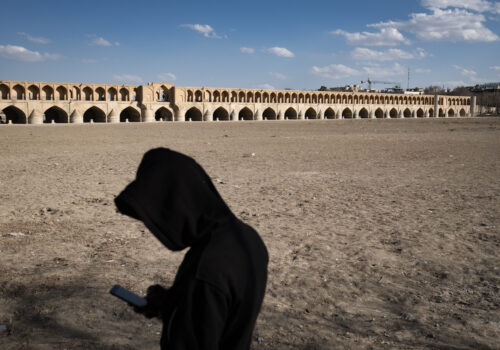
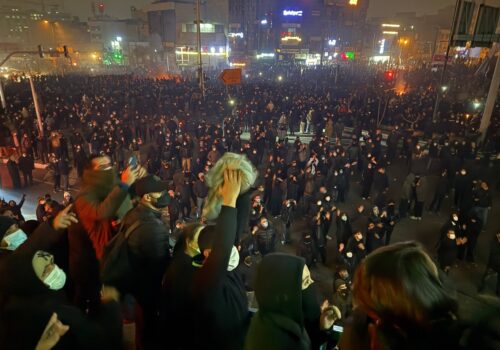
Image: A woman looks out over the smog-ridden metropolis of Tehran. Water shortages and air pollution plague the inhabitants of the Iranian capital.