Ukraine’s Sports Minister Matvii Bidnyi has slammed calls for Russia’s return to international football and warned that any attempt to reinstate the Russians would risk legitimizing the country’s ongoing invasion of Ukraine. “The ban is an important part of international efforts to stop the aggressor,” commented Bidnyi. “It’s a crime and you want to legitimize this crime.”
The Ukrainian official was speaking in response to recent comments by FIFA President Gianni Infantino. During a February 2 interview with Sky News, the head of world football’s governing body said that both FIFA and their European counterparts at UEFA should consider lifting the ban on Russian national and club football teams. “This ban has not achieved anything,” he argued. “It has just created more frustration and hatred.”
Stay updated
As the world watches the Russian invasion of Ukraine unfold, UkraineAlert delivers the best Atlantic Council expert insight and analysis on Ukraine twice a week directly to your inbox.
The current ban on Russian football teams competing in international competitions was one of many similar measures imposed in response to the full-scale invasion of Ukraine in February 2022. The International Olympic Committee and International Paralympic Committee placed restrictions on Russian athletes, as did the World Athletics Council. Other sports that imposed a full ban on Russian athletes included archery, badminton, baseball, basketball, biathlon, canoeing, ice hockey, rowing, sailing, softball, skating, skiing, taekwondo, and volleyball.
As the war has progressed, some international sports organizations and governing bodies have begun to soften their stance toward Russia. The country’s tennis stars have returned to the sport’s most prestigious tournaments, while Russian athletes in a range of disciplines have been permitted to participate in international events under a neutral flag.
Some sports have opted to lift restrictions entirely. In September 2025, the International Paralympic Committee announced that it would end its ban on Russian athletes, allowing them to participate fully in the 2026 Winter Paralympics. Similarly, in November 2025, the International Judo Federation, the International Sambo Federation, and the European Gymnastics General Assembly all removed bans on Russian athletes.
Eurasia Center events
Many of those advocating for or justifying the relaxation of restrictions on Russian athletes have done so by insisting on the separation of sport from politics. Others have noted that with the Russian invasion of Ukraine soon set to enter a fifth year, there is no indication that the bans have had any impact on Kremlin policymaking. Instead, they claim, these restrictions have merely imposed unjustified costs on individual Russian athletes and hindered their development.
These arguments conveniently overlook Russia’s long record of routinely exploiting sports for propaganda purposes. Throughout the Cold War, the Kremlin pioneered the practice of generating political capital from sporting success. While the USSR did not permit the development of professional sport, the Soviet authorities invested heavily in sophisticated training programs in a wide range of sports.
This trend has continued into the twenty-first century. Russian President Vladimir Putin spent tens of billions of dollars hosting the 2014 Winter Olympics and the 2018 FIFA World Cup. Both events provided the Kremlin with an opportunity to whitewash modern Russia’s image among international audiences.
Russian sporting successes abroad are also frequently celebrated in Moscow as victories for the country as a whole and brandished as proof of Russia’s standing on the world stage. When Russian hockey player Alex Ovechkin made history in spring 2025 by beating Wayne Gretzky’s record as the US National Hockey League’s all-time goal scorer, the Kremlin propaganda machine was quick to toast a national triumph.
On numerous occasions, Russian athletes have directly participated in Putin regime propaganda, including appearing alongside the Kremlin dictator at public events. The BBC reports that some prominent Russian athletes have direct ties to the Russian military, while others have shared pro-Putin and pro-war content on social media in support of the Russian military.
Efforts to ease restrictions on Russia’s participation in international sports are particularly painful for Ukraine. Russia has killed hundreds of Ukrainian athletes during the current invasion, while preventing countless thousands of young Ukrainian talents from continuing with their training and fulfilling their potential. To many Ukrainians, the entire notion of allowing Russians to return to the international sporting arena amid the ongoing war seems exceptionally unethical.
Any further moves to lift existing international bans on Russian athletes may have consequences far beyond the sporting arena. Welcoming Russia back would risk normalizing the invasion of Ukraine and sending a message that the international community ultimately lacks the resolve to hold major nations to account for acts of aggression. This would be potentially disastrous not only for Ukraine, but for countries across the globe.
Mark Temnycky is a nonresident fellow at the Atlantic Council and a freelance journalist covering Eurasian affairs.
Further reading
The views expressed in UkraineAlert are solely those of the authors and do not necessarily reflect the views of the Atlantic Council, its staff, or its supporters.

The Eurasia Center’s mission is to enhance transatlantic cooperation in promoting stability, democratic values, and prosperity in Eurasia, from Eastern Europe and Turkey in the West to the Caucasus, Russia, and Central Asia in the East.
Follow us on social media
and support our work
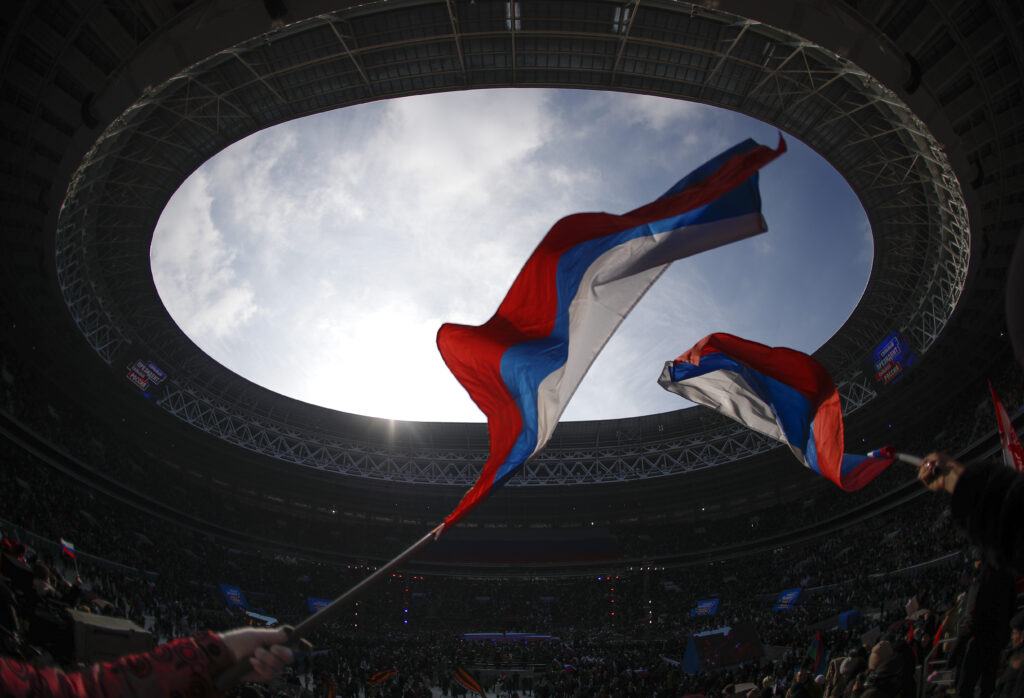
Image: People wave national flags as they take part in a pro-war rally to support Russian President Vladimir Putin in the upcoming presidential election at Luzhniki Stadium in Moscow, Russia. March 3, 2018. (REUTERS/Maxim Shemetov)