
MUNICH—In a quiet corner of the Hotel Bayerischer Hof, home to the Munich Security Conference (MSC)*, a senior European official—no fan of Donald Trump—explained to me why he nevertheless would be unhappy if the US president’s Republican Party loses in the midterm elections this November.
“Europe needs Trump,” this official told me with a wink suggesting half-seriousness. Love Trump or hate him, the European argued, no US leader in the official’s lifetime has done as much to advance European defense, political, and economic common cause.
As a result of his threats that he would not help defend allies who didn’t bear more of the burden, European countries have dramatically increased their defense spending in the past year. Through his tariff blandishments and economic bullying, Trump has accelerated historic European Union (EU) trade deals with Latin America, India, and Indonesia—and has triggered progress toward a capital markets union. In response to his threats (since withdrawn) to acquire Denmark’s autonomous territory of Greenland, European leaders showed rare backbone in near-unanimous alignment against him.
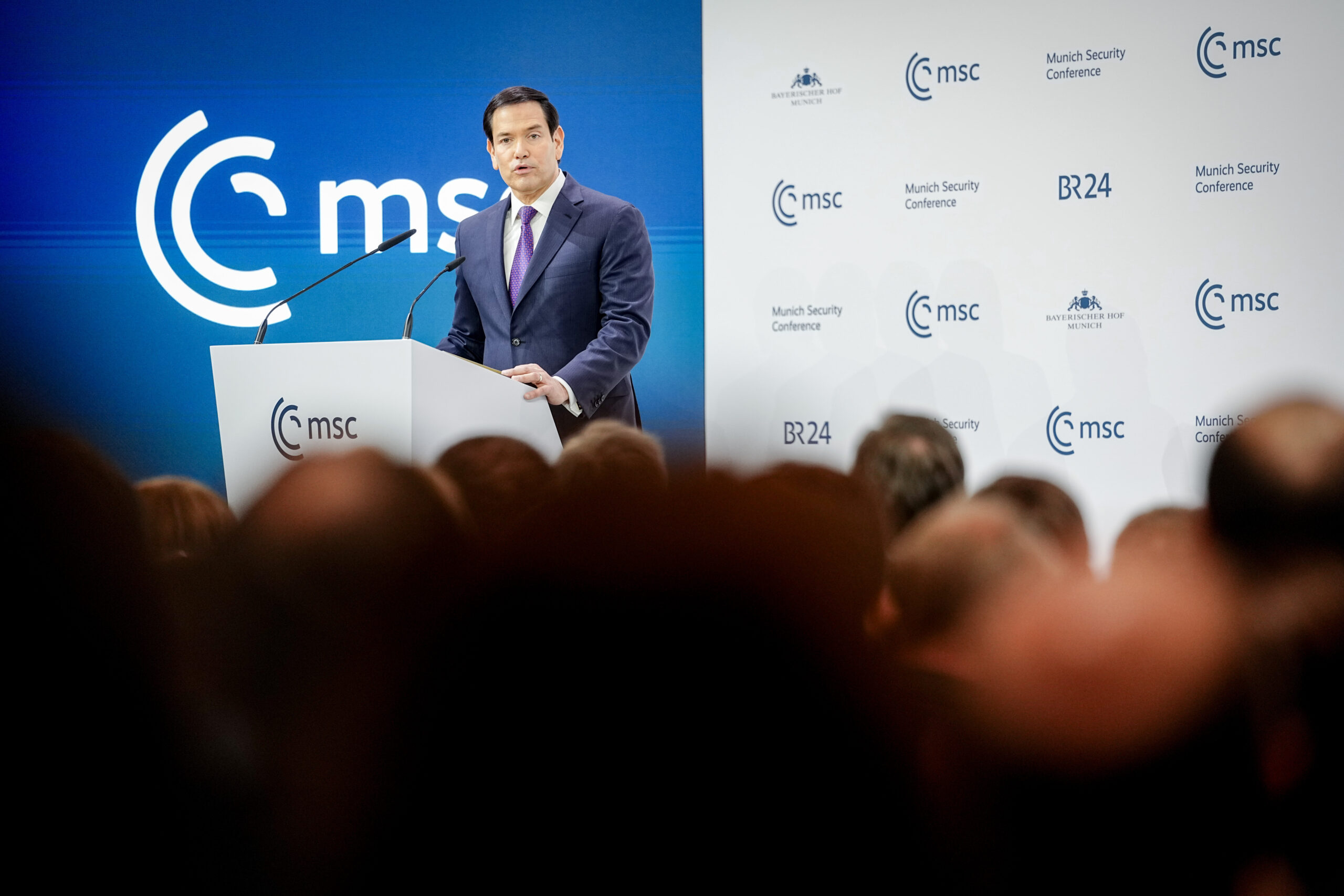
Over its sixty-three-year history, the MSC has provided a thermostat for transatlantic relations. By that measure, Trump’s return to the White House produced a bracing chill last year, when US Vice President JD Vance delivered his “bad cop” broadside against Europe. US Secretary of State Marco Rubio provided some countervailing warmth this past weekend, but his underlying message was no less tough on Europe’s need to change. “We want Europe to be strong,” he said, “because the two great wars of the last century serve for us as history’s constant reminder that ultimately, our destiny is and will always be intertwined with yours, because we know that the fate of Europe will never be irrelevant to our own.”
What was most important about this year’s MSC, however, wasn’t what it said about US-European relations, but rather what it demonstrated about Europe itself. Last year’s European emotional shock has evolved into a steely determination among the continent’s leaders to address their enduring vulnerabilities. These vulnerabilities include insufficient political unity, inadequate economic vibrancy, and—most immediately perilous—inadequate defense capabilities.
French politician Benjamin Haddad, minister delegate for Europe, invoked Roman emperor Marcus Aurelius’s thoughts on stoicism to describe the shift from European hand wringing to more resolute action. “You have power over your mind—not outside events,” the Roman emperor wrote in his Meditations. “Realize this, and you will have strength.”
Haddad’s point was that Europe cannot control US elections or presidential mood swings, but it can control its defense spending, its industrial capacity, its political cohesion, and its resilience. Marcus Aurelius ruled an empire beset by plague, invasion, and political instability, so his writings weren’t abstract philosophy. Europe’s existential test is whether its political experiment of pooled sovereignty can be leveraged and expanded in a world where Russia threatens its security, China threatens its economy, and the United States has become a more uncertain partner.
While Europe might have the luxury of time to address many aspects of this combined challenge, the most immediate danger is its race against the clock in Ukraine, where Russia’s full-scale war will soon enter its fifth year. Meanwhile, Moscow’s hybrid threats to Europe are growing, in particular against countries nearest to its border. Beyond that, The Financial Times reported over the weekend on a growing Russian sabotage network in Europe.
The “European awakening”
The EU’s existential problem is that it was created to integrate Europe peacefully after World War II but was not designed to defend it. At the MSC, one European leader after another addressed this challenge from the main stage as a high priority, while down the street, the inspiring SPARTA conference, a new MSC feature to meet the demands of the times, brought together dozens of European defense startups and prime contractors with private capital and government decision makers who have the authority to deploy, fund, or integrate next-generation defense technologies.
“We must grow a European backbone of strategic enablers: in space, intelligence, and deep strike capabilities,” said Ursula von der Leyen, the European Commission president and a former German defense minister. “Mutual defense is not optional for the EU,” she noted. It is an obligation in the little-invoked Article 42(7) of the Treaty on European Union, a clause, she said, that now needed to be brought to life.
She speaks as no EU leader before her about the urgency of building up Europe’s military muscle. “As they say in Ukraine, you change or die,” she said. “We must adopt this mantra too.” She urged Europe to “tear down the rigid wall between the civilian and defense sectors,” seeking ways for its formidable automobile, aerospace, and heavy-machinery industries to urgently contribute to the “defense value chain.”
Some progress is already being made. European defense spending in 2025, von der Leyen said, was up some 80 percent since before Russia’s war in Ukraine. By 2028, she added, European defense investment is projected to be even higher than what the United States spent in 2025. Beyond that, European countries are buying US arms for Ukraine worth billions through NATO’s Prioritised Ukraine Requirements List initiative. Europe also recently approved a ninety-billion-euro loan for Ukraine’s budgetary needs, which Kyiv would only be required to pay back if Russia eventually pays it war reparations. At the same time, the EU’s new Defense Innovation Office in Kyiv is merging European scale with Ukraine’s war-time speed and ingenuity.
“This is a true European awakening,” von der Leyen said, laying out a goal of independence. “We need a new doctrine for this—with a simple goal: to ensure that Europe can defend its own territory, economy, democracy, and way of life at all times. Because this is ultimately the true meaning of independence.”
The ticking clock
The question for Ukraine is whether the awakening has come soon enough. The clock is ticking as Russia continues to hammer away at civilian targets, energy infrastructure, and national morale, while the Trump administration continues to pressure Kyiv to make concessions to strike a peace deal that many Europeans feel would only be an interlude before further threats on Ukraine and beyond.
What’s little recognized, one European foreign minister shared with me, is that Vance’s jarring speech last year was followed the next day by European leader-level meetings that set in motion the Coalition of the Willing, led by British Prime Minister Keir Starmer and French President Emmanuel Macron. This group has since grown to embrace thirty-five countries, including Australia, Japan, and New Zealand.
The group has played two roles in the past year: It has stepped up European support for Ukraine as an existential imperative, including deep and continuing discussions over how best to provide Ukraine security guarantees. And it has done so while ensuring that Washington doesn’t abandon Kyiv. What concerned its leading members in Munich this past weekend was that Rubio didn’t meet with them—and also that he didn’t speak at all about continued US support for Ukraine in his otherwise encouraging speech.
In his speech at the MSC, German Chancellor Friedrich Merz noted that the EU’s gross domestic product (GDP), which was over $22 trillion in 2025, is about ten times as big as Russia’s. “Our military, political, and technological potential is huge,” he said, “but we haven’t tapped it to the necessary extent for a very long time.” Add to that the United States’ GDP in 2025 of more than $31 trillion, and the potential of the transatlantic community to shape the global future remains unequaled.
“Dear friends, being part of NATO is not only Europe’s competitive advantage,” said Merz almost wistfully, hoping the Trump administration was listening. “It’s also the United States’ competitive advantage. So, let’s repair and revive transatlantic trust together.” He poignantly reminded his audience that after 1945 it was “our American friends in particular who whetted us Germans’ appetite” for partnerships, alliances, and organizations that fought for freedom based on the rule of law. “We will not forget what you did for us. On this foundation, NATO became the strongest political alliance of all time.”
As for the Trump administration, Washington’s critics here focused on Rubio’s comments on Europe’s “climate cult” and the civilizational threat of mass migration. Alongside that, Rubio’s conciliatory message on shared values and history provided hope that’s worth building upon. “We belong together,” he said.
This year’s MSC made clear what Europe needs to do, irrespective of what happens next in US politics. To paraphrase another of Marcus Aurelius’s axioms, then: Waste no time arguing what should be done. Do it.
Frederick Kempe is president and chief executive officer of the Atlantic Council. You can follow him on X @FredKempe.
This edition is part of Frederick Kempe’s Inflection Points newsletter, a column of dispatches from a world in transition. To receive this newsletter throughout the week, sign up here.
Note: The Atlantic Council has a strategic partnership with the MSC and convenes several sessions in Munich each year.