Tehran appears to be suffering from a case of strategic vertigo. As Iranian leaders continue to see their major decisions backfire over the course of two and a half years, a disorienting dizzy spell may be the best way to describe the state of Iranian foreign policy.
Negotiations between the United States and Iran are ongoing, with US President Donald Trump saying Thursday that he expects a resolution within ten to fifteen days, as he also undertakes a massive military buildup for a possible conflict. The talks provide the regime with a rare opportunity—a gift, even—to escape from yet another predicament. The question right now is whether leaders in Tehran grasp the magnitude of the moment and refrain from their old habits of obstinance, or whether they will add another strategic error to their string of missteps—one that could be their last.
With the United States preparing for strikes if negotiations fail, it begs the question of how Iran got to the precipice in the first place.
Blinking on October 7
On October 7, 2023, Hamas achieved a long-held Iranian ambition: it managed to momentarily paralyze the Israel Defense Forces (IDF) and effectively hold parts of Israeli territory while Israeli society felt it was facing an existential crisis. Yet in hindsight, this pivotal moment overshadowed another simultaneous failure. With Hamas surprising the entire region, including its allies in Beirut and Tehran, Iran blinked while Israel was at its most vulnerable state in decades. Had Iran ordered Hezbollah—the crown jewel and strongest of its regional terror network—to join Hamas and launch a full-scale invasion of northern Israel, the Middle East’s landscape could have looked very different today.
Instead, Supreme Leader Ali Khamenei and his protégé Hassan Nasrallah, the Hezbollah leader, failed to grasp the magnitude of the event and made their first in a string of mistakes, opting for a limited-intensity conflict to stretch Israel’s capacity to fight on two fronts simultaneously without risking an all-out war that could have led to Hezbollah’s destruction. Thus, Iran and Hezbollah allowed the IDF to regain its footing after the initial shock. By choosing this path, Iran inadvertently gave Israel the space to dismantle Hamas’s military infrastructure in Gaza while systematically degrading Hezbollah’s capabilities in southern Lebanon.
Attacking Israel directly
Iran crossed a new threshold in April 2024, following Israel’s killing of Quds Force General Mohammad Reza Zahedi in Damascus. Mistakenly thinking Israel was still at a low point following October 7, Iran boldly moved its decades-long conflict with Israel from the shadows into full view when it launched a barrage of over one hundred ballistic missiles and roughly two hundred drones and cruise missiles. Backed by a coalition led by the United States along with European and regional allies, Israel thwarted the assault and countered with a strike targeting Iran’s air defense capabilities.
Iran’s decision to directly strike Israel reflected a major shift from its traditional reliance on its proxies for retaliatory measures. In doing so, Iran helped Israel cross a mental Rubicon. By the end of the next round of conflict between the two sides in October 2024, Israel realized that not only can it strike Iran, but contrary to the prior belief within its security establishment, it can do so at a relatively low cost due to its operational superiority.
Choosing defiance in nuclear talks
By early 2025 the strategic landscape in the Middle East had changed and Iran was more vulnerable than its leadership had realized. Its S-300 air defense systems were gone, Bashar al-Assad’s regime in Syria had fallen swiftly, and Israel managed to drastically degrade the military capabilities of Iran’s primary proxies, Hezbollah and the Houthis. And yet, Iran’s leaders entered negotiations with the United States on the country’s nuclear program in April 2025 thinking they were in a position of power to make demands without being attacked by either the United States or Israel. Presented with a sixty-day deadline by the Trump administration to reach a nuclear deal, Iran chose defiance again. It was the wrong choice.
With Trump’s deadline expiring, Israel launched Operation Rising Lion, which led to a joint US-Israeli campaign that paralyzed Iran in a matter of twelve days. Putting decades of planning into action, Israel struck Iran’s nuclear program, missiles, launchers, and air defense systems; precisely targeted its top commanders and nuclear scientists; and destroyed large portions of its defense industrial complex. To top it all, Israel laid the groundwork for the United States to join and carry out Operation Midnight Hammer, its airstrikes against Iranian nuclear facilities.
The regime had long said that the Islamic Republic and its revolution are the answer to the “great satan” and the “small satan”—the United States and Israel, respectively. But when the “satans” teamed up for the twelve-day war, the regime had no answers.
Killing the Iranian people en masse
After years of economic stagnation and hyper-inflation, and without any regional gains that would justify decades of spending billions on the Islamic Revolutionary Guard Corps and proxy groups, Iranians saw this regime for what it was: an empty shell of a “revolution” ruled by a corrupt clerical elite. Hence, it should come as no surprise that Iranians decided to courageously revolt.
Rather than realizing the major shift needed in policy, the supreme leader doubled down on old habits and ordered the mass killing of his people—effectively showing that he’s trapped in a sunk cost fallacy. Instead of addressing economic problems at home, the regime continues to pour money into rebuilding its proxies abroad. Instead of releasing detained protesters, the regime executes them in the dark of night while calling for Iranians to rally around the national flag and brace for yet another war.
Although these are not the first major protests in the Islamic Republic’s history, this time might be different. With so many killed and the economy in dire shape, growing numbers of Iranians don’t have much to lose right now. “Seeing the mass killing all over the country felt like waking up from a deep sleep with a slap on my face. I am so ashamed to be alive,” one Iranian woman told The Washington Post. “I am also full of rage.” With Iranians clear-eyed about this regime, the crackdowns could well be seen in hindsight as the start of this regime’s downfall.
Arriving at another crossroads
Amid this growing pressure, the current talks mediated by Oman could serve as a vital lifeline for the regime. Trump presented Iran with a golden opportunity to survive and achieve relief from punishing economic sanctions, but once again set a timeline to reach a deal. Iran has to decide whether to make concessions that conflict with its core values and identity or stick to defiance and risk the regime’s survival.
Given the fact that Khamenei has spent over thirty-six years cultivating a legacy of defiance against Western powers, a pivot seems highly unlikely. By now he may be incapable of sacrificing his ideological zealous to extricate Iran from an upcoming war. His public statements indicate that Iran isn’t going to make major concessions in any aspect the United States deems important.
Iran’s leaders appear to once again be choosing defiance. They would rather drag the country into another war than dismantle their nuclear program or put strict limitations on their ballistic missiles.
It is a gamble that could pay off. Iran is certainly capable of inflicting damage on the United States and its regional allies in any military conflict, and the regime won’t easily back down and rush to the negotiation table if it’s attacked for the second time in a year. If the regime somehow manages to withstand another military campaign without collapsing, it would solidify its standing both domestically and internationally.
But more likely, this defiance is a losing bet, as the ayatollahs fail once again to see that the strategic landscape has changed to their detriment. Having lost their balance due to strategic vertigo, they could fall at last.
Michael Rozenblat is a visiting research fellow at the Atlantic Council’s Middle East programs, from the Israeli security establishment. The views in this article are the author’s own and do not necessarily reflect those of any other entity.
Related Reading
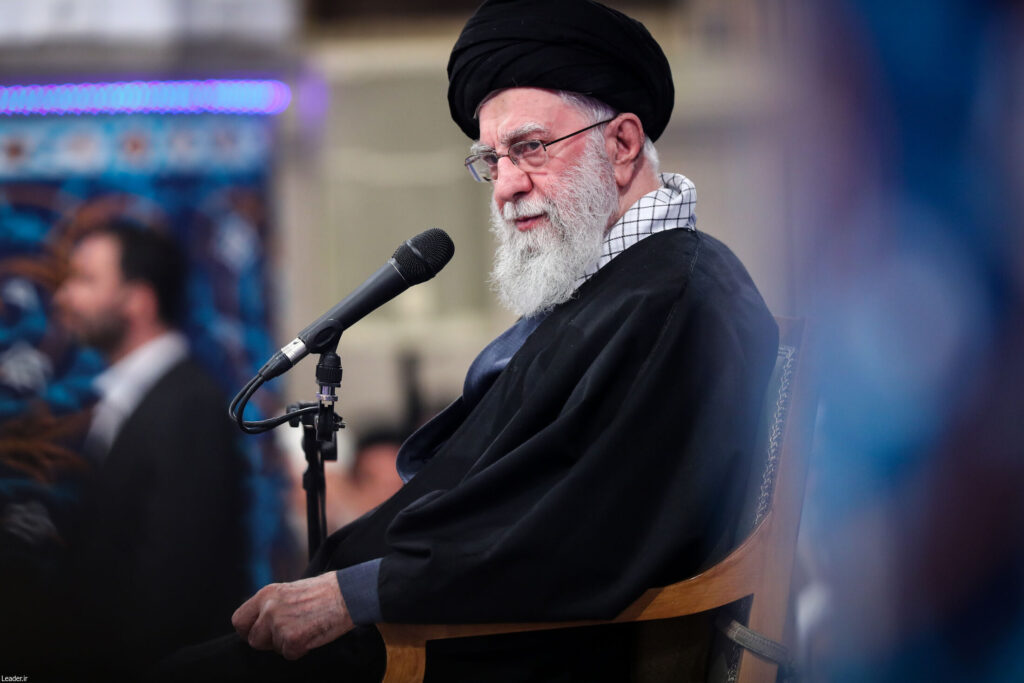
Image: February 17, 2026, Tehran, Iran: Iran's Supreme Leader, Ayatollah ALI KHAMENEI, attends a meeting in Tehran (Credit Image: © Iranian Supreme Leader'S Office via ZUMA Press Wire)