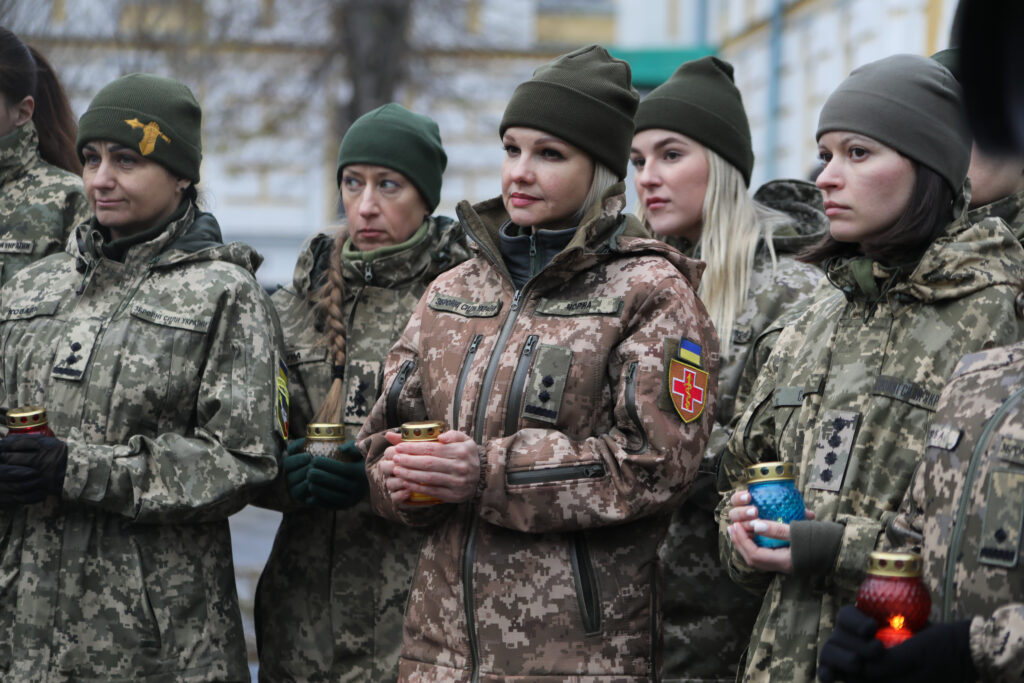
Ukraine’s fight against Russia’s ongoing invasion is often framed as a referendum on Western resolve, but the real test is whether the Ukrainians themselves can sustain a credible defense posture over time. As the war enters a fifth year, Ukraine’s long-term security will depend less on promises from abroad than on decisions made at home.
Ukrainian President Volodymyr Zelenskyy’s recent diplomatic push reflects this reality. Throughout 2025, he intensified efforts to shape a settlement that would not simply freeze the front, but also create a durable security framework. He did so knowing that any peace will be judged by its ability to prevent a future renewal of Russian aggression.
Crucially, peace through strength must mean the strength of the entire nation, not half of it. Ukraine’s security cannot rest on external guarantees alone. It must also be based on national capacity, including a cultural and institutional shift that integrates women as a pillar of defense planning. This is not a social policy argument. It is a force generation argument.
Even in an optimistic scenario, any agreement between Kyiv and Moscow will demand long-term readiness and self-reliance. Ceasefires can be violated. Commitments can erode. What endures is force posture: Trained units, predictable rotation, and the resilience to absorb pressure.
Deterrence is not a document. It is a condition and it rests on how effectively a state mobilizes and prepares its population. Yet Ukraine’s mobilization still reflects post-Soviet assumptions. Men between the ages of twenty-five and fifty-nine are treated as the default defenders of the state, while women are viewed as supplementary. That division no longer matches battlefield realities or Ukraine’s strategic needs.
Since 2024, Kyiv has tightened mobilization rules, expanded enforcement, and narrowed exemptions. These measures have stabilized force levels, but they have not solved the underlying problem: Ukraine is fighting a prolonged war of attrition against a far larger adversary. Pulling more men into the system without changing how the system functions will not produce sustainable results.
One weakness is preparation and allocation. Many men still only receive limited training before mobilization. At the same time, tens of thousands of women with in-demand support skills in fields such as logistics, communications, medicine, intelligence, engineering, IT, and drones, remain outside the recruitment and training pipelines.
The result is inefficiency on two fronts. Front line units are overstretched and denied predictable rotation, while rear area roles are often filled by personnel whose skills are misaligned with their assignments.
Stay updated
As the world watches the Russian invasion of Ukraine unfold, UkraineAlert delivers the best Atlantic Council expert insight and analysis on Ukraine twice a week directly to your inbox.
Ukraine does not need to mirror Russia’s mass mobilization model. It needs smarter force management. Women can be systematically integrated into roles currently performed by men far away from the front, including checkpoints, border duties, logistics hubs, training commands, communications and intelligence units, and other rear-area security functions.
In a war of attrition, regular rotation is essential to combat effectiveness. Reallocating personnel this way would relieve pressure on front line units. Over time, it would create a broader preparedness posture in which more Ukrainians have the skills to resist renewed aggression. It would also broaden the pool of people with military experience, which strengthens deterrence long after any ceasefire.
The case for integration is not hypothetical. Ukrainian women have volunteered in large numbers since 2014. Legislation adopted in 2018 granted women equal rights and responsibilities in the Ukrainian armed forces. By 2025, more than 70,000 women were serving in the Ukrainian military, including in drone units, medical evacuation teams, intelligence cells, and logistics chains. Recruiting data from the past year indicates that roughly one in five new candidates entering the pipeline was female.
Despite the growing prominence of women, the Ukrainian military has not yet fully adapted. Legal equality has not translated into institutional integration. Access to training and promotion is inconsistent. Women are still too often treated as volunteers rather than a core element of force planning. Discrimination and sexual harassment persist, while accountability is uneven.
Many barriers are practical. Units often lack properly fitted equipment and uniforms. Separate barracks, showers, and toilets are not universal. Access to gynecological care is inconsistent. Mechanisms to prevent and address harassment and misconduct are sometimes poorly enforced. These are not symbolic deficiencies; they directly affect retention, readiness, and morale.
A modern defense strategy is not built on weapons alone. It is built on resilience. Russia’s theory of victory assumes Ukrainian society will fracture under prolonged pressure. Zelenskyy’s diplomacy aims to deny Moscow that outcome by securing international backing and buying time. But society must disprove Russia’s assumptions in practice.
A whole-of-society defense that mobilizes women across military and security roles sends a strong signal of endurance. It demonstrates that Ukraine is prepared for years of deterrence and reinforces the message that Ukraine is building a modern European state.
This signal will also matter to allies. Western support is increasingly constrained by domestic politics. Ukraine’s strongest argument is not moral clarity alone, but strategic credibility. A country that can sustain defense over time is easier to support than one perpetually dependent on emergency assistance.
Eurasia Center events

Other states facing serious long-term threats have updated their security cultures. Israel mandated conscription for both genders in 1949. Norway introduced gender-neutral conscription in 2015; Sweden followed in 2018.
Ukraine has taken steps toward modernization. In 2024, it updated defense education curricula in secondary schools. By 2025, pilot programs expanded civilian preparedness. But beyond high school, structured pathways for women to acquire military training remain limited. Lyceums and military academies are still underused as talent pipelines.
The costs of delay compound. Exhaustion erodes combat effectiveness. Poor rotation accelerates burnout, desertion, and casualties. No peace plan, however carefully negotiated, can compensate for a force structure that excludes half the population from systematic preparation.
Whether Zelenskyy’s peace initiative succeeds or stalls, Ukraine will require endurance. The policy agenda should be clear. First, Kyiv should extend mandatory service to women aged twenty-five to sixty for designated non-front line support roles currently filled by men such as logistics, medical support, communications, and administration.
It will be crucial to clearly codify exemptions based on factors including parental and family commitments, along with professional status and medical limitations. This will make it possible to free more male personnel for front line duty while sustaining continuity of operations.
Second, the Ukrainian authorities need to fix the basics that determine retention and readiness. This includes properly fitted uniforms and equipment, adequate facilities, reliable medical and gynecological care, and strict enforcement against harassment and misconduct.
Third, Ukraine should expand training and education pipelines that actively target women, including military higher education. Recruiting data already shows demand; the state should convert that demand into readiness, while civil society tracks progress.
Fourth, Ukraine’s allies should support women’s integration through training exchanges. Western military commanders have decades of lessons to share on integrating women into units and training pipelines.
Finally, Kyiv will need to invest in long-term societal preparation. Ukraine cannot rely on emergency mobilization alone; youth must be educated early for the responsibility of defense. When service is framed as an expected civic duty rather than an abrupt wartime shock, conscription becomes a sustainable pillar of national security.
Security guarantees will shape Ukraine’s future, but guarantees are not substitutes for national capacity. Zelenskyy is right to pursue diplomacy that does not mortgage sovereignty; he is also correct to insist peace must be durable. Durability, however, will be measured in battalions, rotations, and readiness, not in signatures.
Ukraine’s most reliable long-term defense asset is its people: Men and women alike. Mobilizing and integrating women is not about ideology. It is a strategy for victory and long-term security.
Calin Trenkov-Wermuth is the former principal security governance advisor at the US Institute of Peace and co-author of The Future of the Security Sector in Ukraine, published by USIP. Sofia Kryshtal is the former executive coordinator of the USIP Task Force on the Future of the Security Sector in Ukraine.
Further reading
The views expressed in UkraineAlert are solely those of the authors and do not necessarily reflect the views of the Atlantic Council, its staff, or its supporters.

The Eurasia Center’s mission is to enhance transatlantic cooperation in promoting stability, democratic values, and prosperity in Eurasia, from Eastern Europe and Turkey in the West to the Caucasus, Russia, and Central Asia in the East.
Follow us on social media
and support our work
Image: Ukrainian servicewomen hold candles during an event honoring women who died for Ukraine at the National Kyiv-Pechersk Lavra Reserve in Kyiv, Ukraine, on November 24, 2025. A tulip tree (Liriodendron tulipifera) is planted between the Church of St. Nicholas and the Monastic Cells in memory of servicewomen, medics, volunteers, media workers, mothers, and daughters (Photo by Yuliia Ovsiannikova/Ukrinform/NurPhoto)
