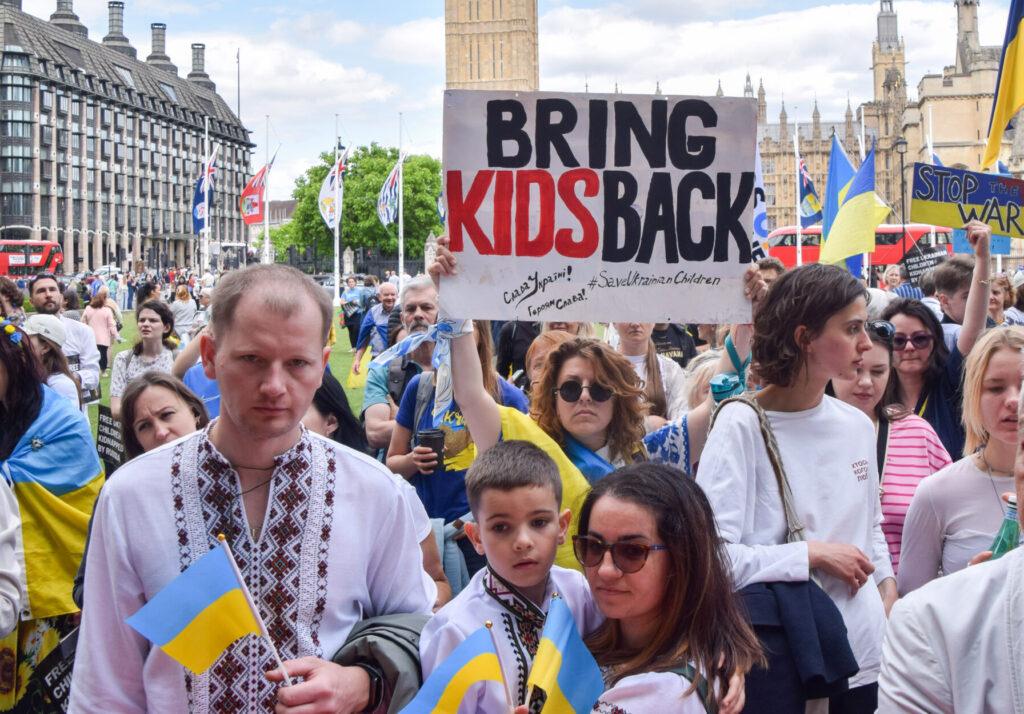
This week, the US Senate is holding a landmark Congressional hearing on Russia’s mass abduction of Ukrainian children. Most will understandably frame the issue as a grave human rights crisis, but it is also much more. Rescuing Ukraine’s abducted children can help pave the way for peace, while allowing Russia’s crimes to go unpunished would set a disastrous precedent for global security.
Russia’s systematic removal, indoctrination, and militarization of Ukrainian children goes to the heart of the broader security dilemma that must be resolved before the war in Ukraine can end. Any credible conversation about peace negotiations or security guarantees for Ukraine must begin with a demonstration that the United States and its allies can meaningfully influence Russian behavior. Ensuring the safe return of these children is a concrete way to do that.
The scale of the crime is staggering. Ukrainian authorities have verified 19,456 children taken to Russian or Russian-occupied territories, while independent experts estimate the actual number of victims may exceed 35,000.
What is indisputable is that Russia’s mass deportations are now among the best-documented crimes of modern warfare. Among numerous other investigations, the Yale School of Public Health’s Humanitarian Research Lab identified at least 210 facilities inside Russia or Russian-occupied territory where deported Ukrainian children have been sent for “re-education,” forced assimilation, and in many places, military-style training.
The evidence is overwhelming and includes coerced relocations, illegal adoptions and naturalization under Russian citizenship, ideological indoctrination aimed at erasing Ukrainian identity, and numerous violations of international law. This is not incidental collateral damage. It is a deliberate state policy of population transfer and Ukrainian national identity destruction; a Russian program that mirrors the legal definitions of numerous atrocity crimes, including genocide.
Stay updated
As the world watches the Russian invasion of Ukraine unfold, UkraineAlert delivers the best Atlantic Council expert insight and analysis on Ukraine twice a week directly to your inbox.
So far, it has only been possible to rescue a small fraction of abducted children. As of November 2025, 1,859 children have returned to Ukraine, while international experts estimate that 90 percent of the burden of rescue currently falls to Ukrainians themselves.
Moscow’s refusal to facilitate repatriation and its ongoing efforts to conceal identities and locations underscores the impossibility of any stable post-war order without addressing this crime. Humanitarian language alone obscures a critical truth: The forced transfer of children is not a peripheral human rights issue; it is a central obstacle to any credible security settlement in Europe.
For months, United States and European officials have been exploring frameworks for eventual peace talks with Russia and long-term security guarantees for Ukraine. But these conversations often treat Russian atrocities, including child deportations, as adjacent to the real business of hard security. This is a mistake.
Russia’s abduction of children is a window into its strategic intent. The Kremlin campaign to kidnap young Ukrainians and turn them into Russians reveals that Moscow’s war is not merely about territory but about imperial restoration. If Vladimir Putin only sought to adjust borders, the millions spent on relocating, indoctrinating, and militarizing thousands of Ukrainian children would make little sense.
Putin’s ominous intent becomes clearer when viewed alongside Russia’s broader atrocities. The Russian ruler clearly seeks to diminish the demographic future of an entire neighboring nation, while preparing the next generation for future Russian military aggression.
The issue of abducted Ukrainian children is especially relevant for Ukrainians as they debate painful political compromises, territorial concessions, and security guarantees premised on Western assurances. If world leaders cannot secure the return of the most vulnerable victims of Russia’s aggression, how could Ukrainians trust that those same leaders can prevent Russia from reigniting the war or committing new atrocities?
Eurasia Center events

Western policymakers insist that any post-war settlement must include credible enforcement mechanisms. But credibility is not defined by rhetoric; it is a matter of capability and political will. Right now, both are in question.
If the United States, with its immense military, diplomatic, and economic power, cannot compel Russia to return thousands of abducted Ukrainian children, it becomes harder to argue that Washington can deter further aggression or prevent violations of a future peace agreement. Ukrainians understand this reality well.
Demonstrating US leverage over Russia is therefore not merely symbolic. It is a strategic prerequisite to any durable peace. The United States has untapped tools at its disposal. These include sanctioning individuals and institutions directly involved in the abduction of Ukrainian children, while supporting multilateral accountability efforts. It should be also possible to condition further diplomatic engagement on verifiable steps toward repatriation. Meanwhile, the United States could lead a coordinated information effort to identify children and counter Russian concealment tactics.
These measures are proportional responses to atrocity crimes recognized under international law. The forcible transfer of children is a premeditated crime designed to shatter Ukraine’s future. A successful effort to bring Ukrainian children home will demonstrate that the United States can influence Russian behavior. This is a critical condition for any effective peace initiative.
Securing the return of abducted children would also help to build the trust needed for Ukrainian society to accept Western-backed security frameworks. After many failed efforts to constrain Russian aggression, Ukrainian society needs to know that Western promises are not empty.
Ignoring the issue, or relegating it to the humanitarian margins, undermines the very negotiations that the Trump administration is seeking to advance. Ending the war requires Ukrainian faith in international guarantees.
Child abduction is among the clearest moral red lines in global conflict. Failure to uphold this red line in Ukraine will invite repetition elsewhere. If Russia can abduct tens of thousands of children with impunity during a major European war and face no real consequences, then no norms protecting children in conflict can hold anywhere.
This week’s hearing marks an opportunity for Congress, the Trump administration, and Ukraine’s other partners to clarify that returning abducted Ukrainian children is not optional, negotiable, or separate from security discussions. It is central.
Kristina Hook is assistant professor of conflict management at Kennesaw State University and a nonresident senior fellow at the Atlantic Council’s Eurasia Center.
Further reading

The views expressed in UkraineAlert are solely those of the authors and do not necessarily reflect the views of the Atlantic Council, its staff, or its supporters.


The Eurasia Center’s mission is to enhance transatlantic cooperation in promoting stability, democratic values, and prosperity in Eurasia, from Eastern Europe and Turkey in the West to the Caucasus, Russia, and Central Asia in the East.
Follow us on social media
and support our work
Image: June 1, 2025, London, England, United Kingdom: Protesters gather in Parliament Square demanding the release of Ukrainian children kidnapped by Russia and an end to Russian aggression in Ukraine. (Credit Image: © Vuk Valcic/ZUMA Press Wire)