As American, Ukrainian, and European officials continue to debate potential peace plans among themselves, there remains very little to indicate that Russia is genuinely interested in ending the war. On the contrary, many of the Kremlin’s key demands during negotiations appear tailored to facilitate a continuation of the invasion on more favorable terms.
Russian President Vladimir Putin’s territorial claims alone should be enough to set off alarm bells. He insists that in order to secure a ceasefire, Ukraine must first hand over the remaining 10 percent of the Donbas region that his troops have failed to seize since the invasion first began eleven years ago.
As the ruler of what is by far the largest country in the world, Putin has no pressing need for the approximately 6600 square kilometers of Donbas territory still under Ukrainian control. Nor does the region contain any particularly important natural resources or historic sites that could justify its present position at the very heart of the peace process.
Putin’s true motivation is not difficult to discern. The unoccupied portion of the Donbas that he now so openly covets may seem relatively inconspicuous on the map, but it plays host to some of Ukraine’s strongest fortifications. Developed over the past decade, this fortress belt represents a formidable obstacle to Moscow’s invasion.
Analysts estimate that it could take years for Russia to occupy the area by force, and would likely cost the Kremlin hundreds of thousands of additional casualties. Beyond the fortress belt, the way would be open for further sweeping Russian advances into central Ukraine and toward Kyiv itself. This vital role in Ukraine’s overall defense explains why Putin is prepared to reduce his demands elsewhere but remains so eager for Kyiv to hand over this particular territory without a fight.
Stay updated
As the world watches the Russian invasion of Ukraine unfold, UkraineAlert delivers the best Atlantic Council expert insight and analysis on Ukraine twice a week directly to your inbox.
Among Moscow’s many demands, the biggest red flag of all is the Kremlin’s determination to demilitarize Ukraine and deprive the country of international allies. Ever since the first round of peace talks during the initial months of the war, Putin has consistently sought to impose restrictions on the size of the Ukrainian military and the categories of weapons the country can possess. While recent drafts envision a Ukrainian army of 600,000 troops, the fact that Russia remains so keen on limiting Ukraine’s ability to defend itself is an unambiguous signal of Putin’s bad intentions.
Likewise, the Kremlin’s bitter opposition to continued international support for Ukraine betrays the reality behind Moscow’s current peace posturing. This extends far beyond Russia’s well-documented objections to Ukrainian membership of NATO. Putin’s negotiators also seek to block future arms supplies to Kyiv and have completely ruled out the possibility of even a symbolic Western troop presence in postwar Ukraine, while demonstrating a deep reluctance to accept anything resembling credible security guarantees.
Attempts to defend Russian objections on security grounds are unconvincing. Putin has debunked his own claims of a NATO security threat to Russia by reacting with obvious indifference to neighboring Finland’s NATO accession in 2022, just months after using the issue as a convenient pretext for the invasion of Ukraine. According to this bizarre Kremlin logic, Ukraine’s slim hopes of joining NATO in the distant future were sufficient grounds to unleash the largest European war since World War II, but Finland’s almost immediate membership of the alliance was “no problem” for Moscow, despite the fact that both countries share long land borders with Russia.
Putin’s refusal to countenance purely defensive commitments from Kyiv’s allies that are clearly designed to safeguard Ukrainian sovereignty is even harder to justify. If the Russian ruler intended to coexist with an independent Ukraine, he would surely recognize the need for international involvement in efforts to reestablish stability in the region. Instead, he has adopted the opposite approach. While Ukraine appeals for security guarantees, Putin seeks to guarantee Ukraine’s insecurity.
Eurasia Center events
The insincerity of Russia’s current approach to the US-led peace process should come as no surprise. After all, while Putin may be willing to consider a pause in hostilities if it comes on Kremlin-friendly terms, he simply cannot risk a peace deal that secures the continued existence of an independent Ukrainian state. Any settlement based on the present front lines of the war would leave around 80 percent of Ukraine beyond Kremlin control and free to continue along the path toward greater European integration. That is exactly what Putin is fighting to prevent.
The Kremlin dictator has always viewed his war against Ukraine in the broadest of historical contexts as a crusade to reverse the verdict of 1991 and return Russia to its rightful place as a global superpower. Like many of his contemporaries, Putin remains embittered by the Soviet collapse and determined to avenge what he perceives as modern Russia’s humiliating fall from grace. This has fuelled his obsession with independent Ukraine, which he has come to regard as the ultimate symbol of the historical injustice resulting from the breakup of the USSR.
Putin’s increasingly rabid opposition to Ukrainian independence reflects his Cold War experience as a KGB officer in East Germany, where he witnessed the disintegration of the Soviet Empire firsthand. This traumatic experience has helped to convince him that the Ukrainian state-building project now poses an existential threat to Russia itself. If Ukraine is able to consolidate its statehood and emerge as a recognizably European democracy, Putin fears this could serve as a catalyst for the next phase in a Russian imperial retreat that began with the fall of the Berlin Wall.
Over the past two decades, Putin’s determination to undermine Ukrainian statehood has come to dominate his entire reign and has led directly to a new Cold War. From the 2004 Orange Revolution to the 2014 seizure of Crimea and the full-scale invasion of 2022, Ukraine has been at the epicenter of each new milestone in the deteriorating relationship between Russia and the West.
Time after time, Putin has demonstrated his readiness to sacrifice all other Russian national interests in his quest to subjugate Ukraine and force the country permanently back into the Kremlin orbit. He has reversed decades of integration into Western economies, placed Russian society on a wartime footing, and sent hundreds of thousands of Russian soldiers to their deaths. It is deeply delusional to think that he is now suddenly ready to abandon all of this and accept the reality of Ukrainian independence in exchange for the marginal gains of a compromise peace.
Putin’s own position during peace talks betrays his complete lack of interest in ending the war. His territorial demands would rob Ukraine of crucial fortifications and set the stage for further Russian advances, while his calls for restrictions on the Ukrainian armed forces and Kyiv’s ability to maintain military ties with the West would leave postwar Ukraine disarmed and defenseless. In isolation, any of these demands would look deeply suspect. Taken together, they represent overwhelming evidence of Putin’s intention to continue the invasion.
Peter Dickinson is editor of the Atlantic Council’s UkraineAlert service.
Further reading

The views expressed in UkraineAlert are solely those of the authors and do not necessarily reflect the views of the Atlantic Council, its staff, or its supporters.

The Eurasia Center’s mission is to enhance transatlantic cooperation in promoting stability, democratic values, and prosperity in Eurasia, from Eastern Europe and Turkey in the West to the Caucasus, Russia, and Central Asia in the East.
Follow us on social media
and support our work
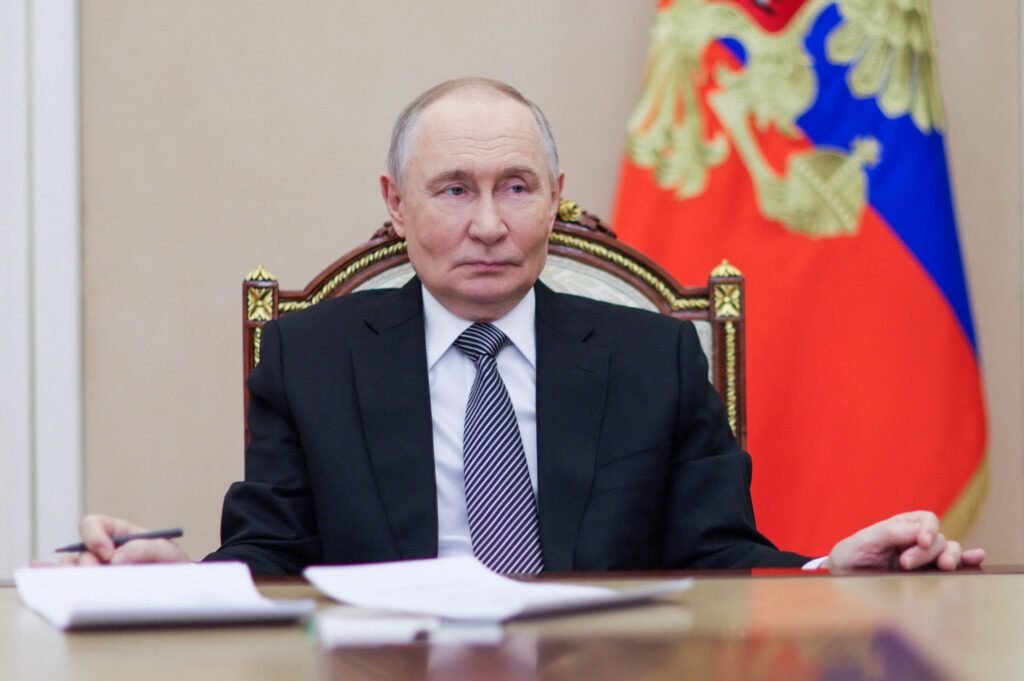
Image: Russian President Vladimir Putin chairs a meeting of the presidential council for civil society and human rights via a video link in Moscow, Russia. December 9, 2025. (Sputnik/Gavriil Grigorov/Pool via REUTERS)