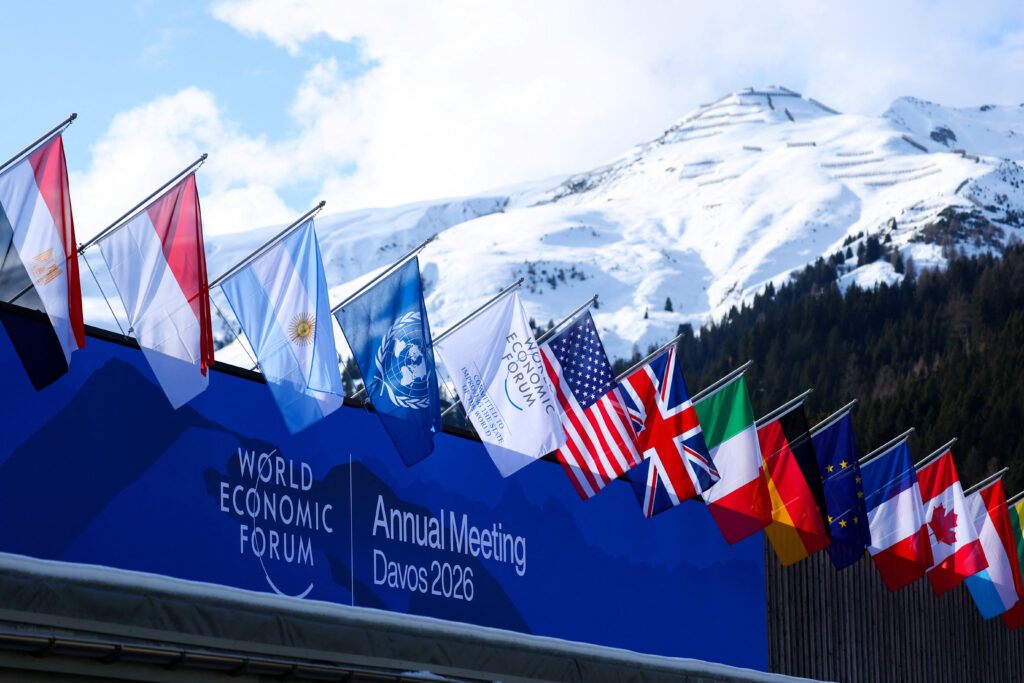
It’s hard to imagine a more discordant way for Donald Trump to mark the first anniversary of his second inauguration than by attending the World Economic Forum’s annual gathering of global leaders in Davos. When he speaks in the Swiss Alps on Wednesday, the US president will be contesting—whether intentionally or not—the very notions of global common cause Davos was designed to advance.
Klaus Schwab founded the World Economic Forum in 1971, a decade after the Atlantic Council’s own birth, with a post-World War II premise that held until recently: that greater security cooperation, economic interdependence, institutional cooperation, and shared rules could prevent another global catastrophe and advance more lasting peace and prosperity in a manner that also served US interests.
Trump travels to Switzerland this week as perhaps the most forceful skeptic of that internationalist assumption ever to occupy the Oval Office. He set the stage on Saturday by threatening new 10 percent tariffs on European nations that stood in the way of his heightened efforts to acquire the Danish territory of Greenland.
Trump has pledged to slap those tariffs on NATO allies Denmark, Norway, Sweden, France, Germany, the United Kingdom, the Netherlands, and Finland on February 1. If those countries don’t yield, Trump wrote on his Truth Social platform, he will jack up the tariffs to 25 percent—presumably atop the tariffs he has already put on Europe—on June 1 “until such time as a Deal is reached for the Complete and Total purchase of Greenland.”
For their part, European leaders are considering a number of possible economic counterstrikes. The Financial Times reports that the European Union (EU) is considering €93 billion of new tariffs, while the French are reportedly pushing for the first-ever use of Brussels’s “Anti-Coercion Instrument.” Known as ACI, it is regarded as the nuclear option in that it could put limits on foreign direct investment, restrict US suppliers’ access to the EU market (excluding them from public tenders), and place export and import restrictions on goods and services.
That turns Davos, whose theme this year is “A Spirit of Dialogue,” into the epicenter of the worst transatlantic economic conflict in memory. European leaders hope they can still reach yet another deal with Trump. That said, one senior allied official told me it is hard to imagine common ground given Trump’s “absolutist” position that the only outcome he will accept is Greenland becoming US property. Another European official described Trump to me as an aberrational bully willing to risk eighty years of accumulated transatlantic trust to achieve territorial ambitions.
A nineteenth-century president in a twenty-first-century world
To better understand who they’re dealing with, a long-time friend of Trump’s suggested to me that European leaders should look less to the past eighty years and more to the time before the world wars. He calls Trump a nineteenth-century US president governing in a twenty-first-century world—a leader who combines the expansionism of US President James Polk, pushing to enlarge the United States’ territorial realm as part of a “Modern Manifest Destiny,” with the twenty-first-century nationalism of current counterparts like Russian President Vladimir Putin (whom the Kremlin claims has just been asked to join Trump’s Gaza peace board), China’s Xi Jinping, India’s Narendra Modi, and Turkey’s Recep Tayyip Erdoğan.
While it was journalist John L. O’Sullivan who coined the term “Manifest Destiny,” it was Polk who popularized and implemented the notion that the United States was divinely ordained to expand its realm and spread democracy, capitalism, and American values across the entire North American continent.
To refresh your history: Polk, the eleventh US president, presided over Texas’s formal entry into the United States on December 29, 1845, though President John Tyler and Congress had initiated the process before Polk took office. That helped trigger the Mexican-American war that resulted in Mexico’s ceding of the entire American southwest to the United States. After a negotiation fraught with the risk of war, Polk acquired the Oregon Territory from Great Britain in 1846, giving the United States land for the future states of Washington, Oregon, and Idaho, along with parts of Montana and Wyoming, while Britain kept Vancouver Island.
That history lesson won’t hearten the leaders of Denmark or its Europeans allies, who presumably believed the nineteenth century was, well, history. Polk’s era was an age not of global governance but of sovereign states, great power competition, mercantilism, and jealously guarded spheres of influence, followed by two world wars. Diplomacy was personal and transactional—just as Trump likes it. Leaders wielded commitments as conditional and trade as an instrument of power, as was the case this week when Trump upended trade deals he had negotiated with European states to open a new fight over Greenland.
What’s further capturing conversation in Davos is Trump’s military-judicial operation that brought Venezuelan leader Nicolás Maduro to New York to face criminal charges, part of a heightened focus on the Western Hemisphere through his “Trump Corollary” to the Monroe Doctrine; his on-again, off-again threats to strike Iranian targets in response to Tehran’s killing of protesters; the US Department of Justice’s criminal investigation into Federal Reserve Chair Jerome Powell; and a series of domestic events that have made global headlines, most significantly the death of Renee Good in Minneapolis at the hands of an Immigration and Customs Enforcement agent.
A world-historic figure—but in what sense?
Many in Trump’s electoral base charge that he’s paying far too much attention to global affairs at the expense of their own economic struggles. However, don’t expect Trump’s focus to shift—not even in a mid-term electoral year when the Republican hold on Congress is in doubt. Trump’s eye is on history, not congressional seats.
“The world, he thinks, is where a political figure makes his mark,” writes Wall Street Journal columnist Peggy Noonan. “He desires a big legacy, still wants to show Manhattan (not to be too reductive, but there’s still something in it) that the outer-borough kid you patronized became a world-historic figure.” If that’s true regarding Manhattan, it is even more so for Davos, given that it symbolizes for Trump the club of first-tier global business leaders to which he never previously belonged.
If Trump’s aim is to be a world-historic figure—and that’s increasingly beyond dispute early in his second term—then what’s most important to ask is: world-historic in what sense? For that reason alone, it will be worth listening closely to how Trump describes himself this week in Davos and comparing that to his previous three appearances.
In 2018, early in his first administration, he declared in Davos, “America first doesn’t mean America alone. When the United States grows, so does the world.” In 2020, ten months before his electoral defeat, he highlighted two trade deals he had just closed, one with China and the other with Mexico and Canada. “These agreements represent a new model of trade for the twenty-first century—agreements that are fair, reciprocal, and that prioritize the needs of workers and families.”
Then in 2025, three days after his second inauguration, he set a far feistier tone. Appearing remotely via video, Trump declared the beginning of “a golden age of America,” speaking of the most significant US election in 129 years, lambasting his predecessor President Joe Biden, and announcing a storm of executive orders to address a “calamity,” particularly regarding immigration, crime, and inflation. He said little about the tariffs that would follow. “They say that there’s a light shining all over the world since the election,” Trump told the Davos crowd.
The big question chasing Trump this week, as I asked earlier this year in this space, is: “What sticks?”
It’s still uncertain whether Trumpism will usher in a new and enduring ideology of some sort. US President Franklin Delano Roosevelt brought the world New Deal liberalism, an ideology that has remained until this day; US President Ronald Reagan ushered in an era of internationalist conservatism that won the Cold War alongside allies, and it still lingers. When American presidents break with the past and usher in new eras, those trends tend to stick.
Many argue that Trump’s emergence underscores and advances a new nationalist era, one of nineteenth-century tenets laced with twenty-first-century technologies and geographies, even though those who know him best say Trump is not a student of history himself.
If it’s a new nationalism that’s emerging, what brand of nationalism might that be? Autocratic or democratic? Isolationist or internationalist? Realist or imperialist? The range of possibilities is immense.
A new vocabulary
What has stuck over the past year—a shift that’s palpable in Davos—is the erosion of old certainties. Trump’s emphasis on tariffs, industrial policy, and economic security has redrawn global trade rules and attitudes. His skepticism about multilateral arrangements has forced allies and partners to question systems they’ve depended upon since World War II. Trump’s blunt focus on borders, energy dominance, and the Western Hemisphere has global partners rethinking their own concepts of geography and leverage.
Davos matters this week not in terms of whether Trump will convert his listeners to his worldview, but rather because the world has already begun to change around those gathering there. The Davos vocabulary of cooperation and convergence coexists now with the new language of fragmentation, national interest, and strategic autonomy.
When he appears at Davos this week, Trump arrives with the ambitions of a nineteenth-century president confronting leaders with a twentieth-century mindset inadequate to the uncertainties of a twenty-first-century world. At this inflection point, all three eras are colliding. There’s no settled script for what comes next.
Frederick Kempe is president and chief executive officer of the Atlantic Council. You can follow him on X @FredKempe.
This edition is part of Frederick Kempe’s Inflection Points newsletter, a column of dispatches from a world in transition. To receive this newsletter throughout the week, sign up here.
Further reading

Mon, Jan 19, 2026
Greenland, Davos, and a week that could redefine the transatlantic alliance
Dispatches By
This week’s World Economic Forum in Davos will play host to transatlantic leaders at a volatile moment following Trump’s tariff threats against Europe over Greenland.

Sat, Jan 17, 2026
The US and NATO can avoid catastrophe over Greenland and emerge stronger. Here’s how.
Dispatches By Daniel Fried
If the White House is interested in a deal, then there is space to make one through the recently announced working group.
Mon, Jan 5, 2026
The most significant question for Trump’s America in 2026: What sticks?
Inflection Points By Frederick Kempe
Not every shock becomes a structure, and not every provocation determines an enduring policy change.
Image: Flags flutter during the 56th annual World Economic Forum (WEF) meeting, in Davos, Switzerland on January 19, 2026. (REUTERS/Denis Balibouse)