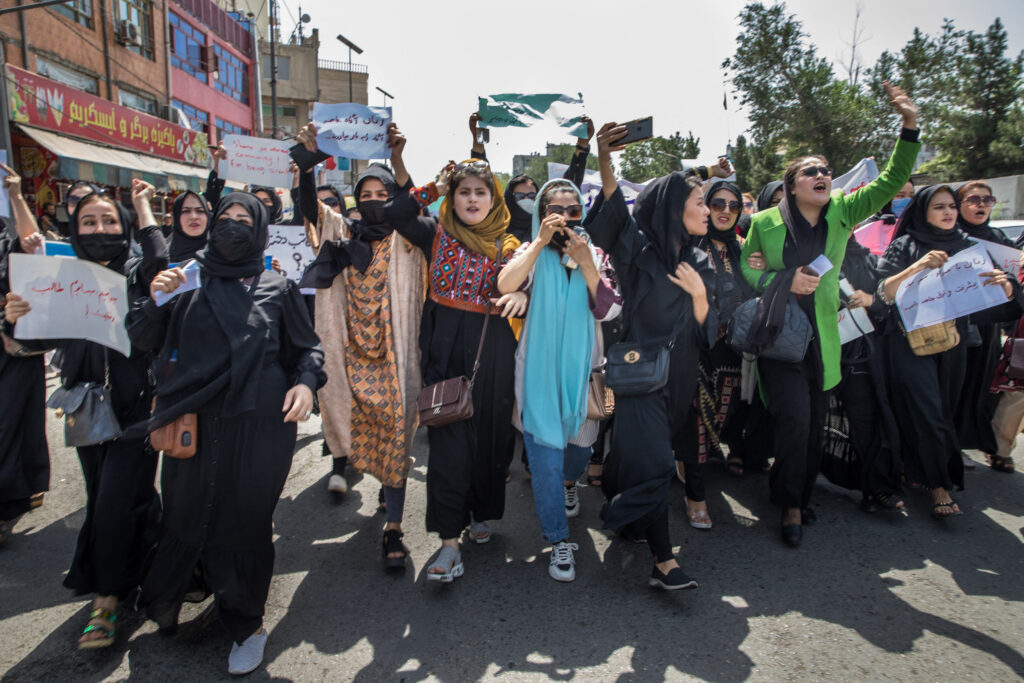
The systemic discrimination and dehumanization that defined the apartheid era in South Africa is recognized by the world as a crime against humanity that must never be allowed to happen again. However, almost thirty-one years later, women in Afghanistan are living under a similarly totalizing, systematic, and institutionalized oppression.
Women in Afghanistan are now campaigning to end gender apartheid in their country. In this series, women from South Africa and Afghanistan come together to reflect on the parallels between their struggles and to draw strength from the experiences of those who have fought before them. In the second article of this series, South African journalist and activist Zubeida Jaffer joined Tamana Zaryab Paryani, a human rights activist from Afghanistan and founder of the Stop Gender Apartheid Campaign, for a conversation on resilience amid resistance to systems of oppression that spanned continents and generations.
In their respective countries, Jaffer and Paryani have both endured detention, torture, and threats of sexual violence meant to silence them. But what truly unites is their commitment to a resistance that is rooted in community, courage, and healing aimed at putting an end to apartheid regimes. The fight against apartheid in South Africa was not only a political struggle, but a movement sustained by bravery, perseverance, and collective action that helped dismantle a system designed to erase them. Today, women in Afghanistan resisting the Taliban’s gender apartheid are drawing lessons from that history.
‘Young people have a unique energy’
Jaffer began by recounting her story. As a young reporter at the Cape Times during South Africa’s apartheid regime, she was only twenty-two when in 1980 she was detained after reporting on a police shooting. Held in prison without trial, she was physically assaulted, psychologically tortured, and threatened with sexual violence. After two months of pretrial detention, she was released and charged with possession of a banned book.
Instead of retreating, Jaffer leaned deeper into the work of resistance, leaving her job at the Cape Times to become an anti-apartheid activist and unionist. In 1986, after editing community and trade union papers, she was detained again—this time, while she was several months pregnant. She was released shortly before her baby’s birth, only to be rearrested nine weeks later and jailed again with her infant. Held in solitary confinement and denied medical care, she nearly lost her child.
Holding up the cover of her memoir, Our Generation, Jaffer shared a photo from the book with Paryani, pointing to an image of her as a young mother with her infant daughter. The fight against apartheid, Jaffer said, was not just about individual acts of bravery but also about the collective defiance of women—young and old, mothers and daughters—that contributed to the system’s fall. “Looking back now, despite the pain,” Jaffer said, “I am proud to have been part of something that resulted in the freedom of all South Africans. It was worth it.”
Since then, Jaffer has written three books, and she now has her own website and runs a program where she mentors young journalists and gives them the opportunity to write on a multimedia website. Jaffer played a key role in South Africa’s first democratic elections as part of the Independent Media Commission.
Jaffer reflected on the power of youth, which she said carried with it fearlessness, the sense of justice, and the belief in change. “Young people have a unique energy,” she said.
‘The world turned a blind eye’
Paryani, a twenty-seven-year-old activist from Kabul, has become one of the most visible faces of Afghanistan’s protest movement. Following the Taliban’s return to power in 2021, Paryani, alongside her sisters, took to the streets of Kabul to protest the regime’s decrees banning girls from attending school and imposing repressive dress codes on women. Together, they chanted “naan, kaar, azad”—bread, work, freedom—a slogan that has since become a powerful symbol for the resistance of Afghan women, both inside the country and in exile.
Her defiance carried a heavy price. In January 2022, a video of Paryani went viral on social media in which armed men pound on her door while she pleads shakily, “Come back in the morning. My underage sisters are with me, come tomorrow. I cannot talk to you now.” Her plea went unanswered; Tamana and her sisters were taken. No one knew where they were, and the Taliban denied detaining them.
Like many women in Afghanistan, Tamana and her sisters were forcibly disappeared—snatched from their homes in the middle of the night, sometimes with their children, sometimes with their husbands and entire families. In prison, she was separated from her sisters, beaten, psychologically tortured, and threatened with sexual violence. Under intense international pressure, they were released in February 2022 but were silenced with threats and had their passports confiscated.
After several attempts to leave the country, in October 2022 Paryani and her family managed to flee to Germany, where exile brought safety but not peace. In exile, she has continued to fight for global awareness of the gender apartheid imposed by the Taliban. In 2023, she staged a hunger strike in Cologne to draw attention to the plight of women in Afghanistan, which ended with her hospitalization. Her struggles have left her with a lingering sense of abandonment: “I tried everything to draw the world’s attention to the struggle of women in Afghanistan,” she said. “And the world turned a blind eye.”
The trauma she endured in Afghanistan continues to surface, she said, even more acutely now that she is no longer in survival mode. She added that she frequently wakes from nightmares filled with the cries of those she heard being executed in the prison in Kabul after dawn prayers.
Passing the torch
As Paryani spoke, her voice broke. “Will I live to see the liberation of my country?” she asked.
Jaffer responded by telling Paryani that healing is not a luxury, but a necessity. “You have been in the belly of the beast,” she said. “You have endured what many fear the most. The scariest and cruelest part is behind you. Now you must take care of yourself—not just for your own survival, but so you can continue to lead this movement.”
Jaffer told Paryani that one of the biggest mistakes she had made when she was younger was trying to carry on without seeking help. The trauma, left unaddressed, eventually caught up with her. “It paralyzed me,” she said. “Had I known then what I know now, I would have begun healing much earlier.”
The struggle for liberation, Jaffer insisted, is not a sprint. It is a long, painful journey, said Jaffer, and it demands not only courage and sacrifice, but also reflection, self-care, self-love, and resilience. And most importantly, she added, it requires community.
“Tamana,” Jaffer said, “don’t let what they did to you silence you. Share your story. Ask for help. Simplify the message so others can join. Personalize your struggle. Your pain is real, but it’s also powerful. It can move hearts and minds. And this pain will carry you towards what you are burning for—liberation.”
Paryani, who had arrived at this meeting with her notebook and pen, eager to absorb every tip and tactic to end gender apartheid, now wept uncontrollably. Not out of sorrow, but because she was confronting a difficult realization: dismantling gender apartheid takes time. While it demands sustained activism and a burning passion, it equally requires the continuous inner work of healing—the labor that builds not only resistance, but the resilience that is necessary to sustain it.
Farhat Ariana Azami is a social worker and advocate for the rights of women and girls, as well as refugees. She serves as president of the Afghanistan Solidarity Group, an Austria-based association that provides homeschooling for girls and develops sustainable livelihood projects for women in Afghanistan.
This article is part of the Inside the Taliban’s Gender Apartheid series, a joint project of the Civic Engagement Project and the Atlantic Council’s Strategic Litigation Project.
Further reading
Thu, May 29, 2025
How the Taliban is using law for gender apartheid, and how to push back
New Atlanticist By
To combat the Taliban’s institutionalization of gender apartheid, international actors must document the system of lawmaking that underpins the regime's human rights abuses.
Wed, Nov 19, 2025
How we women of Afghanistan are defying Taliban repression
New Atlanticist By
Recounting her own ordeals with the Taliban, an Afghan woman shares how each new restriction pushes women and girls further into confinement.
Fri, Oct 24, 2025
In the shadow of gender apartheid: Four years of loss and resistance by women in Afghanistan
Inside the Taliban's gender apartheid By
It is important not only to document the grim reality of gender apartheid under the Taliban but also to honor the women of Afghanistan's persistence.
Image: Afghan women, who have seen their rights diminish day by day, demonstrate in the center of Kabul, Afghanistan on Saturday August 13, 2022. Taliban fighters fired into the air to disperse this rare women's protest, days ahead of the first anniversary of the hardline Islamists' return to power. Photo by Oriane Zerah/ABACAPRESS.COM via Reuters Connect.