
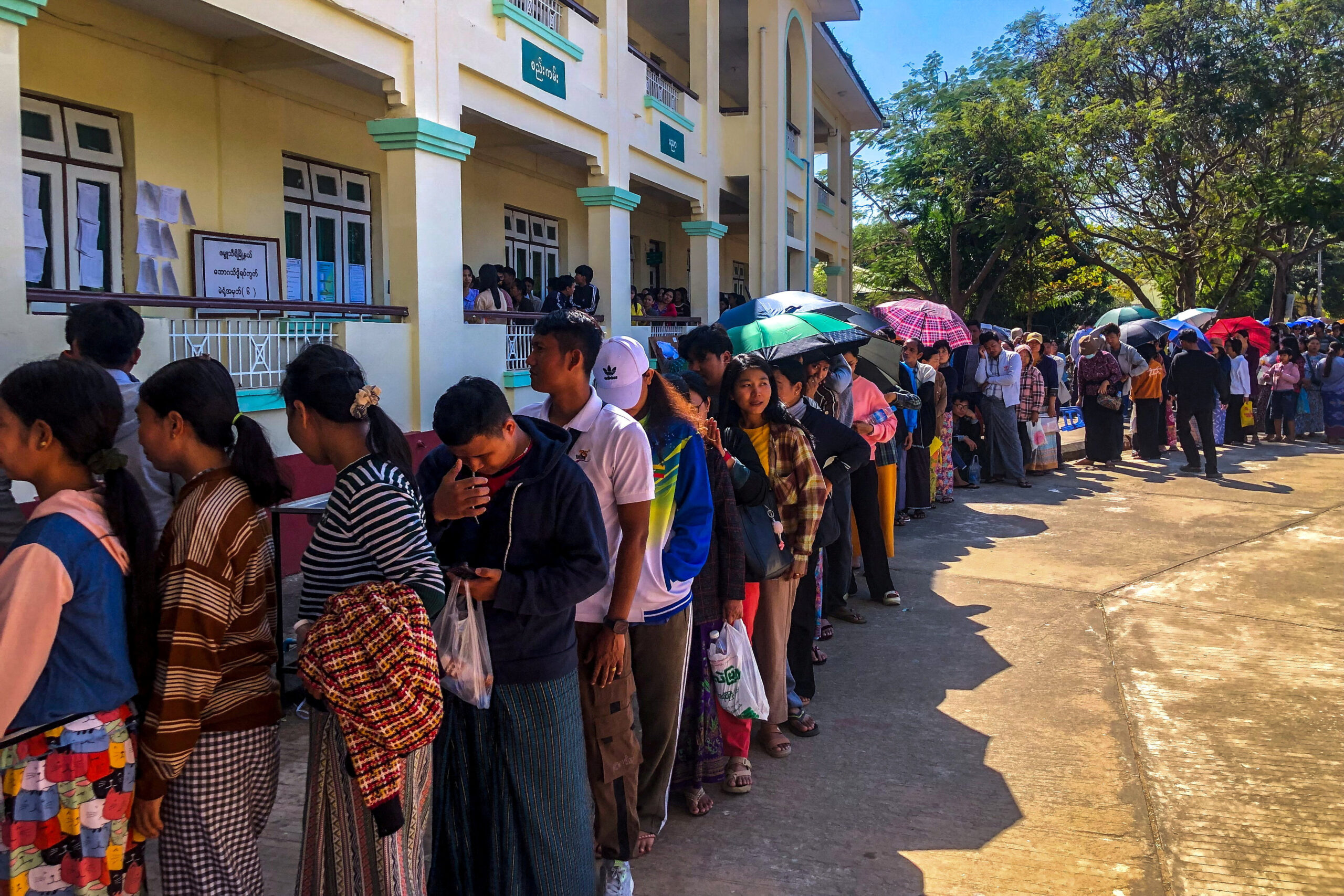
On January 11, Myanmar will conduct the second phase of its general election, which began in December and will continue in a third phase later this month. When completed, it will have been the first such election in Myanmar since the 2021 military coup there. But what the ruling junta touts as a return to democratic governance is, in reality, a carefully managed exercise in self‑preservation by the generals who seized power almost five years ago. The elections, staged amid civil war and repression, will neither restore genuine democracy in Myanmar nor stabilize its fractured society. Instead, the electoral charade threatens renewed regional instability with implications for Bangladesh, India, and South Asia as a whole.
A “sham” election
Already, human rights organizations and civil society groups have condemned the process as illegitimate and incapable of meeting democratic standards. Human Rights Watch characterized the election as a “sham,” while the International Crisis Group, the International Republican Institute, and regional monitors such as the Asian Network for Free Elections have raised alarms about the absence of conditions for a credible vote.
The organizations’ concerns are valid. Myanmar’s vote is being conducted amid ongoing civil war, mass displacement, and widespread violations of political freedoms. Major opposition parties are blocked from meaningful participation. For example, the junta-backed Union Solidarity and Development Party is contesting widely, but the National League for Democracy (NLD)—the party of imprisoned opposition leader Aung San Suu Kyi—remains banned from meaningful competition, with most of its leadership detained or barred from standing. Reports indicate that civilians feel coerced into voting out of fear rather than choice. Testimonies describe pressure to vote from local authorities, military-linked administrators, and security actors, creating a climate in which participation is seen less as civic exercise and more as fearful compliance.
The geographic scope of the vote itself reflects the imbalance at the heart of this process. Rather than a nationwide election, only a portion of Myanmar’s townships are included in the polling, with the rest excluded on the grounds of conflict, insecurity, or administrative decisions that conveniently remove opposition strongholds from participation. Out of the country’s 330 townships, polling is scheduled in just 274; in other words, 56 townships—and in some assessments, even more—will not vote at all because authorities have designated them too unstable. Almost entire regions—particularly in the states of Rakhine, Chin, Kachin, Sagaing, and Karenni—remain cut out of the process, highlighting how the vote is structured less as a democratic exercise and more as a managed performance of legitimacy.
Bangladesh: Caught between crisis and containment
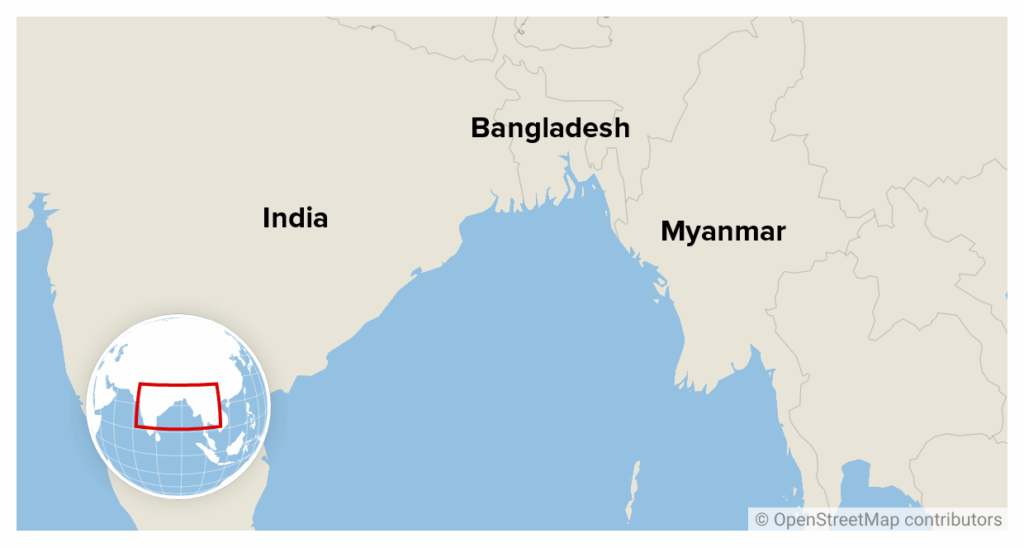
For Bangladesh—already host to more than a million Rohingya refugees and undergoing its own fraught political transition—the outcome offers little hope of resolution. The Rohingya crisis dates back several decades, with the biggest influx happening in 2017 because of mass expulsions from Rakhine State, which occurred under the NLD-led government that many Western observers once hailed as Myanmar’s democratic success story. Successive crises since then have exposed Dhaka’s limited leverage over Naypyidaw’s rulers, whether in military uniform or in civilian dress, and these elections are unlikely to change that calculus. The forced return of refugees without guarantees of safety and citizenship remains unrealistic under a Myanmar regime seeking legitimacy rather than reconciliation.
Continued violence in western Myanmar risks further displacement toward Cox’s Bazar, in southeastern Bangladesh. The border region has also seen shifts in control by armed groups, complicating trade and security cooperation and heightening anxiety in Dhaka about criminal networks and militant spillover. Prospects for stable, collaborative border governance remain dim.
Analysts characterize the current moment as a Rohingya stalemate, warning that the junta-driven polls offer “no meaningful pathway” for resolving the crisis and that any hope of voluntary, safe return remains illusory while the junta remains in place. Bangladesh already hosts more than a million Rohingya, while fresh fighting in Rakhine since 2024 has generated another surge of displacement, estimated at 150,000 people. Dhaka has rejected requests to send election observers, interpreting them as a bid to manufacture legitimacy. The interim Bangladeshi government, under pressure from domestic rights advocates, refuses to negotiate with Myanmar authorities who have no intention of allowing a safe and dignified return.
Security concerns compound this stalemate. The northern frontier is contested by the Arakan Army, Rohingya armed groups, and splinter factions, driving militarization. Bangladesh’s fence-building and patrol deployments respond to periodic cross‑border raids and trafficking networks, while nongovernmental organizations document camp‑level violence and extortion. In this context, even small escalations could trigger humanitarian emergencies and force Dhaka into defensive postures rather than constructive diplomacy.
India: Strategic ambivalence in the face of uncertainty
India’s stance reflects a tension between strategic interests and democratic principles. New Delhi shares a long, porous border with Myanmar’s restive northwest—an area where insurgent groups have long operated across boundaries and where any new wave of refugees, fighters, or illicit flows can inflame fears about the demographic balance in sensitive frontier states such as Mizoram, Manipur, and Nagaland. India’s priority is to prevent these pressures from spilling deeper into its territory, a task historically underpinned by security cooperation with the Myanmar military. Yet such cooperation is now a political liability given international condemnation of the junta.
At the same time, India has clear interests in counterbalancing China in Myanmar. Connectivity and energy projects under the Act East Policy—including highways and ports—depend on at least a minimal degree of order in Myanmar. The ongoing elections, marred by conflict and exclusion, do not provide that. New Delhi faces tough choices as it seeks to balance pragmatic ties with the junta even as doing so could enable Myanmar’s authoritarian consolidation, all while Chinese-backed infrastructure and security influence deepens along India’s eastern flank. India’s recent willingness to engage a wide spectrum of actors in the region—from Myanmar’s military to the Taliban government in Kabul, which New Delhi hosted for talks in October 2025—underscores how far it is prepared to stretch diplomatic orthodoxy to protect its strategic and connectivity interests.
This pragmatism reflects security pressures as well. Since the 2021 coup in Myanmar, New Delhi has documented increased flows of arms, refugees, and insurgents into India’s northeast, with groups such as the National Socialist Council of Nagaland-Khaplang exploiting Myanmar’s political vacuum. Analysts warn that if the junta’s authority erodes further, Indian factions could seek sanctuary across the border or develop support channels through Bangladesh, threatening to upset the demographic balance in sensitive border states. Meanwhile, India’s signature projects—the Kaladan multi‑modal transit route and the India–Myanmar–Thailand highway—remain stalled by conflict, allowing China‑aligned infrastructure to gain relative momentum. Even as India dispatches observers and calls for an “inclusive poll,” critics argue that if India aligns too closely with the junta, it would cause a future resistance‑led government to tilt more toward Beijing. The dilemma is clear: Stability is indispensable for India’s Act East calculus, but stability anchored in repression could prove strategically self‑defeating.
The regional stakes
Myanmar’s electoral theater unfolds against a backdrop of great‑power competition. China sees the process as a means to safeguard strategic corridors linking Southeast Asia to the Indian Ocean. For China, it is a dual‑track strategy—formal engagement with the junta, informal management of militias—ensuring continued influence regardless of electoral credibility. Beijing wants elections above all for the promise of order: Even a tightly controlled, unfair vote is preferable, from its perspective, to open-ended civil war that threatens pipelines, ports, and overland trade routes. Chinese officials have leaned on some ethnic armed organizations to enter talks with the junta, with activists alleging that elements of this pressure campaign have veered into coercive tactics. These actions underscore the lengths to which Beijing is prepared to go to secure border stability, energy corridors, and uninterrupted trade.
The Association of Southeast Asian Nations (ASEAN) has sent inconsistent messages on Myanmar’s election. Publicly, the bloc signals unease and maintains a measure of diplomatic distance, showing little appetite for a strong multilateral stance. Privately, however, several member states have opened bilateral channels with Naypyidaw—through security cooperation, commercial agreements, and selective political engagement—effectively diluting ASEAN’s collective leverage. Malaysia has taken a more critical line, warning that partial elections “achieve nothing without peace,” while Vietnam has broken with the broader consensus by sending observers and portraying the polls as a possible starting point for stability.
In sum, the election functions less as a transition than as a diplomatic sorting mechanism, clarifying who will tolerate the junta for strategic gain and who will condition engagement on democratic legitimacy.
False dawn, real dangers
Myanmar’s ongoing elections do not mark a step toward democratic recovery; they mark the consolidation of an authoritarian holding pattern whose shockwaves extend far beyond Myanmar’s borders. What is unfolding is not a transition but a recalibration of power, engineered through selective participation, territorial exclusion, and coerced consent. If anything is clear for South Asia, it is that Myanmar’s unraveling is no longer contained within its borders. Elections may freeze formal politics, but the conflict itself continues to move—across borders, through refugee flows, supply routes, insurgent networks, and competing infrastructure projects.
In the absence of a coordinated regional response that prioritizes accountability, humanitarian protection, and a political settlement rooted in more than military control, this democratic crisis will only become harder to manage.