Through our Rafik Hariri Center for the Middle East and Scowcroft Middle East Security Initiative, the Atlantic Council works with allies and partners in Europe and the wider Middle East to protect US interests, build peace and security, and unlock the human potential of the region.
Meet our blogs

All commentary & analysis

IranSource

Feb 10, 2020

Iran’s credit line to Syria: A well that never runs dry

By Karam Shaar and Ali Fathollah-Nejad

There is barely an article about the Syrian economy since the 2011 uprising that does not entail a reference to that rather mysterious Iranian credit line.

Economy & Business
Iran

MENASource

Feb 7, 2020

Why Arab Sunnis are disengaged from Iraq’s protests

By Tamer Badawi

If Sunni politicians and powerful tribal chiefs back an upheaval in Arab Sunni areas, they would risk losing the political and economic gains realized by their alliance with Iran-backed political powers and could face repression and marginalization.

Iraq
Middle East

IranSource

Feb 6, 2020

Why Europe should delay FATF countermeasures on Iran

By Esfandyar Batmanghelidj

Iran’s economic policymakers and economic operators remain committed to reforms that improve the transparency of the Iranian financial system.

Economy & Business
Iran

MENASource

Feb 5, 2020

Should the Palestinians look a gift horse in the mouth?

By Kyle Thetford

Palestinian policymakers might not actually want all that cash. This is in part because of the challenges associated with spending such a vast sum.

Israel
Middle East

MENASource

Feb 4, 2020

Absence at Berlin conference highlights Tunisia’s difficult challenges

By Alessia Melcangi

So-called marginalization at the Libya Peace Summit in Berlin aroused strong feelings of resentment among Tunisians, exacerbating the country’s already difficult economic, social, and political challenges.

Politics & Diplomacy
Security & Defense

New Atlanticist

Feb 3, 2020

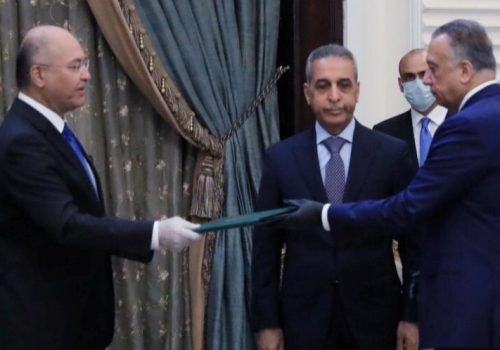
Can Iraq’s new prime minister nominee navigate Baghdad’s political chaos?

By Atlantic Council

The next task for Allawi is to win the consent from two mutually exclusive spheres of influence inside Iraq: the protesters who forced the resignation of the current government at a high cost with nearly a thousand lives lost and more than twenty thousand wounded and the entrenched political actors who are still unwilling to give up all or part of their extraordinary privileges and take steps to curb corruption.

Iraq
Politics & Diplomacy

New Atlanticist

Feb 3, 2020

US targets al-Qaeda leader: What it means for Yemen and the US counterterrorism mission

By Masoud Mostajabi

“When the United States is able to identify a terrorist abroad who threatens Americans, in the vast majority of cases the solution is relatively simple,” William Wechsler says. “Simply reach out through law enforcement or intelligence channels and ask the local government to arrest them. Unfortunately, there remain a few places in the world in which the host governments have no practical ability to do so—indeed, in some of these places legitimate government authorities face a high risk of being killed if they tried. Yemen is one of these places.”

Conflict
Terrorism

MENASource

Jan 31, 2020

The two-state solution comes back

By Thomas S. Warrick

The one-state solution is dead. The two-state solution may have a faint heartbeat, but it is unmistakably alive. Now, at least, we know where we are supposed to end up. All we have to do is to work backwards to find out what it will take to get from here to there.

Israel
Middle East

MENASource

Jan 29, 2020

Let’s make a deal of the century

By Shalom Lipner

Hopes for an immediate breakthrough toward a peace agreement between Israel and the Palestinians remain bleak.

Israel
Middle East

New Atlanticist

Jan 28, 2020

Trump’s new Middle East peace deal: A real path or dead on arrival?

By Daniel J. Samet

“The sad irony is that the peace process desperately needs new ideas, even if the ideas revealed today and the means by which they were developed and announced were not ideal,” William Wechsler says. “And given the longstanding positions taken by the current Israeli and Palestinian leaders, the only credible source for those new ideas is the United States.”

Israel
Middle East