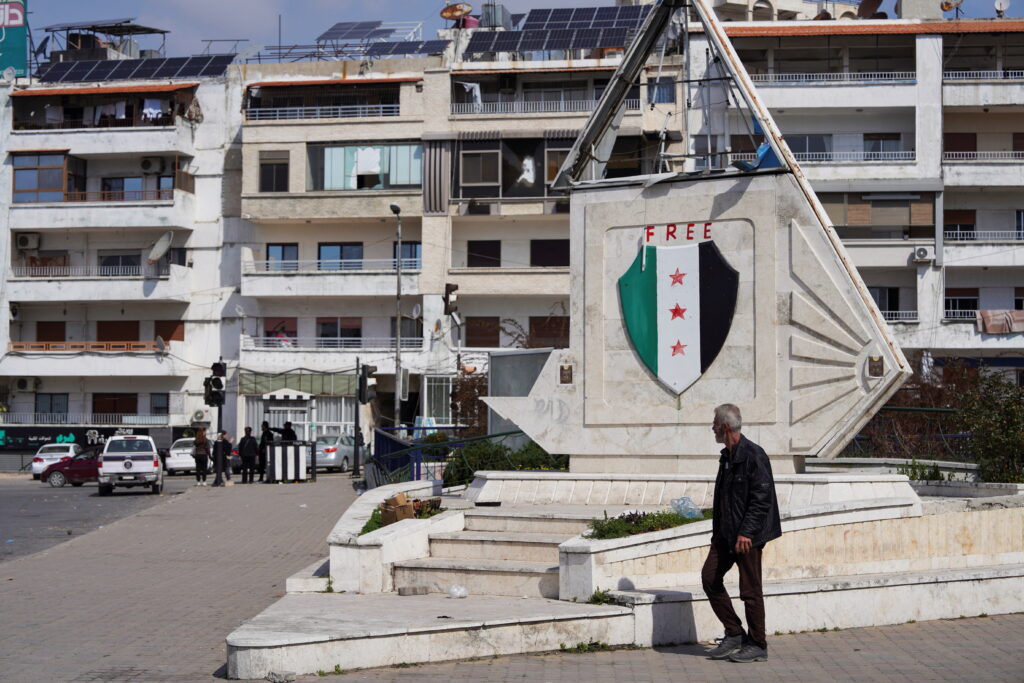
In late September, violence erupted in the countryside around Suqaylabiyah, a large Christian town in Syria’s Hama governorate. The area had generally avoided the type of sectarian violence that has plagued other parts of the country since the December 8, 2024 collapse of the Assad regime. But an unsolved rape case in nearby Hawrat Amurin fueled new anger and tensions, eventually leading to the kidnapping and torture of a local soldier by Alawi insurgents. The next day, members of the soldier’s family entered the village near where he was kidnapped, demanding he be released. At the same time, Sunnis from other nearby communities stormed Hawrat Amurin, looting homes and killing an elderly man.
Security forces quickly intervened and the mob fled. In response to the rapidly deteriorating situation, the head priest of Suqaylabiyah held several dialogue sessions with Sunni and Alawi community leaders and local security officials. They agreed to form a committee to continue intercommunal dialogue and to address any future disputes before they turned violent.
This impromptu civil peace committee is not the first of its kind in post-Assad Syria. The first such committee was formed in Tartous’s Qadmus district in December 2024 by the town’s Ismaili population to address disputes with their Alawi neighbors and ease the arrival of the new government’s forces to the area. Since then, similar committees have been formed across parts of Damascus, Homs, Tartous, Latakia, and rural Hama. They are largely oriented toward resolving sectarian-related problems, whether between the Sunni security forces and Alawi locals, or between neighborhoods and villages of different sects.
The authors have traveled regularly to Syria over the past year, visiting with local security officials and activists across much of Homs, Hama, Tartous, and Latakia studying the challenges and successes of local peace-building in the wake of dictator Bashar al-Assad’s fall. Civil peace committees and similar systems have consistently stood out as an important aspect of trust-building and dispute resolution. While they have proven highly effective in some areas, they are only present in a few parts of the country. At times, they face opposition from government officials. Still, they offer one important model for dealing with the country’s decades of deeply rooted social divisions and the bouts of intercommunal violence that continue to leave Syrians dead.
The role of civil peace committees
Damascus formed a National Civil Peace Committee in the aftermath of the March 6 coastal massacres, theoretically tasked with preventing violence and easing intercommunal tensions through mediation. In June, this committee made headlines when news broke that one of the Assad regime’s most notorious criminals, Fadi Saqr, had effectively joined the committee. His inclusion reflected Damascus’s choice to try and maintain calm via close engagement with former regime-affiliated security and military officers, who some members of the new government argue will help prevent their former colleagues from engaging in renewed insurgent activity.
This controversial national body, however, has nothing to do with the civil peace committees organically forming at the local level in several municipalities across Syria. These committees vary in size, function, and form, but they all seek to prevent violence and improve communication at the hyper-local level. This often involves connecting locals to the new security apparatus via trusted community figures.
It is difficult to say with certainty how many civil peace committees are active in Syria, since many do not conform to the name even when they function in a similar capacity. Most of the more structured and explicitly named committees are concentrated in the southwestern Damascus suburbs, Homs, and Syria’s coast—reflecting both the concentration of strong activist networks and complex sectarian communal dynamics.
There are, however, core commonalities among the groups. Committees are usually formed around a council of local notables. Their success is largely dependent on two factors: 1) the attitudes and acceptance of local security officials and 2) the initiative and determination of local civil society. At their core, these committees facilitate communication between the security officials and locals who are too afraid to communicate with them directly. One Christian activist in Baniyas explained the importance of this role to the authors succinctly:
- “Fear is rooted in isolated violations and a rejection of government narratives . . . direct government outreach cannot fix this fear because locals don’t trust the government’s words or actions. Rather, they need civil society intermediaries.”
Due to their organic formation, each civil peace committee has its own culture and practices. In Jaramana, according to one member, the civil peace committee is very strong, includes representatives of all sects, and even has its own security force. In Alawi communities, the committees’ main roles are improving communication between locals and security officials and working with officials from Syria’s General Security Service, the country’s core internal security force, to address concerns and violations. Local officials use the committees to disseminate information, conduct peaceful disarmament campaigns, and gather complaints about misconduct of government personnel.
In other places, such as Homs and parts of Damascus, committees are equally focused on resolving intercommunal and housing, land, and property (HLP) disputes. For example, the committees in the suburbs of Daraya, Moadimiyah, and Sahnaya worked together to return civilians kidnapped and arrested during the violence there in May and to stop the attacks on the nearby Alawi suburb of al-Somoriyeh in September.
Expansion of informal intermediaries and religious bodies
More common than the formal civil peace committees are informal networks and individuals who do the same work as committees but under different names. Many of these networks are built around religious figures, as opposed to the aforementioned committees built around activists and administrative leaders of local towns. For example, in Homs, a small network of Christian priests, Sunni sheikhs, and Alawi leaders work together with the city’s mukhtars and security officials to resolve disputes and calm intercommunal tensions. While not a formal committee or council, these men are able to use their personal connections to each other and their respective communities to resolve many smaller issues.
In Homs’s Old City, the Syriac Orthodox Santa Maria Church is the main actor for settling disputes involving the neighborhood’s Christian population. The church’s leader, Father Yuhanna, has helped mediate disputes that occur between the residents and others in the city, but he also helps ease tensions when security officials conduct arrests or investigations of Christian men in the area. These religious and community leaders interact directly with the city’s security officials and the governorate’s political affairs director to discuss the implementation of laws and issues of government abuse.
In Salamiyah, the long-standing National Ismaili Council plays the same role through its various subcommittees. This council has been crucial for bridging the gap between the new government and the Ismaili population more generally, as well as the Alawi and Shia populations in Salamiyah specifically.
But in other places, the intermediary networks are much weaker and rely on only one or two individuals. This is particularly true in the coast, where Alawi communities face a double hurdle: a lack of historical civil society and extreme distrust and fear between themselves and the new government. Still, in some places, such as Tartous’s Sheikh Badr and Latakia’s Beit Yashout, there are individual men and women who do the same work as civil peace committees: improving communication between locals and security officials and resolving arrest- and security-related disputes.
For example, the mayor of Beit Yashout serves as a key communication node between the district security official and the local towns and villages. Whenever news of a large security convoy entering the area emerges, locals quickly message the mayor, who in turn calls the district security official to convey their concerns and learn what is happening. He then sends messages to a wide network of local leaders and media activists, sharing what the official told him and urging calm (the authors witnessed this first hand during a visit in September). He also regularly sits with security personnel at checkpoints to help encourage closer relations between them and the locals. In a region wracked with fear, these basic actions are critical for reducing tensions and preventing reckless actions by terrified locals and security forces.
Reconciliation committees
Both the formal civil peace committees and informal networks are new phenomena which have been met with mixed reactions by local officials. But there is a third type of dispute resolution mechanism, which has for decades been a staple of Syrian society: the reconciliation committee (majlis al-sulhi). However, these committees differ significantly from civil peace committees both in scope and the type of communities they serve.
Reconciliation committees focus almost exclusively on HLP issues for displaced people. The bulk of the dispute resolution conducted by the bodies are between those community members who were displaced and those who remained under the regime. They are most commonly found in Sunni communities in Idlib, Hama, and Homs, and they rely heavily on close family and communal ties for mediation. Nonetheless, these committees have long been embraced by the Hayat Tahrir al-Sham-backed Salvation Government in Idlib, setting a precedent for the new government’s acceptance of such civil peace-oriented systems. This acceptance should now be extended to the civil peace committee model.
Creating opportunities for peace
Creating lines of communication may be the most important function of these different systems. They often provide the only means of engagement with the authorities in places where many people are too afraid to approach officials on their own. These committees and networks also play a central role in resolving intercommunal and community-state disputes before they spiral into serious violence, as happened in Hamrat Amurin in September.
Much of the work of civil peace committees is initiated by motivated individuals who take it upon themselves to advance intercommunal trust-building. Many Ismaili and Christian activists who have been involved in these networks since December have stressed the same thing to the authors across multiple field trips—that local groups must assert themselves to the new government and force it to work with them. This approach has proven to work, but it is also a difficult concept for many activists, especially those from the Alawi community, to embrace when there is so much fear and distrust, and inconsistent government treatment of civil society more broadly.
Thus, most activists working in civil peace and dispute resolution issues emphasize the need for officials to genuinely engage with their work while giving them the space to operate freely. Members of multiple committees also discussed with us the need for logistical support to expand their networks, linking committees across districts to help share experiences and strategize communication and dispute resolution approaches. Such regional networks would give rural areas a more grounded view of the situation in other regions, undermining the chokehold that social media misinformation has on much of the country.
Inconsistent government limitations
Yet despite the benefits of this system, many civil peace activists across the country are still facing obstacles from the new government. While committees in places such as Qadmus, Damascus, and Salamiyah have seen many successes, the experiences of cities such as Baniyas, Masyaf, and Dreikish show how reliant this system is on a cooperative local government.
In Baniyas, a civil peace committee was formed after the extreme violence the city experienced on March 6, bringing together prominent Sunni and Alawi activists and religious leaders. Yet while it gave space for the Alawi community to voice complaints and work with local officials, their demands have been consistently ignored. The committee has been described by some former members as essentially being a mouthpiece for the local government, with no real agency of its own.
Masyaf’s short-lived committee faced a more direct challenge from its local government. In June, activists in the city gathered more than five hundred people to hold the country’s first-ever local elections for a civil council. Prior to the election, the organizers had received approval from the district director, Muhammad Taraa, to create the new body. Yet as soon as it was formed, Taraa began to oppose it. After sidelining and ignoring the new council for a month, Taraa called on the Hama Political Affairs Office to order its disbandment. Civil peace work in the district has now gone partially underground, with only a small civil peace committee now working exclusively on securing the release of ex-regime soldiers from the district’s rural villages who were captured by opposition forces during the final battles of the war.
Tartous’s Dreikish District has largely been another success story for the role of civil peace committees, but recent pressure from some local officials may undermine the positive steps that have been made. Like with the Ismailis in Qadmus, a small group of respected and educated Alawi leaders formed a committee in Dreikish the day after the regime fell. These men worked closely with Damascus’s newly appointed security official, fostering a deep bond of trust that endures today. However, the official was later transferred out of Dreikish, and his replacement was executed by local insurgents on March 6. The committee members were able to save the lives of the rest of the General Security officers that night, but the murder of the official has resulted in new pressure on the area since March. Now, two of the districts’ security officials still work closely with the committee, while a third views the body with distrust and refuses to engage with it. Committee members stress the importance of the close personal relationship they had built with their first official as well as the official killed on March 6, and the role these personal friendships and animosities play in the effectiveness of their work today.
Even when local government officials do embrace these committees and informal networks, their ability to address local grievances remains limited. These systems almost always engage with security officials—representatives of the Interior Ministry charged with overseeing the Internal Security Forces. Thus, issues such as the behavior of checkpoint personnel, detentions, and communication are more easily addressed, but these local officials have no say over the more pressing structural issues such as economic recovery, the settlement problem, political demands, and services. The inability of local security officials to address these topics limits the trust-building impacts of their engagement.
Empowering committees
Despite the potentially significant benefits of an expanded and empowered civil peace committee network in Syria, this system is largely isolated to addressing the symptoms of social discord. These committees should form one part of a broader approach to civil peace, bridging organizations and wider Syrian society with good governance practices to gradually break down the anger and loss felt between Syrian communities. One former civil defense member in Aleppo, who now works on humanitarian and civil peace issues, described the problem to the authors this way:
- “Civil peace itself is not a means but an end. . . it is not possible to make people accept this idea so quickly. . . but the government is burning this by trying to make everyone accept each other in a few days. They don’t understand civil peace. . . In all of Syria, there are civilian intermediary offices working between General Security and the people. . . But these offices solve the problems only after they occur. We have to focus on dealing with the source of conflict, not just one symptom.”
Some committees and civil peace activists fear that expansion could result in backlash from the government. Licensing issues and anxiety offer state monitoring stem from the government’s unclear and discouraging policies toward civil society. Instead, Damascus should understand the benefits these committees can provide as allies for civil peace.
The Syrian government should create and enforce a clear policy for how its security and political officials engage with civil society organizations that work on civil peace and sectarian issues. This policy should encourage the creation of independent civil peace committees across districts and sub-districts experiencing sectarian tensions, particularly in the coast, Homs, and rural Hama.
Damascus should ensure that officials engage with these committees in a genuine and honest manner to maintain their trust with their own communities, without which these committees are entirely ineffectual. Lastly, Damascus should expand the type of officials and government bodies that engage with these systems to begin addressing non-security-related local issues. This would increase peoples’ trust in both these intermediaries and the local government, while also providing more senior officials with granular insights into the needs of these area.
International organizations can support this work by funding trainings and dialogue sessions that bring together committees and activists from different parts of the country to share their experiences and best practices. Countries such as Turkey and Qatar that provide training to Syria’s Ministry of Interior personnel can also support these local peace efforts by including civil engagement and communication courses when training security officials.
Despite their mixed track record, these committees have laid forth a blueprint for preventing intercommunal violence and trust-building with the new government. Now they should be expanded across more areas and empowered by Damascus to operate freely rather than hindered. Taken together, this approach will help prevent further conflict while strengthening the new government’s ties to local communities across the country.
Gregory Waters is a nonresident fellow for the Syria Project in the Atlantic Council’s Middle East programs.
Kayla Koontz is a PhD candidate at the Carter School for Conflict Analysis and Resolution and a researcher at the Syrian Archive.
Further reading
Fri, Nov 21, 2025
Syria joining the anti-ISIS coalition is a westward pivot—with opportunities and risks
MENASource By
The decision is a shift in the country’s alignment—from Russian and Iranian spheres of influence to one in NATO and GCC regional orbits.
Mon, Aug 25, 2025
Dispatch from Syria’s Christian strongholds: A new government, a full political spectrum
MENASource By
The conditions of Christian communities across the country remain varied, with the opinions of religious and community leaders deeply mixed.
Wed, May 28, 2025
Sectarianism, social media, and Syria’s information blackhole
MENASource By
Since Assad’s December ousting, Syrians have struggled to sift the truth from fake claims about security incidents across the country.
Image: A man walks along a street, after hundreds were killed in some of the deadliest violence in 13 years of civil war, pitting loyalists of deposed President Bashar al-Assad against the country's new Islamist rulers in Latakia, Syria March 9, 2025. REUTERS/Karam al-Masri.