Mining without rules: The risky US bet on the deep sea
Bottom lines up front
- In April 2025, President Donald Trump issued an executive order permitting deep-sea mining in international waters.
- This is contrary to the United Nations Convention on the Law of the Sea, and might mean that the United States has violated customary international law.
- The executive order raises questions regarding the legal status of any mining that might take place under US license, particularly whether insurers and companies based outside the US would be willing to participate.
The increasingly tense geopolitical landscape has brought into sharp relief Western dependence on rare earth minerals. The minerals exist in minuscule concentrations (hence the “rare” label) in rock around the world, but where the rare earths are found is less important than how they are processed. Because the processing is cumbersome and extremely polluting, Western countries have long been reluctant to permit large-scale processing, which has instead become the domain of Chinese companies.
That has resulted in rare earths overwhelmingly being processed in China: As of 2025, some 90 percent of rare earths are processed there.1“China Currently Controls over 69% of Global Rare Earth Production,” Mining Technology, January 18, 2025, https://www.mining-technology.com/analyst-comment/china-global-rare-earth-production/. Western governments have long tolerated this situation, even though it involved minerals crucial to the functioning of modern societies, because they believed in the rules of globalization and calculated that China would not weaponize other countries’ rare earth dependence. (Products such as smartphones, electric vehicles, wind turbines, and fighter jets require one or more rare earths.) However, escalating geopolitical competition has raised concerns that China could ban exports of these minerals to Western countries. At various points, Beijing has suspended rare earth exports to specific countries or threatened to do so. The most infamous case occurred in 2010, when Beijing banned exports to Japan after the latter detained a Chinese fishing-boat captain for trespassing in Japanese waters (over which China also claims sovereignty).2Keith Bradsher, “China Bans Rare Earth Exports to Japan amid Tension,” New York Times, September 23, 2010, https://www.cnbc.com/2010/09/23/china-bans-rare-earth-exports-to-japan-amid-tension.html. Such actions, however, were so limited that most countries considered continued reliance on Chinese-processed rare earths an acceptable risk. Or, rather, they knew that citizens would vehemently oppose processing the rare earths domestically.3Michael Standaert, “China Wrestles with the Toxic Aftermath of Rare Earth Mining,” Yale Environment 360, July 2, 2019, https://e360.yale.edu/features/china-wrestles-with-the-toxic-aftermath-of-rare-earth-mining.
But as geopolitical tensions between China and the West have intensified, Beijing has increasingly threatened to impose restrictions on rare earth exports to Western countries. In April 2025, China responded to Trump’s announcement of steep tariffs on Chinese goods (as well as goods from other countries) by imposing export restrictions on seven rare earths.4Gracelin Baskaran, “China’s New Rare Earth and Magnet Restrictions Threaten U.S. Defense Supply Chains,” Center for Strategic and International Studies, October 9, 2025, https://www.csis.org/analysis/chinas-new-rare-earth-and-magnet-restrictions-threaten-us-defense-supply-chains. At the end of that month, Trump issued an executive order, “Unleashing America’s Offshore Critical Minerals and Resources,” giving US-based companies the right to mine for critical minerals in seabed areas beyond national jurisdiction; that is, in international waters.5“Unleashing America’s Offshore Critical Minerals and Resources,” White House, April 24, 2025, https://www.whitehouse.gov/presidential-actions/2025/04/unleashing-americas-offshore-critical-minerals-and-resources/. In the order, the president instructs his administration to identify “private sector interest and opportunities for seabed mineral resource exploration, mining, and environmental monitoring in the United States Outer Continental Shelf; in areas beyond national jurisdiction; and in areas within the national jurisdictions of certain other nations that express interest in partnering with United States companies on seabed mineral development.”6Ibid. In October 2025, Beijing imposed further export restrictions on rare earths. This was an apparent response to the US announcement of significant tariffs on Chinese goods; after the United States lowered the tariffs, China suspended the restrictions.7Peter Hoskins and Laura Bicker, “China Tightens Export Rules for Crucial Rare Earths,” BBC, October 9, 2025, https://www.bbc.co.uk/news/articles/ckgzl0nwvd7o; “Trump Lowers Tariffs on China and Announces End to ‘Rare Earths Roadblock’ after Xi Meeting,” BBC, October 30, 2025, https://www.bbc.co.uk/news/live/cd7ry3x0nvet.
Mining in the law of the sea
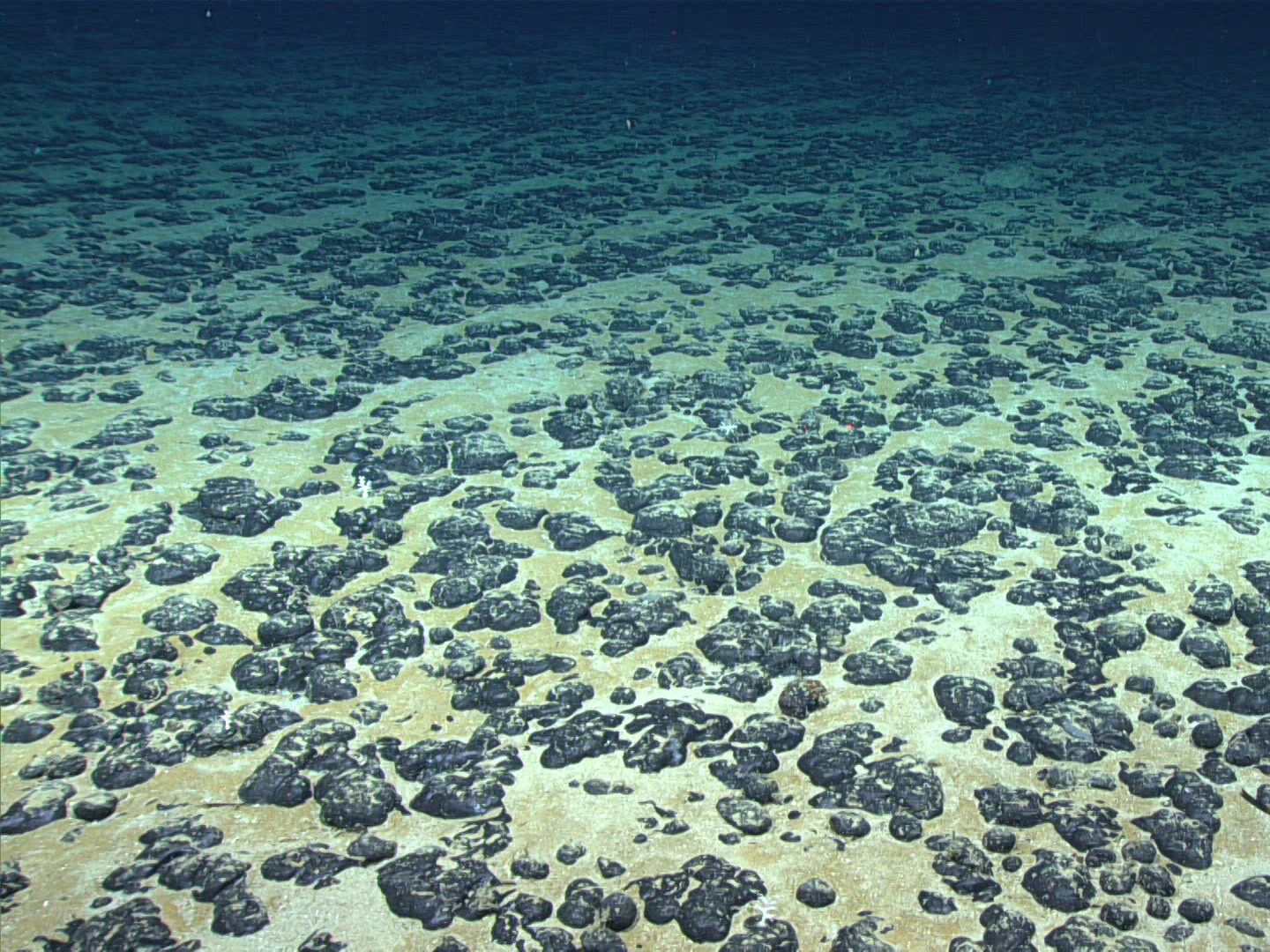
The existence of valuable minerals—manganese, cobalt, nickel, copper, and rare earth elements—at the bottom of the ocean has been known since the 1800s, and the minerals’ locations are well documented. The largest concentrations are in the deep sea; that is, outside countries’ territorial waters and exclusive economic zones (EEZ).8“Polymetallic Nodules,” International Seabed Authority, June 2022, https://www.isa.org.jm/wp-content/uploads/2022/06/eng7.pdf. (The Clarion-Clipperton Zone between Hawaii and Mexico is home to particularly large amounts.) The minerals are found in so-called polymetallic nodules the size and shape of potatoes, which lie on the seabed at depths of 3,500–6,000 meters.9“Deep-Ocean Polymetallic Nodules and Cobalt-Rich Ferromanganese Crusts in the Global Ocean: New Sources for Critical Needs,” US Geological Survey, April 21, 2022, https://www.usgs.gov/publications/deep-ocean-polymetallic-nodules-and-cobalt-rich-ferromanganese-crusts-global-ocean-new. Because the nodules reside primarily in international waters, reaching agreement on the circumstances under which they can be mined has long been considered a task for the global community of nations.
In 1982, when the vast majority of the world’s nations adopted, signed, and later ratified the United Nations Convention on the Law of the Sea (UNCLOS), they included a section dedicated to the deep-sea mining of these minerals, which Part XI of UNCLOS calls “the common heritage of mankind.”10“United Nations Convention on the Law of the Sea,” United Nations, 1994, Article 136, https://www.un.org/depts/los/convention_agreements/texts/unclos/unclos_e.pdf. UNCLOS specifies the conditions under which polymetallic nodules can be mined from the areas of the international seabed where they can be found: “All rights in the resources of the Area are vested in mankind as a whole, on whose behalf the Authority shall act. These resources are not subject to alienation. The minerals recovered from the Area, however, may only be alienated in accordance with this Part and the rules, regulations and procedures of the Authority.” UNCLOS continues: “No State or natural or juridical person shall claim, acquire or exercise rights with respect to the minerals recovered from the Area except in accordance with this Part. Otherwise, no such claim, acquisition or exercise of such rights shall be recognized.”11Ibid., Article 137.
The authority referenced is the International Seabed Authority (ISA), which was created when UNCLOS came into force in 1994. With UNCLOS universally considered the constitution of the oceans, the ISA is ipso facto the global seabed regulator. (UNCLOS also encompasses elements of customary law.) Since the ISA’s inception, its member states—the countries that have ratified UNCLOS—have tried to reach an agreement governing deep-sea mining. Because the United States has not ratified UNCLOS, it is not a member of the ISA, though it has participated in the negotiations as an observer.12Caitlin Keating-Bitonti, “U.S. Interest in Seabed Mining in Areas Beyond National Jurisdiction: Brief Background and Recent Developments,” Congressional Research Service, May 16, 2025, https://www.congress.gov/crs-product/IF12608#:~:text=International%20Seabed%20Authority%20(ISA)%2C%20an%20autonomous%20organization&text=The%20United%20States%20participates%20as%20an%20observer%20state%20in%20the%20ISA%20but.
Legal challenges
A key reason why the United States decided not to sign or ratify UNCLOS was opposition to Part XI. This issue aside, the United States has long abided by UNCLOS’s key tenets, not least because a functioning maritime order also benefits the United States. Indeed, the United States has always treated UNCLOS as a reflection of customary international law, save for Part XI. It is also worth highlighting that the part of UNCLOS regarding the settlement of disputes does not, and cannot, reflect customary international law as it lacks a “norm-creating” character, said Iva Parlov, an associate professor at BI Norwegian Business School who specializes in the law of the sea.
This means that if you, for example, are a party to UNCLOS, mandatory settlement of disputes applies to you. You can have certain reservations about it, but essentially another state can bring you to an international court or tribunal, as specified under UNCLOS. When you’re not a party to a certain treaty, you don’t face mandatory settlement of disputes mechanism under UNCLOS, even though that treaty can reflect customary international law, precisely because settlement of disputes is not part of the customary international norm. That means you can be bound by the customary international norm reflected in UNCLOS, but not by the settlement of disputes provisions.
—Iva Parlov
Because UNCLOS codifies and thus functions as customary international law, Trump’s executive order permitting deep-sea mining under US license—which runs contrary to UNCLOS—presents an obvious and immediate legal experiment. The US government can argue that, as a non-UNCLOS signatory, it is free to pursue actions that violate the convention. That argument, however, rests on whether the United States can convincingly present itself as a persistent objector to UNCLOS provisions that reflect customary international law. Under international law, a persistent objector is “a State which persistently objects to a rule of customary international law during the formative stages of that rule will not be bound by it when it becomes established.”13Olufemi Elias, “Persistent Objector,” Oxford Public International Law, last updated April 2024, https://opil.ouplaw.com/display/10.1093/law:epil/9780199231690/law-9780199231690-e1455.
“UNCLOS in general is considered a reflection of customary international law,” Parlov said. “This is clear when it comes to shipping, but deep-sea mining is more complicated. In general terms, the obligation not to unilaterally launch deep-seep mining may be considered customary international law. However, the United States had a problem with Part XI when UNCLOS was being negotiated. This was the main reason why the 1994 Implementation Agreement was adopted—i.e., to bring the United States on board.”14Interview with the author, October 27, 2025.
Despite the Implementation Agreement, the United States did not ratify UNCLOS, but it did sign the Implementation Agreement and participated in ISA as an observer. That complicates the United States’ potential identification as a persistent objector. “Scholars are divided on this issue. Some US scholars argue that the US is a persistent objector, while others would say that’s not the case,” Parlov noted.15Interview with the author, October 27, 2025.
To qualify as a persistent objector, the United States would need to demonstrate that it has indeed “persistently” objected to the specific parts of customary international law it wishes to violate—in this case, the prohibition of unilateral decisions and the treatment of seabed resources in international waters as the common heritage of mankind. “Part XI has been conceptualized as an ‘objective regime,’ which, under an orthodox understanding of international law, reaches non-States Parties through CIL [Customary International Law]. The US understood this when it voted for the 1970 Declaration of Principles Governing the Area,” notes Eduardo Cavalcanti de Mello Filho of the Centre for International Law at the National University of Singapore.16Eduardo Cavalcanti de Mello Filho, “May the United States Unilaterally Conduct or Regulate Activities in the Area According to International Law?” National University of Singapore, April 4, 2025, https://cil.nus.edu.sg/blogs/may-the-united-states-unilaterally-conduct-or-regulate-activities-in-the-area-according-to-international-law/. International lawyer Coalter Lathrop observes that the United States gave up its opposition to the items included in Part XI when it consented to the 1994 Implementation Agreement, with President Bill Clinton writing to the Senate that “the Agreement meets the objections the United States and other industrialized nations previously expressed to Part XI.”17Coalter Lathrop, “The Latest Trump Threat to International Law: Unilaterally Mining the Area,” EJIL:Talk!, May 6, 2025, https://www.ejiltalk.org/the-latest-trump-threat-to-international-law-unilaterally-mining-the-area/. James Kraska of the US Naval War College, in contrast, argues that the United States is a persistent objector. He argues that “Part XI of UNCLOS form customary international law, the United States has been a persistent objector to them and therefore is not restricted as a matter of customary international law” and that “the US signature on the 1994 Implementing Agreement does not make it sufficiently clear that the United States intended to be bound by it, especially in light of action under DSHMRA.”18James Kraska, “The U.S. Executive Order on Seabed Mining Is Consistent with International Law,” International Law Studies 106 (2025), https://digital-commons.usnwc.edu/cgi/viewcontent.cgi?article=3113&context=ils. (The Deep Seabed Hard Mineral Resources Act from 1980 was “an interim measure to allow the United States to proceed with seabed mining activities in areas beyond national jurisdiction (ABNJ) until an international regime was in place.”)19“U.S. Interest in Seabed Mining in Areas Beyond National Jurisdiction: Brief Background and Recent Developments,” Congressional Research Service, last updated December 30, 2025, https://www.congress.gov/crs_external_products/IF/HTML/IF12608.html.
In practice, the issue of whether the deep-sea mining order violates customary international law might matter little to US policymaking: The world’s most powerful nation has the liberty to act in ways not available to less powerful nations. In January 2026, Trump told New York Times reporters, “I don’t need international law.”20David E. Sanger, et al., “Trump Lays Out a Vision of Power Restrained Only by ‘My Own Morality,”” New York Times, January 8, 2026, https://www.nytimes.com/2026/01/08/us/politics/trump-interview-power-morality.html.
The wider challenge arises around the implications for UNCLOS and the global maritime order. Although nations’ and companies’ commitment to UNCLOS and other maritime treaties has never been perfect, China has openly engaged in violations through its maritime harassment and construction of artificial islands in waters in the South China Sea that are either disputed or officially belong to other countries. So has Russia, through its systematic use and support of the shadow fleet, as have the Houthis through their attacks on merchant shipping. The US executive order risks contributing to an environment in which other nations launch activities that harm the maritime order.
The executive order and any licenses granted also raise questions for any companies that might become involved. Because the mining would be conducted by private companies rather than the US government, the fact that they would be mining outside UNCLOS places them in a novel and challenging position. Although they would be licensed by the US government, their operations would also involve businesses based in other countries, including suppliers, engineering firms, and insurers. It is unclear whether, and how, such companies would be willing or able to work with US-based deep-sea miners, as by doing so they would be violating their own countries’ laws. “When it comes to insurers, it’s unlikely that any of the well-known major names in underwriting deep ocean equipment would be willing to cover it,” noted Stephen Hall, a leading oceanographer and former chief executive officer (CEO) of the Society for Underwater Technology.21Interview with the author, October 14, 2025. “Projects in the EEZ, yes, but not in international waters. They may be willing to insure, for example, an autonomous underwater vehicle or an inspection system, but underwriting the actual mining equipment itself would be a tough, tough call. And that’s going to be the expensive kit.” Hall is currently part of an international undertaking mapping the seafloor.
On January 26, 2026, the National Oceanographic and Atmospheric Administration (NOAA) announced that it will map the ocean bed near American Samoa to find minerals for industry. “What an exciting time to know that within the next few years, under this administration, there will be companies pulling deep sea nodules out of the ocean and bringing them to the US,” the New York Times quoted Erik Noble, a NOAA deputy assistant secretary who oversees deep sea minerals, as saying.22Eric Niiler and Sachi Kitajima Mulkey, “A Shift for NOAA’s Surveys: From Science to Mining,” New York Times, January 27, 2026, https://www.nytimes.com/2026/01/27/climate/noaa-deep-sea-mining.html
Practical considerations
Over the years, the International Seabed Authority has granted exploration contracts to twenty-two companies and organizations from different countries.23“Exploration Contracts,” International Seabed Authority, last visited December 11, 2025, https://isa.org.jm/exploration-contracts/. The licenses allow the entities to mine allocated areas in international waters, though not for commercial purposes. Commercial mining will only be allowed once the ISA’s member states reach agreement on whether, and under what conditions, such mining will be permitted. The exploration contracts naturally allow exploratory mining, and some of the companies with such contracts have succeeded in bringing nodules from the seafloor to the surface. They include the Metals Company (TMC), a Canada-based firm that has exploration contracts through the governments of Nauru, Tonga, and Kiribati—South Pacific nations whose surrounding waters are also home to significant amounts of polymetallic nodules.24“The Metals Company Advances Deep-Sea Research Program to Unlock World’s Largest Known Source of Battery Metals,” Metals Company, September 28, 2021, https://investors.metals.co/news-releases/news-release-details/metals-company-advances-deep-sea-research-program-unlock-worlds/. Days after the White House issued the executive order, TMC’s US arm applied for two US licenses.25“World First: TMC USA Submits Application for Commercial Recovery of Deep-Sea Minerals in the High Seas under U.S. Seabed Mining Code,” Metals Company, April 29, 2025, https://investors.metals.co/news-releases/news-release-details/world-first-tmc-usa-submits-application-commercial-recovery-deep. The company plans to mine more than 1.6 billion wet tonnes of polymetallic nodules from which it will extract nickel, copper, cobalt, and manganese.26Ibid. It has not announced plans to extract rare earths.
Commercial deep-sea mining might sound like a larger version of exploratory deep-sea mining, but it presents a host of additional complications. As discussed above, the first complication is the legal status of mining outside UNCLOS—including the challenges involved in getting insurance and equipment, as well as partnering with companies based in countries that adhere to UNCLOS. A perhaps even more significant hurdle involves the equipment transporting the nodules from the seabed to the surface. “The mining is easy,” Hall said. “The hard bit is getting the nodules you’ve mined from the bottom of the sea to the top.” That is because unlike oil and gas, which are extracted from the continental shelf (that is, at much shallower depths) and are soft, the deep-sea nodules are located at depths of several thousand meters and are, naturally, hard. “There have been a lot of people who’ve done small-scale experiments,” Hall explained. “Some firms have done really interesting work on using suction techniques to try to bring things up. Others have tried hoppers of various kinds or an elevator-type system where you’ve got underwater excavators loading up what almost looks like an underwater railway cart and then lifting the whole thing up on wires. There are different ways of doing it, but to do this on an industrial scale where trying to recover thousands of tonnes of material starts becoming quite tricky.”
The technique used, or envisaged, by most companies engaged in deep-sea mining exploration involves a massive pipe that transports the nodules. But, Hall warned, “transporting them to the surface is the point where you start running into complications. If, for example, your valve fails, tons of material suddenly fall back out of the pipe. You’re going to end up with a fallout plume. Then you’ve got to somehow scoop it all back up again and get it back into the pipe. It’s the same issue if you get breakages, cracks, and leaks in the pipeline. You’re going to have a lot of material loss. Depending on where the current is blowing at different depths, you could end up with a multi-directional fallout plume going into all points of the compass, depending on where the current is running at different depths of the water column.”
Such plumes of content being removed from the seabed and accidentally released in several other places would cause harm to the marine environment. In July 2025, NOAA, which is part of the US mining licensing regime, announced plans to accelerate the application process.27“Deep Seabed Mining: Revisions to Regulations for Exploration License and Commercial Recovery Permit Applications,” Federal Register, July 7, 2025, https://www.federalregister.gov/documents/2025/07/07/2025-12513/deep-seabed-mining-revisions-to-regulations-for-exploration-license-and-commercial-recovery-permit?utm_campaign=subscription+mailing+list&utm_medium=email&utm_source=federalregister.gov. It is unclear how NOAA will assess the risk of environmental harm, but any such accidents bring the risk of lawsuits. (BP’s Deepwater Horizon accident in 2010 resulted in hundreds of lawsuits.)28“US Deepwater Horizon Explosion and Oil Spill Lawsuits,” Business and Human Rights Centre, April 25, 2010, https://www.business-humanrights.org/en/latest-news/us-deepwater-horizon-explosion-oil-spill-lawsuits. “You won’t be able to state that any fallout is only going to go in one direction, because there might be a current going in completely the other direction a few thousand meters further up the water column,” Hall noted. “That means you might have to draw a big circle around the mining area and say ‘anywhere within this circle could potentially be impacted by the fallout from this mining activity.’ That opens you up to a lot of potential liabilities, a lot of litigation, a lot of insurance damages if anything goes wrong with your mining operation.”29Interview with the author, October 13, 2025.
To reduce the risk of such leaks during commercial mining (which would, at hundreds of millions of tonnes, involve far greater quantities than does exploratory mining), the pipe would need to be extremely sturdy. This would add considerable expense. Mining taking place outside UNCLOS would also raise the issue of whether a manufacturer willing to make the pipe could be found.
Any company operating under a US licence, outside UNCLOS, would also face a challenge finding certified engineers and other experts. Such experts are certified by different professional bodies, which might be reluctant to certify an engineer or other expert involved in a project that violates UNCLOS.
Ships taking the mined nodules to port would face related complications. Because the mining would violate UNCLOS, the ships would need to be owned and flagged in the United States. They would, however, still need to call at ports, and ports in countries that have ratified UNCLOS would likely be unwilling to accept ships operating in violation of UNCLOS. “You find out that the ship needs to refuel,” Hall said. “Where does it take on its fuel? Where can it do a crew change? You’ll probably find that the only nation the mothership was able to safely sail to and return to would actually be the US, because everybody else would just turn around and say, ‘As far as we’re concerned, you’re operating in, contravention of UNCLOS and the ISA. We’re not willing to open our facilities to your vessel.’ Instead of paying for only enough fuel to run from the nearest available port, you’re having to load up fuel and crew for a voyage lasting weeks or even months.” Ports in countries such as India and China regularly receive shadow vessels—which violate maritime rules—but that is because these ports benefit from receiving the cargo carried by the vessels. Though a few countries with limited maritime activities might service vessels involved in US-licensed deep-sea mining, it is unlikely that any major nations would do so, as doing so would undermine ISA and thus disadvantage efforts in which they themselves are involved.
Potential outcomes
The legal challenges related to deep-sea mining would naturally vanish if and when the ISA’s member states reach an agreement that allows commercial mining to begin. That is unlikely to occur in the near future, as forty countries including Mexico, Brazil, and most of the European Union have called for a moratorium on commercial mining.30Momentum for a Moratorium, Deep Sea Conservation Coalition,
https://deep-sea-conservation.org/solutions/no-deep-sea-mining/momentum-for-a-moratorium/ These and other nations argue that far more research needs to be conducted into the potential implications of deep-sea mining on the marine ecosystem.
The technical challenges are also likely to remain. Many can be overcome, at considerable expense, especially if the ISA’s member states reach an agreement and mining in international waters becomes legal. Any operator would, however, need to weigh the expense involved in mining against the revenues the minerals could bring. That depends on what minerals the operator aimed to extract: copper, cobalt, nickel, and iron, which are relatively easy to extract but currently command low prices; or rare earths, which are extremely cumbersome and dirty to extract but command high prices and will likely become even more crucial to Western economies as China’s on-and-off ban on exports of them continues.31Hoskins and Bicker, “China Tightens Export Rules for Crucial Rare Earths.” To reduce their dependence on mining of both kinds of metals, from land and sea, countries including those in the European Union have also stepped up efforts to recycle metals currently in circulation.32Jonathan Josephs, “How Europe Is Vying for Rare Earth Independence from China,” BBC, August 6, 2025, https://www.bbc.co.uk/news/articles/cm2zp6m4gy7o. At the time of writing, TMC remains the only company that has submitted an application for a US license under the new executive order.
It seems the likely outcome of the executive order is, paradoxically, that it will result in little deep-sea mining but risks undermining the already precarious global maritime order.
About the author

Featured project
Related reading

Explore the program

The Transatlantic Security Initiative aims to reinforce the strong and resilient transatlantic relationship that is prepared to deter and defend, succeed in strategic competition, and harness emerging capabilities to address future threats and opportunities.
Image: Most of the seafloor explored during Dive 07 of the 2019 Southeastern US Deep-sea Exploration was covered with these manganese nodules, the subject of the Deep Sea Ventures pilot test nearly five decades ago. Image courtesy of the NOAA Office of Ocean Exploration and Research, 2019 Southeastern US Deep-sea Exploration.