Ever since US President Donald Trump returned to the White House just over a year ago, it has become increasingly apparent that the world is now entering a new and unpredictable era of international relations. For Europe, this has meant coming to terms with the idea that continued US military support can no longer be taken for granted. After decades of outsourcing their security to the Americans, Europeans must once again learn to defend themselves.
Throughout the past twelve months, there has been much talk in European capitals of wake-up calls but relatively little actual action. While many European countries have vowed to dramatically increase defense spending, the debate over a new European security architecture still lacks a sense of urgency and remains hampered by competing national interests.
One of the few things that a majority of European policymakers appear to agree on is the importance of Ukraine in the continent’s emerging security strategy. This recognition of Ukraine’s role underlines the scale of the changes that have taken place over the past four years.
When Russia’s full-scale invasion first began in February 2022, Ukraine was heavily reliant on Western military aid as the country fought for survival. Since those early days, the Ukrainian army has expanded dramatically and evolved into the largest and most experienced fighting force in Europe. As a result of this transformation, a country that many had previously dismissed as a minor military player is now widely regarded as indispensable for the future defense of Europe.
Stay updated
As the world watches the Russian invasion of Ukraine unfold, UkraineAlert delivers the best Atlantic Council expert insight and analysis on Ukraine twice a week directly to your inbox.
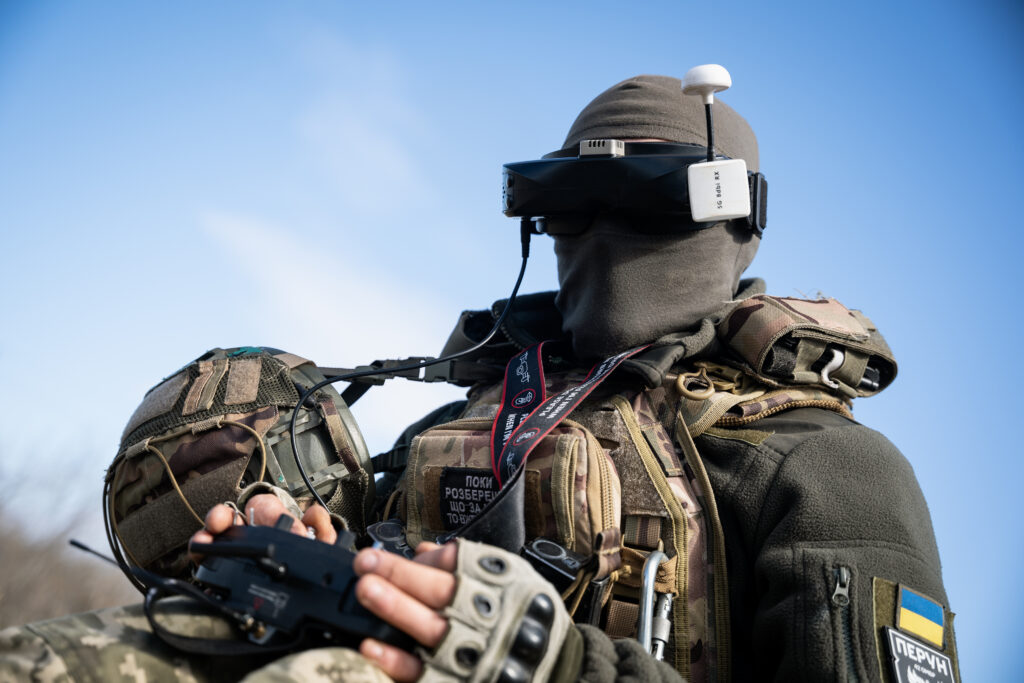
Ukraine’s potential to shape Europe’s new security architecture is most immediately obvious in the field of drone warfare. The Russian invasion of Ukraine is widely acknowledged as the world’s first full-scale drone war, with huge quantities of drones dominating the battlefield and operating deep inside enemy territory. Over the past four years, Ukraine has established itself as a “drone superpower” with an annual output of around four million drones, Bloomberg reported in November 2025.
Western security experts are no doubt acutely aware that alongside Ukraine, the two other nations currently driving the international development of drone warfare are Russia and China. This underlines Kyiv’s strategic importance as the democratic world adjusts to the challenges posed by an emerging alliance of authoritarian powers centered on Moscow and Beijing.
A growing number of US and EU defense companies have already sought to establish a presence in Ukraine in order to capitalize on the country’s technological expertize. This approach is understandable but may be shortsighted. In reality, Ukraine’s value extends far beyond access to existing military drone technologies.
Since 2022, Ukrainian drone developers and military units specializing in unmanned operations have learned to solve problems and adapt to new battlefield realities at lightning speed. Out of necessity, they have become accustomed to upgrading individual drone models and counter-drone systems within ever-decreasing innovation cycles that can now be measured in weeks.
Ukrainian forces have pioneered the use of combat drones on the front lines of the war. The country has also led the way at sea, with Ukrainian naval drones sinking multiple Russian warships and forcing Putin to withdraw the bulk of his remaining fleet from occupied Crimea to the relative safety of Russia itself. Meanwhile, long-range Ukrainian drones now routinely strike targets deep inside Russia. This Ukrainian success can serve as the foundation for a wider European security strategy as the world moves into a new era of drone-based warfare.
Eurasia Center events

Ukraine’s most immediate contribution to European security is likely to be in terms of helping countries defend against the mounting threat posed by Russian drones. The Kremlin’s current harassing activities around airports and other strategic sites across Europe are essentially an annoyance, but even such small-scale drone operations have exposed an alarming lack of readiness. At present, it seems safe to say that the continent as a whole is utterly unprepared for the kind of large-scale Russian drone attacks that have become a routine feature of the war in Ukraine.
Europe has responded to escalating Russian drone activity by developing plans to establish a “drone wall” along the continent’s exposed eastern flank. So far, however, this initiative remains somewhat fragmented with no unified concept or central coordination. While a collective response could eventually prove effective, pursuing this goal without learning from Ukraine’s unique experience makes little sense. Only Kyiv has the data and insights necessary to build layered defensive networks capable of combating waves of Russian drones.
In recent months, a growing number of European countries have taken the practical step of seeking to tap into Ukraine’s drone warfare prowess by working with Ukrainian trainers or establishing joint production initiatives. “Ukraine’s experience is the most relevant in Europe right now. Our specialists and technologies can become a key element of the future European drone wall, a large-scale project that will ensure safety in the skies,” Ukrainian President Volodymyr Zelenskyy commented in September 2025.
In addition to drone tactics and technologies, Ukraine can also offer its European partners an unrivaled environment for drone operator training and weapons development. The whole of Ukraine is now a vast drone warfare laboratory where novel threats are identified and addressed on a daily basis. As a result, new drone models and upgraded designs can move from the drawing board to the battlefield at a pace that is unheard of in peacetime Europe.
Drone warfare is just one of the many areas where Europe can learn from Ukraine. As European leaders explore new security strategies in a rapidly shifting geopolitical environment, it should be abundantly clear that Kyiv has a crucial role to play. No other European country has such a battle-hardened army or intimate knowledge of modern warfare. In an increasingly unpredictable world, that makes Ukraine a vital partner.
Lesia Orobets is the founder of the Price of Freedom air defense initiative and a former member of the Ukrainian parliament.
Further reading

The views expressed in UkraineAlert are solely those of the authors and do not necessarily reflect the views of the Atlantic Council, its staff, or its supporters.


The Eurasia Center’s mission is to enhance transatlantic cooperation in promoting stability, democratic values, and prosperity in Eurasia, from Eastern Europe and Turkey in the West to the Caucasus, Russia, and Central Asia in the East.
Follow us on social media
and support our work
Image: A Ukrainian soldier performs a trial with an FPV drone in the region of Kharkiv, Ukraine, on March 19, 2025. (Photo by Alfons Cabrera/NurPhoto)