Mali has once again become the focus of international attention. Over the past eight months, the Al-Qaeda affiliate Jama’at Nusrat al-Islam wal Muslimin (JNIM) has intensified its operations, launching coordinated attacks across western Mali in July and imposing a fuel blockade on Bamako in September. At the same time, JNIM has expanded its recruitment to new ethnic and regional constituencies via Bambara- and Fulfulde-language social media outreach.
Given speculation that these developments could ultimately topple the Malian regime, the concern is clearly warranted. But a singular focus on Mali risks obscuring an even graver crisis next door. The latest Global Terrorism Index deemed Burkina Faso—not Mali—the country most affected by terrorism. One quarter of all extremist attacks worldwide, and nine of the world’s twenty deadliest attacks, occurred there in 2024, according to the report.
Security conditions have worsened significantly since Ibrahim Traoré seized power in a 2022 coup d’état. Since then, extremists have killed an estimated 87 percent more civilians than in the preceding three years, while government-aligned forces are reported to have killed up to 132 percent more civilians than in the preceding three years. Extremists now operate with relative freedom across as much as 80 percent of the country, though Ouagadougou contests this figure.
Burkina Faso is the epicenter of the Sahel’s security crisis. Yet this reality is obscured by the political environment Traoré has constructed. A combination of domestic repression and online veneration has insulated his regime from scrutiny, even as battlefield losses mount and civilian casualties rise. In Burkina Faso, would-be rivals are sidelined and critical journalists intimidated into silence, while online content glorifies the president. These dynamics threaten national and regional stability, shrinking the space for accurate reporting and informed responses just when they are most needed.
Traoré controls the narrative
Since taking power, Traoré has used the extremist threat to justify his systematic removal of potential rivals and watchdogs. These measures have consolidated his power while dismantling channels for dissent and oversight, effectively rendering Burkina Faso a closed information environment.
Traoré has curtailed dissent under the pretext of building a more cohesive and efficient military. Early in his tenure, he reorganized the army into Rapid Intervention Battalions that report directly to him. He also replaced the heads of the National Gendarmerie and Special Forces with officers more politically aligned with his objectives. In late 2023, he sent a dozen officers suspected of plotting against him to multi-year training programs abroad, effectively removing them from domestic political discourse. Traoré has responded to more recent plots with sweeping arrests and prosecutions. This has discouraged soldiers from criticizing the regime’s record or strategy.
Beyond the military, Traoré has constructed a system of forced conscription and intimidation that targets civil society and journalists. In late January, his regime announced a ban on all political parties arguing that they had “promoted division.” But this crackdown on channels for dissent is not new. In April 2023, Traoré issued a decree granting himself broad authority to requisition people and suspend civil liberties. Since then, multiple outspoken activists and journalists have disappeared, only to reemerge in social media clips wearing military uniforms. “When you don’t agree with [the president], you have the choice between exile, prison, or the front, and therefore death,” said one journalist in 2025. These dynamics have entrenched self-censorship.
International organizations are similarly disempowered. In April 2024, Traoré temporarily suspended BBC and Voice of America after both organizations reported on human rights abuses allegedly committed by security forces. Moreover, he stripped four foreign non-governmental organizations of their licenses this July, citing national security concerns. The message is clear: organizations that challenge the regime are not welcome in Burkina Faso.
Reporting on security conditions now carries substantial risk, and independent information is increasingly scarce. These constraints make it difficult to assess the true scale of the crisis.
Illusions of strength and progress
In the meantime, a parallel online discourse depicts Traoré as a capable and decisive leader, ready to defend his people from violent extremism and predatory neocolonialism. This discourse largely omits the country’s deteriorating security situation, focusing instead on claims that Traoré has restored national dignity and progress.
Traoré has carefully cultivated an image of strength, often inviting comparisons to Thomas Sankara, Burkina Faso’s revolutionary leader. Traoré, like Sankara, dresses in military uniform. His regime’s official communications frame his expulsion of French forces as a reassertion of sovereignty, and they frequently feature images of the military in action. Traoré commands respect by appealing to Pan-African sentiment. According to one Nigerian politician, he incarnates “the spirit of a continent yearning to be free, dignified, and prosperous.”
Online discourse builds on this narrative of progress, actively diverting attention from escalating violence. In AI-generated music videos, celebrities like Beyoncé, Justin Bieber, and R. Kelly are depicted praising Traoré, whose digital recreation is shown on the front lines, valiantly defending his country. Other videos—many of them dubbed in English or distributed by Anglophone influencers—allege that Burkina Faso has grown capable of producing its own agricultural tools, smartphones, and vehicles under Traoré, claims that are unsupported by evidence.
This distortion of reality—paired with Traoré’s tight grip on the country’s security apparatus—is dangerous. Available statistics point to an escalating conflict, characterized by extremist violence, government abuses, and severe humanitarian need. Still, it is likely that the public record understates the gravity of the situation.
Insecurity that cannot be tracked cannot be effectively managed. Should this trend continue, the United States and its regional partners may ultimately lose the ability to anticipate threats, direct resources, and respond to a crisis that is already spilling across international borders.
Jordanna Yochai is a researcher and former Sahel analyst for the US Department of Defense.
The positions expressed in this article are the author’s and do not reflect the official position of the US Department of Defense (DoD). The DoD does not endorse the views expressed in hyperlinked articles or websites, including any information, products, or services contained therein, nor does it exercise any editorial, security, or other control over the information you may find in these locations.

The Africa Center works to promote dynamic geopolitical partnerships with African states and to redirect US and European policy priorities toward strengthening security and bolstering economic growth and prosperity on the continent.
Related Reading

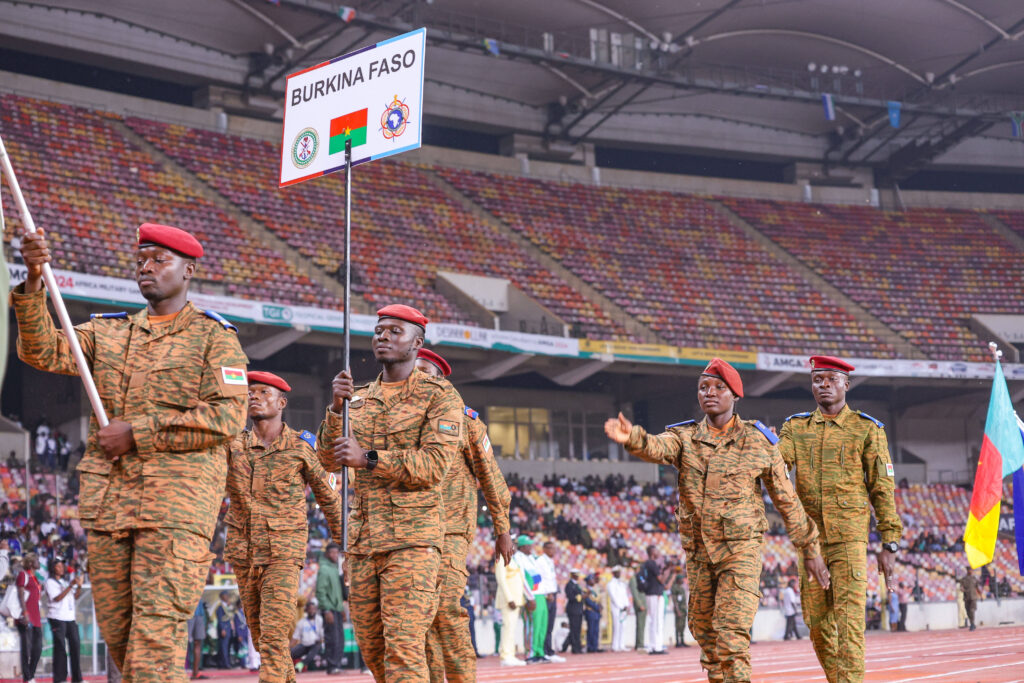
Image: 2nd Africa Military Games 2024 The Burkina Faso Army contingent participated in the closing ceremony parade at the 2nd Africa Military Games in Abuja, Nigeria, on November 30, 2024. This event marked the conclusion of the multi-sport competition, which brought together military athletes from across the African continent. During the ceremony, the Burkina Faso military personnel showcased their discipline and precision in a ceremonial march, highlighting the strength and unity of the African military forces. The games served as a platform to promote camaraderie, sportsmanship, and the overall development of military sports in Africa. Abuja Nigeria Copyright: xEmmanuelxOsodixEmmanuelxOsodixNo Use Switzerland. No Use Germany. No Use Japan. No Use Austria