This article is part of a series published by the Atlantic Council’s Africa Center and the GeoStrategy Initiative of the Scowcroft Center for Strategy and Security exploring the nexus between US security and economic interests across Africa. The previous edition can be read here.
When Mamady Doumbouya was sworn in as Guinea’s president in January 2026, the ceremony drew an illustrious crowd, including the presidents of Rwanda, Gabon, Guinea-Bissau, and Mauritania, as well as Nigeria’s vice president.
But the guest list extended beyond regional leaders. It also included a senior US delegation and a special envoy of Chinese President Xi Jinping.
The presence of both Washington and Beijing at the event was, of course, far from coincidental. Guinea sits at the intersection of regional insecurity, global competition for critical minerals, and the future of democratic governance in West Africa. Consequently, it has become a focal point for global powers.
For the United States, in particular, the country represents not only an investment and economic opportunity, but also a chance to align private-sector engagement with targeted security cooperation to generate geostrategic outcomes. US investment in Guinea—particularly in mining and energy—cannot succeed without stability, and stability cannot be sustained without credible economic prospects.
A western-leaning nation surrounded by insecurity
Guinea is vulnerable to instability spilling over from threats in the Sahel, where 51 percent of global terrorism-related deaths occurred in 2024. Illicit trafficking networks permeate the subregion. Military juntas govern Burkina Faso, Mali, Niger, and Guinea-Bissau, while the Africa Corps—a paramilitary group controlled by the Russian defense ministry—maintains influence throughout the region.
Yet Guinea stands out in this environment. Following the 2021 coup, the country maintained close relations with the West. Unique among Sahelian coup states, the US government supported Guinea’s democratic transition through the African Democratic and Political Transitions program in 2023. Back then, General Doumbouya, now the elected civilian president, set a timeline for elections and delivered in December 2025, formally concluding a four-year transition period.
While these political developments signal alignment with US interests, Guinea’s stability remains fragile. The country has experienced three coups since independence in 1958. Institutions are weak, and opaque revenue management fuels public distrust regarding accountability for natural-resource wealth. With approximately 75 percent of the population under the age of thirty-five, Guinea faces heightened risk of unrest, including threats to mining sites that symbolize both opportunity and elite capture.
That said, President Doumbouya won his December 2025 election with 78 percent of the vote, demonstrating national confidence rarely seen in Guinea’s historically fragmented, ethnically divided politics.
Bauxite, iron, and more
Despite its relatively small size compared with mining giants such as the Democratic Republic of the Congo and Botswana, Guinea plays an outsized role in global critical minerals markets and Africa’s energy supply chains. The country holds approximately 25 percent of the world’s known bauxite reserves, making it the single most important source of the primary input for aluminum production, which is used in automotive, aerospace, and construction industries.
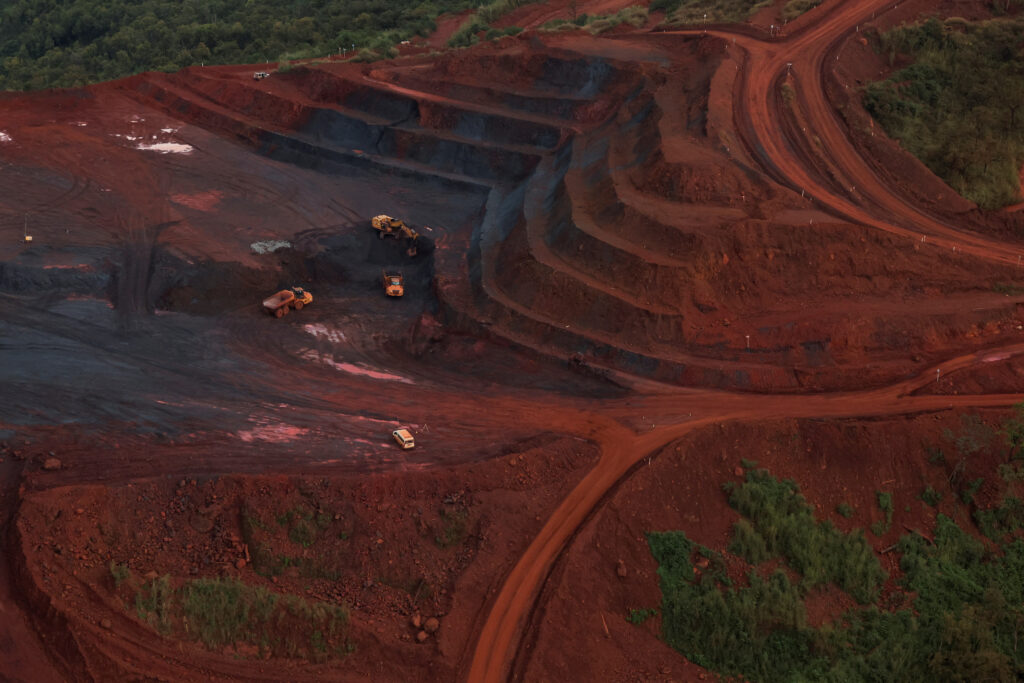
Guinea is also a prominent gold producer, and new exploration has revealed commercial quantities of gallium, lithium, uranium, and graphite, among others. The Simandou mine, ostensibly divided between Chinese- and Australian-led consortia but with overwhelming participation by China, contains extraordinary iron ore stocks representing more than 10 percent of the world’s deposits, drawing sustained diplomatic and commercial attention from Beijing to Conakry.
Recognizing the risks of overreliance on a single external partner and frustrated with Chinese firms’ opacity and noncompliance with local obligations, Doumbouya has signaled his willingness to push back against China’s mining dominance. In 2025, his government canceled more than 250 mining licenses held by Chinese companies, citing environmental damage, contractual noncompliance, and insufficient project development. The move opened space for Western, particularly US, mining companies to compete more evenly for licenses and tenders. US and allied mining and energy companies are now seeking to take advantage of this window, creating an opportunity to reorient Guinea’s supply chains toward the West.
Doumbouya also ended China’s monopoly on rail and port infrastructure for Simandou in favor of a joint venture with the Chinese and Australian consortia, each holding equal 42.5 percent shares, and the government holding 15 percent equity. Guinea’s stake served as a critical swing vote, enabling the joint venture to procure US-made Wabtec locomotives and rolling stock in a deal surpassing $1 billion.
Aligning US private-sector and security interests
With the 2025 National Security Strategy’s emphasis on critical minerals in Africa, Guinea should play a central role in US-Africa policy. The White House has signaled its intent to invest in the relationship and has invited Doumbouya as one of only three African leaders to Washington in early February to discuss critical mineral supply chains. Its Atlantic coastline also positions Guinea as a key partner in supporting a stable Atlantic basin.
China’s influence, however, remains significant, given its long history of investment in Guinea’s bauxite and aluminum sectors and the control Chinese firms exert over logistics, refining, and long-term offtake. If Washington intends to compete, it must offer tangible alternatives beyond diplomatic overtures before Beijing consolidates its advantage. This requires coordinated investment in security cooperation focused on counterterrorism and maritime security, infrastructure supporting the extractives industry, programs to strengthen governance in the resource sector, and efforts to diversify Guinea’s economy.
Although Guinea lacks robust counterterrorism and maritime capabilities, political will provides a platform for engagement. Coordinated with French and European Union initiatives, the United States can help Guinea strengthen maritime threat monitoring, conduct regional exercises with partners in the Gulf of Guinea, deploy low-cost surveillance platforms, improve border security, and share intelligence on smuggling, trafficking, and Sahel spillover risks.
Prior to the 2021 coup, the United States played a significant role in providing pre-deployment training to all of Guinea’s peacekeeping contingents. US legal restrictions led to the cancellation of this program after the coup. However, Guinean authorities are keen to resume the cooperation, which would advance the US interest in promoting regionally based solutions to insecurity. US Africa Command should also prioritize civil affairs and civil-military engagement around mining and energy sites, supporting community-based security approaches that reduce local tensions and protect critical infrastructure.
Completing the Liberty corridor and strengthening transparency
Building on the Millennium Challenge Corporation’s compact with Liberia, the United States should finance and incentivize private-sector participation in completing the Liberty corridor through Guinea to Liberia, which is still in pre-construction. The corridor would advance critical mineral supply chain diversification by enabling iron ore exports from Ivanhoe Atlantic’s US-owned and operated Kon Kweni mine.
To reinforce and sustain these investments, the United States, Canada, and European partners should work with Conakry to design and implement transparency standards, including technical assistance on contract design and revenue management to ensure Guinea captures fair value from its extractive sector. Private philanthropies may support journalists and civil society organizations to reinforce accountability mechanisms.
Such reforms benefit US and Western firms, whose corporate governance standards align with transparency and financial disclosure requirements. The Aluminum Company of America—a joint venture partner in Guinean bauxite operations for over sixty years—is widely considered the “gold standard,” offering reputational advantages to other US companies.
While mining remains central to Guinea’s economy, diversification is critical for long-term stability. Opportunities exist in hydropower, liquefied natural gas, digital infrastructure, and agriculture. Investment in these sectors can generate employment, reduce reliance on extractives, and mitigate demographic pressures. US development finance institutions can catalyze commercially viable projects tied to governance and human-rights benchmarks, managing risk while advancing shared interests. Bilateral investments should incentivize sustainability as well as human-capital and technology development.
A strategic opportunity for the US
Guinea may not feature prominently in US public discourse, but it is of great strategic importance. It is a Western-engaged, Atlantic-facing country, rich in minerals essential to the global economy and navigating a democratic transition in a challenging neighborhood. As authoritarian influence expands across West Africa, Guinea’s willingness to diversify partnerships presents a meaningful opportunity. This is particularly significant given the country’s role in China’s broader strategic calculations.
By pairing private investment with targeted security cooperation and governance support, the United States can help Guinea strengthen stability while advancing its own strategic objectives. The country offers a practical setting for US economic statecraft and light-touch security engagement to reinforce one another—a sustainable model for partnership in Africa.
Rose Lopez Keravuori is a nonresident senior fellow at the Atlantic Council’s Africa Center, an associate director at Strategia Worldwide, and chair of the board of advisors of GCR Group. She previously served as the director of intelligence at the US Africa Command.
Maureen Farrell is a nonresident senior fellow at the Atlantic Council’s Scowcroft Center for Strategy and Security and vice president for global partnerships at Valar, a Nairobi-based strategic advisory and risk firm. She previously served as the deputy assistant secretary of defense for African affairs and director for African affairs at the US National Security Council.
The Africa Center works to promote dynamic geopolitical partnerships with African states and to redirect US and European policy priorities toward strengthening security and bolstering economic growth and prosperity on the continent.

The GeoStrategy Initiative, housed within the Scowcroft Center for Strategy and Security, leverages strategy development and long-range foresight to serve as the preeminent thought-leader and convener for policy-relevant analysis and solutions to understand a complex and unpredictable world. Through its work, the initiative strives to revitalize, adapt, and defend a rules-based international system in order to foster peace, prosperity, and freedom for decades to come.
Related Reading

Image: FILE PHOTO: Mining vehicles operate at the blocks three and four of the Simandou mine, one of the largest high-grade iron ore deposits, run by Rio Tinto and partners' joint venture, SimFer, in the Nzerekore Region, Guinea November 4, 2025. REUTERS/Luc Gnago/File Photo