Below, Jennifer Gavito and Bianca Rosen argue against regime change in Iran. For an alternative view in favor of a major US military campaign in Iran, read Michael Rozenblat’s case here.
Since US President Donald Trump assured the Iranian people on January 13 that “help is on its way” amid nationwide protests—a little over a week after a US operation removed Venezuelan strongman Nicolás Maduro from power—the United States has been on a seemingly steady march to renewed conflict with Iran.
Trump’s State of the Union address this week did little to counter that perception, even as Washington continues to pursue diplomatic negotiations with the Islamic Republic. Both sides are holding firm on their respective redlines regarding Iran’s nuclear enrichment program and the window for a deal seems to be closing quickly. Meanwhile, with the most significant buildup of military assets in the Middle East since the 2003 US invasion of Iraq, every day adds to the sense that US strikes on Iran are inevitable, even as the objectives of that potential military action remain frustratingly murky.
But Trump should think twice before ordering a large-scale conflict aimed at regime change. Such an approach would likely create more problems than it would solve.
The march to … what?
The United States is likely considering among several options for strikes. It is difficult to discern which option is either most likely or could be most effective absent a clear articulation of the Trump administration’s strategic goals. It could, for example, launch targeted strikes on Iranian state security buildings and infrastructure belonging to Islamic Revolutionary Guard Corps (IRGC) and Basij militia. It could broaden those strikes to include regime assets such as nuclear infrastructure and advanced weaponry inventories. It could even attempt a regime change operation to remove Iran’s top leadership and disrupt state institutions.
To date, justifications floated for an attack include protecting civilians in the face of January’s brutal crackdown, further degrading Iran’s nuclear program, and, most recently, addressing the regime’s ever more audacious missile program. Iran’s missile program seemed to be the focus of US Secretary of State Marco Rubio’s February 24 briefing to the “gang of eight,” the select group of US members of Congress who receive classified intelligence briefings from the White House.
Despite some indications the president is wary of embroiling the United States in another prolonged Middle East conflict, Trump and members of his administration have alluded to regime change as a preferred solution to address Iran’s internal dysfunction and provide a pathway to greater regional stability. Trump told Politico on January 17 that it’s “time to look for new leadership in Iran.” When asked explicitly about whether he wants regime change in Iran, he said on February 13 that it “would be the best thing that could happen.” Senator Lindsey Graham (R-SC), who has emerged as the face of hawkish US foreign policy in the Middle East, took it a step further, warning that stopping the push for regime change in Iran would be the United States’ “biggest mistake.”
To what end?
There is widespread international agreement that the Iranian regime destabilizes the region, enables Russia’s aggression against Ukraine, and brutally violates Iranians’ human rights. Despite this, a fundamental transformation of Iran’s political system is unlikely as long as the IRGC remains entrenched in all facets of Iranian society, which makes it hard for any cohesive opposition movement to form and take a stand. A US-instigated regime change operation would thus likely inflict damage on the regime without solving any of those problems. And it could well unleash destabilizing aftershocks across the broader region.
Advocates of regime change often mistake a weakened regime for one on the brink of collapse. Iran’s nuclear progress was indeed set back by the US strikes on the Fordow, Natanz, and Isfahan sites in June. And Israel’s campaigns in Gaza and Lebanon, coupled with US and UK operations to pacify the Houthis in the Red Sea, also dealt major blows to Iran’s proxy network. But the January 2026 mass protests put the IRGC’s continued grip on display. The IRGC imposed a complete communications blackout and launched a lethal crackdown, massacring thousands. Its tight control of the Iranian military and its in-house paramilitary wing, the Basij, underpin a coercive security apparatus financed by sanctions-busting networks and control of strategic sectors of the economy.
Some, including Trump, have argued that removing Supreme Leader Ayatollah Ali Khamenei would cut the IRGC off at its knees. In reality, eliminating the supreme leader would at best produce a messy internal power struggle and at worst further embolden the organization. The IRGC is not a pyramid built around a single man; it is a sprawling institution supported by multiple power centers. The supreme leader may be its public face, but he is not the organization’s ventriloquist. The regime has in fact already taken preventative measures to ensure its survival in the event of an attack, including by tapping Ali Larijani, a former IRGC commander and the current head of the Supreme National Security Council, to take the lead on contingency planning. Khamenei has also reportedly named successors for himself and his key military and government appointees to enable smooth transfers of power and ensure the regime’s longevity.
The IRGC’s power is bolstered by the absence of a unified opposition in Iran. Today’s anti-regime forces are a patchwork of labor groups, ethnic minorities, and monarchists. Decades of repression have left them fragmented. Speculation about the return of Reza Pahlavi, the former crown prince currently living in exile, has been fueled in part by Iran’s diaspora and what Haaretz revealed to be a digital influence campaign operating out of Israel. Ultimately, Pahlavi is distanced from conditions on the ground and lacks credibility with both Iranians and US government officials—including Trump, who declined to meet with him last month.
At what cost?
With the concept of “regime change” ill-defined and its objectives not yet articulated, the United States faces considerable risks with little promise of reward. Iran would almost certainly seek to close the Strait of Hormuz as part of an opening salvo against any attack, a move it foreshadowed on February 17 when it shut the waterway for live-fire exercises. Such a closure would jolt global markets, given that the strait is a chokepoint for about 20 percent of the world’s liquefied natural gas exports and around 20 percent of global oil and oil byproducts.
A US-led regime change campaign in Iran could also trigger a number of spillover and destabilizing effects on Gulf countries. This matters deeply for a US administration operating with a business‑centric foreign policy, which is underpinned by strong relationships with the Gulf countries. Trump’s trip to the region in May 2025 yielded announcements of deals that the White House said are worth two trillion dollars, including a $600 billion investment pledge from Saudi Arabia. Destabilizing the region risks disrupting that signature initiative. Gulf countries may also face Iranian retaliation—notwithstanding the fact that the United Arab Emirates and Saudi Arabia barred their airspace from being used for US attacks on Iran. There is precedent for this: During the twelve-day war last year, Iran retaliated against the United States for Operation Midnight Hammer by launching missiles toward US bases in Qatar even after the Gulf state closed its airspace. Moreover, in the medium and long term, the region would struggle to absorb a massive refugee flow from Iran’s population of 93 million—the largest of any country whose territory is located fully in the Middle East.
The deep entrenchment of Iran’s corrupt political system, combined with its strategic positioning in the Middle East, makes regime change a profoundly destabilizing course of action. As Trump approaches yet another self‑imposed deadline to decide his approach to Iran, it has become clear that the ongoing oscillation between nuclear talks, military buildup, and targeted strikes has become the new normal—and, somewhat paradoxically, a form of stability. It is a manageable and oddly sustainable cycle of negotiation paired with limited, surgical confrontation, one that keeps the regime constrained without triggering the far more destabilizing effects of its complete collapse.
Jennifer Gavito is a nonresident senior fellow with the Scowcroft Middle East Security Initiative. She previously served as US deputy assistant secretary of state for Iraq and Iran.
Bianca Rosen is a research associate at the Cohen Group and a member of its Middle East Practice.
Related Reading
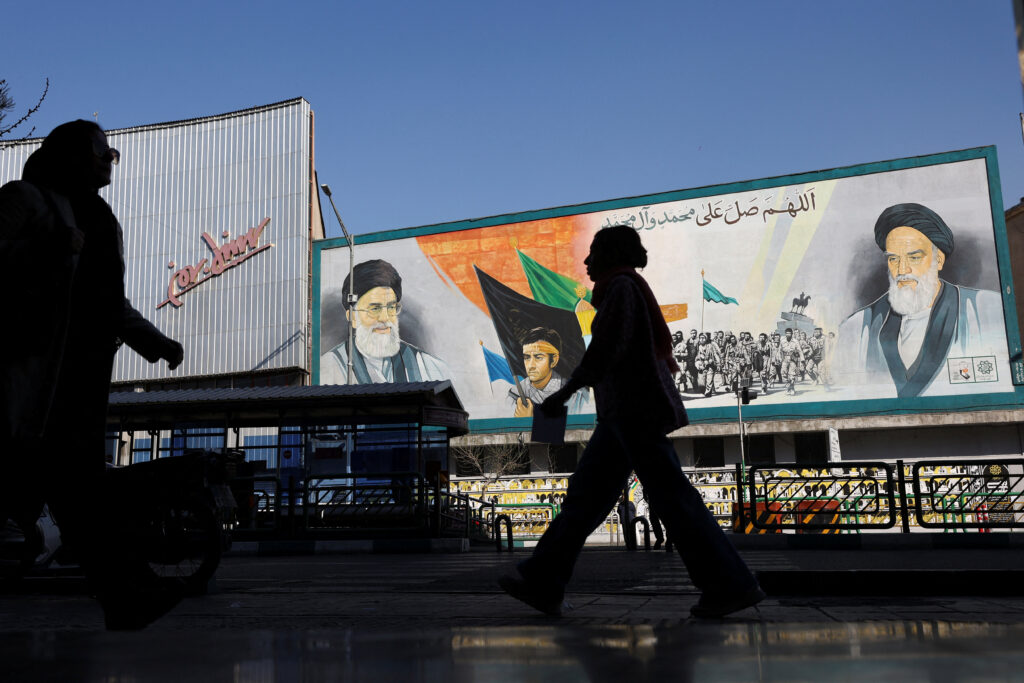
Image: People walk near a mural featuring images of Iran's Supreme Leader Ayatollah Ali Khamenei and the leader of Iran's 1979 Islamic Revolution Ayatollah Ruhollah Khomeini, on a street in Tehran, Iran, on February 26, 2026. (Majid Asgaripour/West Asia News Agency via Reuters Connect)