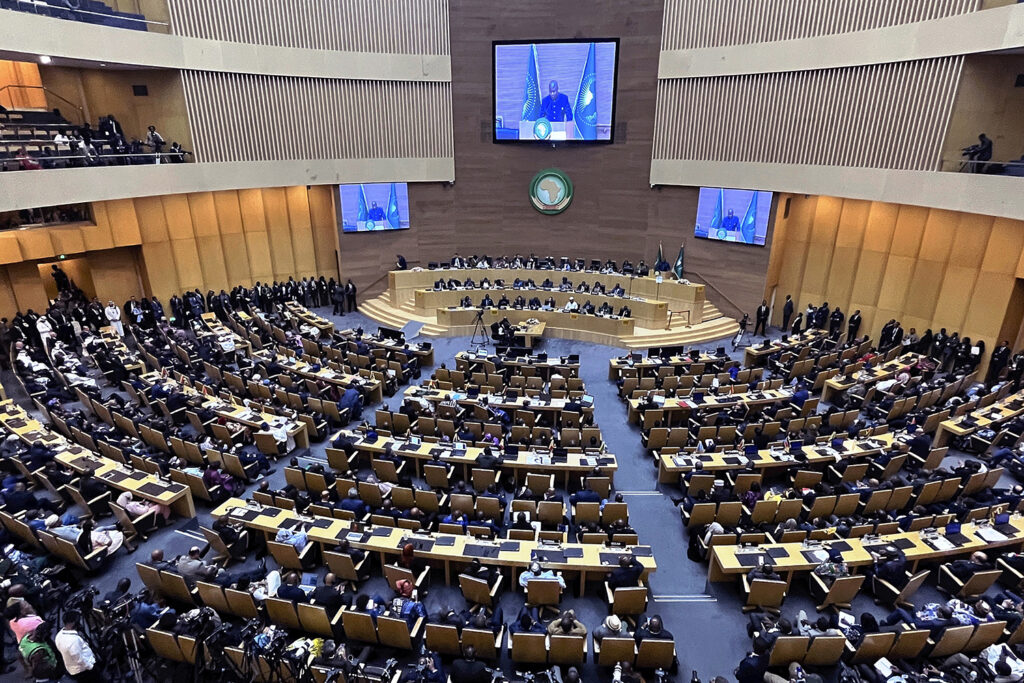
Last weekend, heads of state from the fifty-five member countries of the African Union joined for the regional body’s annual summit, under the theme of water and sanitation. But that didn’t stop the gathering leaders from discussing some of the continent’s most pressing economic and security issues. Mahmoud Ali Youssouf, chairman of the African Union Commission, also sounded the alarm, warning that “from Sudan to the Sahel, to eastern Democratic Republic of Congo, in Somalia and elsewhere, our people continue to pay the heavy price of instability.”
Yet, there are forces in play this year that carry the potential of shaping—and reshaping—the continent. Many offer African countries opportunities to launch new partnerships that serve the continent’s interests and to more permanently carve out Africa’s role in geopolitics. Here are those forces and how they will likely impact the continent in 2026.
Elections
Africa is slated to have a busy election year, which already kicked off with Uganda’s general elections (with the contested re-election of President Yoweri Museveni) and Benin’s parliamentary elections. Benin will go back to the polls in April for presidential elections, with Finance Minister Romuald Wadagni looking to succeed President Patrice Talon, who has declined to seek a third term. Also in April, Djibouti will host presidential elections, with President Ismail Omar Guelleh pursuing a sixth term. In the Republic of Congo, President Sassou Nguesso is running to be reelected in March, serving in his role since 1997.
Ethiopia and South Sudan, which are still struggling to overcome the consequences of war, will hold general elections in June and December, respectively. Zambia will vote in August to elect its president and parliament, with President Hakainde Hichilema seeking a second term. Cape Verde is expected to hold parliamentary elections in April and a presidential election in October, aiming to reaffirm its democratic resilience. In South Africa, local elections are expected by November, while in neighboring Gambia, President Adama Barrow will seek a third term in December.
This electoral cycle shows how diversified Africa’s governance is. And given the profile of the countries going to the polls—some of them being African powerhouses—the future of the continent will be shaped by the elections that unfold.
Violence and peace in the DRC
The international community is closely watching the prospects for peace in the Democratic Republic of the Congo (DRC).
In June last year, Rwanda and the DRC signed a US-brokered peace deal promising to cease hostilities. The deal also cleared the way for US investment in critical minerals in the DRC. But the Rwanda-backed M23 militia, the group that has taken control of large areas in two eastern DRC provinces, was not part of the deal, and, according to the DRC, it continues to terrorize the area. Since the June signing, mediators across the globe, including Qatar, have worked to strike a peace deal between the DRC and M23, with recent talks producing a cease-fire mechanism—although analysts worry about its sustainability.
Following the June peace agreement, the United States and the DRC signed an expanded strategic partnership agreement in December, strengthening economic cooperation, particularly in the cobalt and copper sectors.
Several African actors had arrived at the scene before such mediation efforts and deals. For example, the African Union had convened a Panel of Facilitators last March and designated a lead mediator in April. So even as international actors make security commitments to countries such as the DRC, one can expect regional African organizations to more strongly assert their determination in guaranteeing the security of their people, wary of foreign troops or even private militias occupying African soil.
A Sudan wake-up call
Conflict continues to rage in Sudan between the Sudanese Armed Forces, led by General Abdel Fattah al-Burhan, and the Rapid Support Forces (RSF), under Mohamed Hamdan “Hemedti” Dagalo. Their clashes have caused the deaths of at least 150,000 Sudanese people since the civil war started in April 2023.
During his visit to Washington in November, Saudi Arabia’s Mohammed bin Salman sought to draw US President Donald Trump’s attention to the crisis, with the latter promising to take initiatives. Such initiatives, if taken, could be transformative for Sudan and the continent, seeing as a US initiative is really the best chance to end the war, with some of Washington’s Middle East partners more or less involved.
A realignment on the Sahel
Danger in the “three borders” area—straddling Mali, Burkina Faso, and Niger—continues to exhaust Sahelian populations, already drained after twenty years of terrorist violence, despite the show of security that the Alliance of Sahel States puts on. The leaders of these three countries, who came to power through military coups, offer little toward shaping democracy or attaining economic growth in these countries. The Alliance of Sahel States has been working on projects to solidify its grouping, including a common visa and a Sahelian currency.
Meanwhile, Guinea is returning to the Economic Community of West African States (ECOWAS), following the election victory of General-President Mamadi Doumbouya—also a former putschist—earlier this year. Nick Checker, the highest-ranking official in the US State Department’s Africa Bureau, attended Doumbouya’s inauguration and subsequently traveled to Bamako, signaling the Trump administration’s intention to reengage with this zone. Washington’s return to the Sahel could reshape the regional landscape by reconnecting Sahelians with the West and potentially even changing the course of local counterterrorism efforts.
The renewed attention surrounding the Guinean president likely stems from the fact that Guinea’s economy is projected to grow rapidly in 2026, with forecasted growth rates above 10 percent. The country possesses one of the world’s largest bauxite reserves and largest untapped iron reserves.
Surging growth
According to the International Monetary Fund, African growth in 2026 is expected to surpass that of Asia for the first time. That suggests African countries will finally overcome the economic consequences of the COVID-19 pandemic. The African Development Bank largely agrees with such projections, revising its 2026 growth forecast from 4 percent in May to 4.3 percent in November, following an increase in household consumption, the introduction of accommodative monetary policy, and the US dollar’s weakening. With that, the continent will be able to offer renewed investment opportunities, generating interest from actors both in Africa and abroad.
South Africa, Egypt, and Nigeria will likely remain the continent’s three largest economies in terms of their nominal gross domestic product. Some countries that have struggled with debt in recent years, such as Ghana, Ethiopia, and Zambia, appear to be gaining breathing room.
Nonetheless, Africa’s dramatic 170 percent increase in public debt between 2010 and 2024 highlights the scale of infrastructure needs, the high cost of responding to multiple recent shocks, and constraints in international financing. Additionally, the African Development Bank, in its 2026 Economic Outlook, warned of the risks of geopolitical fragmentation, trade restrictions, conflict, and climate-related shocks, saying that these risks intensify the urgency of deepening intra-African trade and prioritizing value addition on the continent, such as with the African Continental Free Trade Area.
A historic opportunity for Africa
In 2026, Africa’s opportunities in the emerging world order are becoming clearer. Those opportunities include carving out Africa’s role in addressing geopolitical turbulence, as the DRC and Liberia get settled in their seats in the United Nations Security Council. There is also an opportunity to redefine the rules that have thus far governed the world, including the rules of finance, development, and multilateralism—building off South Africa’s Group of Twenty presidency. And, finally, there are opportunities to relaunch partnerships on terms that serve the continent’s priorities.
African countries will need to work harder in 2026 to seize these opportunities. But doing so is well within their and the continent’s interests.
Rama Yade is the senior director of the Atlantic Council’s Africa Center.
The Africa Center works to promote dynamic geopolitical partnerships with African states and to redirect US and European policy priorities toward strengthening security and bolstering economic growth and prosperity on the continent.
Further reading

Mon, Feb 9, 2026
African soccer needs digital innovation, not just investment
AfricaSource By Tom Bonsundy-O’Bryan
A new league that focuses on digital-first entertainment would demonstrate that Africa can innovate, building world-class sporting competition and soft power on the global stage.
Wed, Feb 4, 2026
The United States and Nigeria must rebuild their engagement architecture for a new global era
AfricaSource By Gbemisola Abudu
The diplomatic tools currently available to the United States and Nigeria are intended for episodic and sector-specific engagement, holding back the relationship's potential.

Tue, Nov 25, 2025
El Fasher is only the latest wake-up call to the genocide unfolding in Sudan
AfricaSource By Rama Yade
Sudan’s civil war has become one of the world’s deadliest crises—and the massacre in El Fasher exposes a genocide unfolding in plain sight. As regional powers fuel the war, millions face famine, displacement, and systematic violence.
Image: The African Union Summit 2026 is held in Addis Ababa, Ethiopia, on February 14, 2026. Photo via the Yomiuri Shimbun/Reuters.